Cyborg Pirate Ninja Jesus

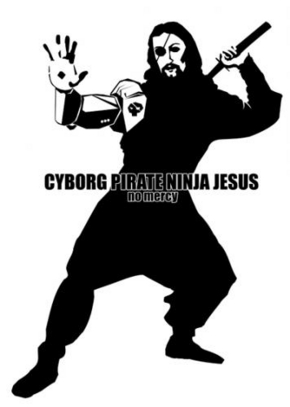
Cyborg Pirate Ninja JesusWow—he’s a cyborg, and a pirate, and a ninja.  That’s one impressive resumé.

This kick-butt Jesus even has his own theme song, which goes something like this:

“Who diced up Pol Pot like Teriyaki Steak?
Who gave the great Ghangis Kahn all that he could take?
Who used his massive cyborg arm to crush the Axis dead?
Who pumped the Germans in the Rhine full of Pirate lead?
Who kung fu kicks anyone who sells mind-altering drugs?
Who’ll infect a robber with scurvy for everyone he mugs?
He’s Cyborg Pirate Ninja Jesus!
Cyborg Pirate Ninja Jesus!”

He also has a Facebook fan page, a comic book, and his own YouTube video game adventure.  Not sure where this meme originated, but it is a few years old.  (Update:  Neil Duffy created the original image, posted above, in early 2005.)  What is interesting to me is that the Internet is chock-full of these inventive Jesus heroes.  Most of it’s all in good fun, of course, but what does it say about Jesus and the world’s general attitude toward him?  Why do we find Jesus adapted in these playful ways, but not Muhammad or the Buddha (or Abraham, or Confucius, or Laozi, etc.)?

Posted in Jesus Kitsch | Tagged , , , | 7 Comments

What Makes Jesus Happy?, Part 2: Giving and Sustaining Life

Jesus laughing

Geoffrey Todd, Drought Breaker, 2007 (Ararat, Australia)

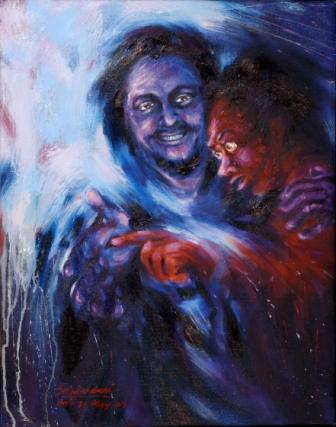
Drought Breaker was painted by Geoffrey Todd, a farmer’s son from the Australian Outback. Growing up, he said, he and his family had to rely on God to send rain for the crops and thereby preserve their livelihood. Although they experienced periodic droughts, God and his grace always came through, he said, and this was something that he had always looked forward to. In the painting, an Australian woman points with joy to the approaching storm, and Jesus celebrates with her, rejoices with her rejoicing.

For those of us who aren’t farmers, it can be hard to see rain as a joyous event; we see it instead as a nuisance, as something that ruins our outdoor plans. But for those who work the land for a living, rain is everything; its absence could mean the loss of a year’s income, or more. And for societies that are agriculture-based, as were those in Bible times, rain is pivotal to survival. That’s why the Bible is full of people’s praises to God for the rain—for example, Elihu’s in chapters 36 and 37 of Job:

How great is God—beyond our understanding! . . . He draws up the drops of water, which distill as rain to the streams; the clouds pour down their moisture and abundant showers fall on mankind. . . . His thunder announces the coming storm; even the cattle make known its approach. . . . He brings the clouds to . . . water his earth and show his love. . . . Do you know how God controls the clouds and makes his lightning flash? Do you know how the clouds hang poised, those wonders of him who is perfect in knowledge? Continue reading

Posted in Non-Western Art | Tagged , | 1 Comment

What Makes Jesus Happy?, Part 1: Revealing Himself to Us

A few weeks ago, I stumbled across an art exhibition called “Jesus Laughing.” It’s made up of 60 paintings, drawings, and papercuts from sixteen different countries. The purpose of the project, according to one of its organizers, Sir Maxwell Macleod, is to show that “Jesus was a cheerful, exciting character and not the miserable man in a nighty with a plate attached to his head” who is so often portrayed in art. Those involved with the project want to emphasize that Jesus came to bring joy to the world, not to make us miserable, guilt-ridden wrecks, nor to turn our minds constantly to suffering.

So, as a spinoff of the “Happy Jesus” series, I’d like to now ask the question, “What makes Jesus happy?” What are some of the things that he smiled about and is still smiling about today? Jesus delights in . . . what, exactly?

This question has many answers, and throughout the next week or so, I’d like to suggest just a few of them, using the “Jesus Laughing” pieces as illustrative aids.

First, an episode that resonates with me, and one that I’ve treated before in a previous post on “Doubting Thomas.”
Jesus laughing

Nit Ketut Ayu Sri Wardani, “Come, See and Believe,” 2007 (Den Pasar, Bali, Indonesia)

Jesus delights in revealing himself to us—in a way that is real and personal and tailored to our own particular mode of knowing and accepting. The disciple Thomas needed to see the resurrected Jesus physically before he could profess faith in him as Lord. Other individuals may be persuaded more by a beautiful sunset, or by an inner prompting of guilt or moral obligation, or by a passage of Scripture, or by a dream or vision. Whatever our communication preference, if we are honest in our seeking, Jesus will reveal himself to us. And it pleases him to do so.

Even when we are not seeking him, he still speaks in a general way and is happy when we open ourselves up to his voice. But most of all, it makes him happy when we respond, like Thomas, by professing faith in him and committing our lives to the fuller knowing and spreading of his truth.  Continue reading

Posted in Non-Western Art, Theology | Tagged , , , , | 1 Comment

Happy Jesus, Part 3: Peace, Love, and Foolishness

What do you get when you cross a Ringling Brother and a Flower Child?

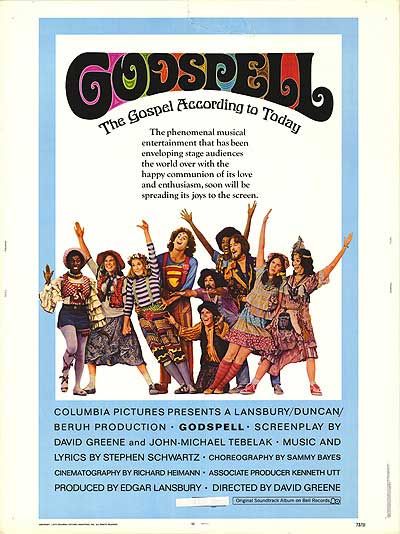
The original movie poster: “The phenomenal musical entertainment that has been enveloping stage audiences the world over with the happy communion of its love and enthusiasm, soon will be spreading its joys to the screen.”

Well, Jesus, apparently.

I’m talking about the Jesus of the 1973 film Godspell, based on the off-Broadway musical by John-Michael Tebelak.  He’s by far the happiest Jesus I’ve ever seen onscreen; he skips and frolics about through New York City, blowing bubbles, twirling a yo-yo, conversing with finger puppets, picking flowers, giving hugs, dancing soft-shoe, and poking fun at the high and mighty, all in the company of his ragtag group of disciples, who enact his parables using random props and noises.  This Godspell Jesus, played in the film by Victor Garber, is a clown—frizzy clown hair, floppy clown shoes, paint on his face, and a pair of suspenders to hold up his rainbow-colored pants.  He’s also a peace-loving hippie.

The upbeat mood of the film is captured well in this short compilation of clips, set to the song “We Beseech Thee” (the song was cut from the movie):

  Continue reading

Posted in Film | Tagged , , , , , | Leave a comment

Happy Jesus, Part 2: Blue Jeans Edition

Who says you can’t wear jeans to church?  Jesus is doing it.

Jesus in Jeans

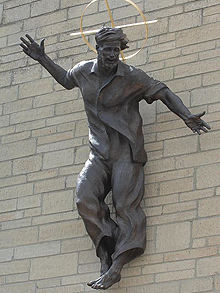
Marcus Cornish, "Jesus in Jeans," 2009

For the last two years, a bronze, denim-clad Jesus has been hanging off the side of the bell tower at Our Lady Immaculate and St. Philip Neri Catholic Church in Uckfield, East Sussex, England.  The statue, created by Marcus Cornish, was unveiled two years ago and continues to be an eye-catcher for passersby.  (To see a panoramic shot of the church and to hear what some area residents have to say, watch the 90-second BBC broadcast.)

“We wanted a figure of Christ not in suffering but dynamic and welcoming,” said parish priest Father David Buckley.  “We felt this design summed up the spirit and activity of Christ perfectly, and I think it speaks for itself.”

Cornish, the artist, said that he meant for the statue to exemplify the truth that we are not to be afraid because Christ is always with us.  He said that he clothed Jesus in contemporary dress to suggest that Jesus belongs as much to the present as he does to the past.  “I hope this sculpture will inspire and communicate in very human terms, reaching out and being relevant to both the congregation and local community,” Cornish told The TelegraphContinue reading

Posted in Western Art | Tagged | 2 Comments

Happy Jesus, Part 1: A Newish Conception

“There was some one thing that was too great for God to show us when He walked upon our earth; and I have sometimes fancied that it was His mirth.”  -G. K. Chesterton, Orthodoxy (1908)

Many people—like Chesterton, apparently—think of Jesus as a predominantly somber guy, one of those serious religious types with straight laces and a long face.  He was so serious, they believe, that he never cracked a joke or shared a laugh.  He was just a pious bore.

One would certainly get that impression from looking at any number of Byzantine icons—or really at any Jesus art produced by the church up until fairly recently.  Joyous events, like Jesus’ performance of miracles, his bestowing of blessings, and his resurrection, were depicted stoically.  Why medieval artists insisted on always downturning Jesus’ lips instead of upturning them, I don’t know.

Christ Pantocrator

"Christ Pantocrator," c. 1100, Church at Daphni (near Athens)

Christ Pantocrator

"Christ Pantocrator"

"Wedding at Cana" (detail), 11th c.

Continue reading

Posted in Popular Art, Who is Jesus? | Tagged , , | 9 Comments

Plastic Jesus Rises Again… and Again…

A giant, 60-foot plastic Jesus is resurrected every hour on the hour at the Christian theme park “Tierra Santa” (Holy Land) in Buenos Aires, Argentina.  Handel’s Hallelujah Chorus plays triumphantly in accompaniment.

I can’t believe this is in Latin America and not the southern U.S.!

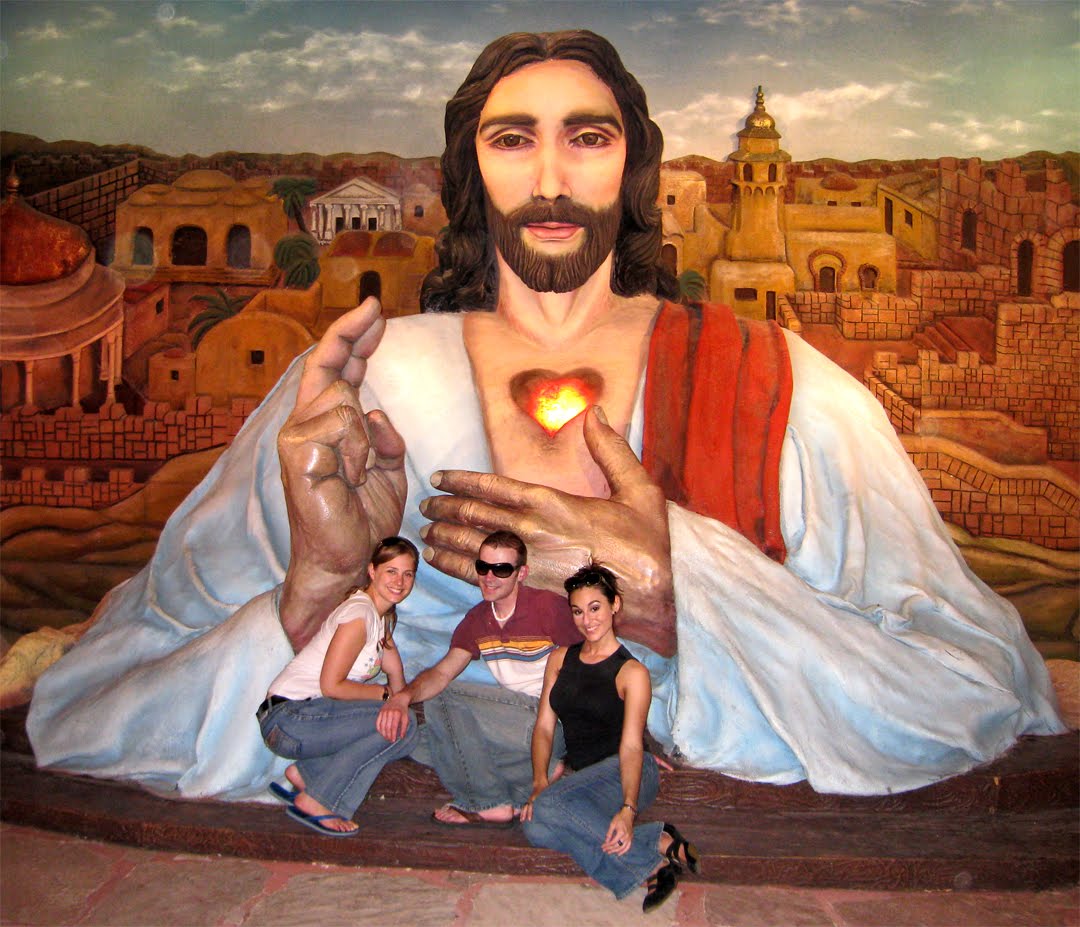
The park also features animatronic reenactments of the Creation, the Nativity, and the Last Supper.  Plus, you can get your picture taken with the Sacred Heart of Jesus.

Sacred Heart of Jesus

Courtesy of Amber Davis. Used with permission. (Yes, she's in on the joke, too.)

Say “Cheesy!”

Posted in Jesus Kitsch | Tagged , , | Leave a comment

The Henna Gospel

Christian blogger hmsarthistorian wrote a great post recently featuring the art of Kimberly Stephens. The post includes a transcript of his missiologically focused interview with her. Read it here.

Last October, Stephens exhibited a series of 18 paintings at the L&P Hutheesing Visual Arts Centre in Ahmedabad, India. The exhibition was called “A True Story,” and it documented, through symbols, different Christward-pointing stories from the Bible. But what is unique about the paintings is that they are acrylic and mehndi on canvas. Mehndi is the Hindi word for “henna,” a powder taken from the leaves of a henna plant and made into a paste, then applied to the skin as a form of decoration.

Henna handsMehndi body art is popular throughout the Middle East, Africa, and South Asia, especially in India. It is used for special occasions. For example, in traditional Indian weddings, the bride will have a henna party the night before the ceremony, during which her hands and feet are painted with fine-lined lacy, floral, and paisley patterns. Other occasions for use include pregnancies, births, circumcisions, and religious holidays. Continue reading

Posted in Non-Western Art | Tagged , , , , , , | 1 Comment

‘Submerged and shining’

Andres Serrano, Piss Christ, 1987. Cibachrome, silicone, plexiglas, wood frame, 60 x 40 in.

Andres Serrano, Piss Christ, 1987. Cibachrome, silicone, plexiglas, wood frame, 60 x 40 in.

Last week, Andres Serrano’s photograph Piss Christ, on display at the Lambert Gallery in Avignon, was vandalized by Christian fundamentalists. The three vandals physically threatened museum guards, then took a hammer to the plexiglass in front of the artwork and slashed the photograph with a screwdriver or an ice-pick. (See news photo and story here.)

The photograph, created in 1987, shows a plastic crucifix submerged in a glass of the artist’s urine. Serrano, a Catholic, said that he meant it as a criticism of the “billion-dollar Christ-for-profit industry” and a “condemnation of those who abuse the teachings of Christ for their own ignoble ends.” Many Christians, though, take serious offense at the piece, as they consider it blasphemous.

My initial reaction when I saw this photograph for the first time, in high school, was offense. Not outrage, just offense. And really, that offense stemmed more from my disgust with how the piece was created, not necessarily because I had moral objections.

Sister Wendy Beckett, an art expert of BBC fame, said in a 1997 interview with Bill Moyers that she’s not going to automatically dismiss the work as blasphemous because she believes that it can have a devotional impact, an upbuilding effect, on viewers if they let it. She said, for example, that seeing it makes her want to reverence the death of Christ even more, because it reminds her, and makes her feel ashamed, that people (herself included) so often scorn his sacrifice through their actions. “This is what we are doing to Christ,” she says. “We’re not treating him with reverence, his great sacrifice is not used, we live very vulgar lives, we put Christ in a bottle of urine, in practice.” While the work is not great art, she says, it is at least admonitory.

Continue reading

Posted in Controversial Art | Tagged , , , | 3 Comments

Peanut Butter Banana Jesus

Banana Jesus“Whoso eateth my soft, pulpy, banana flesh…” (John 6:54)

Found at Jesus Needs New PR.

Posted in Jesus Kitsch | Tagged , | 1 Comment