The Christmas Truce of 1914

This December marks the centennial of the famous ceasefire along the Western Front during World War I. On Christmas Eve, 1914, along the four-hundred-mile frontline, enemy soldiers spontaneously emerged from their trenches, arms laid aside, to celebrate Christ’s birth together. They sang carols, exchanged gifts (jams and candies, cigarettes, newspapers), kicked around a soccer ball, and shared photos of loved ones. They also buried each other’s dead and prayed communally over the bodies, led by chaplains. Some even exchanged home addresses and promised to visit after the war.

One soldier described it in a letter home as “the Wonderful Day.” Another soldier, Pvt. Karl Muhlegg, wrote, “Never was I as keenly aware of the insanity of war.”

>> Read more firsthand accounts. <<

Though temporary truces are not unique in military history (they have been recorded since as far back as the Trojan War), never have they been carried out on such a large scale, and accompanied by such fraternization, as that of the Christmas Truce of 1914. Remarkably, this truce grew out of no single initiative but sprang up independently in many of the camps, against the orders of higher-ups. In most places it lasted from Christmas Eve through Boxing Day (December 26), though in some it lasted into January. It is estimated that some 100,000 men took part.

Inspired by this event, French filmmaker Christian Carion wrote and directed a dramatized film version of it, called Joyeux Nöel, which was nominated in 2006 for an Academy Award for Best Foreign Film. The film focuses on three different regiments—one Scottish, one French, and one German—and their interactions with one another during that first Christmas on the front.   Continue reading

Posted in Death / tragedy / suffering, Film, History, Inspirational, Poetry | Tagged , , , , | 3 Comments

Vintage Jesus, Part 11: Why Did Jesus’s Mom Need to Be a Virgin?

This twelve-part series outlines the “Vintage Jesus” sermons of Mark Driscoll. See part 1 here.

For a more succinct answer to this question, I refer you to the article “The Glory of His Virgin Birth” by David Mathis.


“I would like to ask him [Jesus] if he was indeed virgin-born. The answer to that question would define history for me.”—Larry King, in response to what one question he would ask Jesus

“The day will come when the mystical generation of Jesus by the Supreme Being as His father, in the womb of a virgin, will be classed with the fable of the generation of Minerva in the brain of Jupiter.”—Thomas Jefferson, in a letter to John Adams

0:55: Interview with Rabbi Mark Glickman

10:00: The virgin birth of Jesus is the second most controversial and debated miracle in all of human history.

12:09: What Scripture says

12:19: Genesis 3:15: The Lord God said to the serpent, “I will put enmity between you and the woman, and between your offspring and her offspring; he shall bruise your head, and you shall bruise his heel.”

This verse is known as the Protoevangelium (“first gospel”), because it is the first promise of redemption in the Bible. It alludes only vaguely to the virgin birth, in that it speaks of the woman’s offspring rather than the man’s, which is unusual in a patriarchal society, where genealogies are traced through the male line. Paul follows suit in Galatians 4:4, where he mentions that Jesus was “born of a woman” rather than giving the name of the father.

15:30: Isaiah 7:14: “Therefore the Lord himself will give you a sign. Behold, the virgin shall conceive and bear a son, and shall call his name Immanuel.”  Continue reading

Posted in Theology | Tagged , , , , , , | Leave a comment

Two Songs for Advent

This is the first week of Advent, a span of time during which Christians anticipate the coming of Christ. As Richard John Neuhaus puts it in the book God with Us,

Throughout Advent, Christians prepare their hearts not only for the celebration of Christmas, but also for the many ways that Christ breaks into the world—past, present, and future. We prepare for the celebration of the anniversary of God’s first coming into the world; we prepare for the many ways in which he comes to us now; and we look forward to his future coming in glory at the end of time.

In this time of waiting, here are two songs to help lead you in thought, prayer, and expectation.

“Hark! ’Tis the Watchman’s Cry.” Text: Anonymous. First published in The Revival magazine in 1859. Music: Arranged by Paul van der Bijl and Jason Reed. Performed by Chicago Metro Presbytery Music, from Proclaim the Bridegroom Near.

Paul van der Bijl, Director of Worship and Music at Covenant Presbyterian Church of Chicago and coproducer of the aforementioned album, writes,

The Church has been singing the texts of some of these Advent and Christmastide songs for centuries. They capture the sojourn of God’s people in particularly poignant and haunting ways. It’s a beautiful and sometimes maddening paradox to live in the piercing light of the Incarnation and yet at times feel so helplessly lost and defeated. Advent and Christmastide is the story we live right now. We wait again expectantly for the return of the King in power . . . and as we wait, we sing these pilgrim songs. When we return to these songs every year we are slowly formed into a people that are no longer overwhelmed by the darkness around us: Our hope is confident, our love is selfless, our joy is contagious, and our peace enduring.

“Let All Mortal Flesh Keep Silence.” Text: An ancient Greek chant based on Habakkuk 2:20, translated by Gerard Moultrie. Music: French medieval folk melody. Performed by Bifrost Arts, from Salvation Is Created.

Posted in Music | Tagged , , | 1 Comment

Tee Time: Surfing Jesus

Surfing JesusFound at etsy.com.

Posted in T-shirts | Tagged , | Leave a comment

Exulting in God this Thanksgiving

I will give thanks to the Lord with my whole heart;
I will recount all of your wonderful deeds.
I will be glad and exult in you;
I will sing praise to your name, O Most High.

—Psalm 9:1-2

Praise the Lord

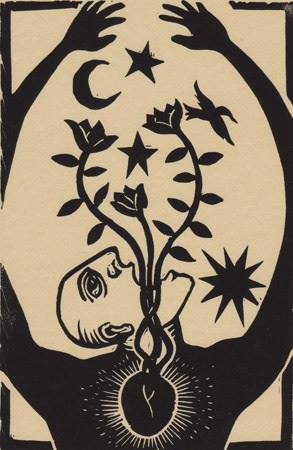
Linocut by Kreg Yingst, from Psalms in Linocuts: Book 1.

What wonderful deeds has He performed in your life this past year?

Posted in Western Art | Leave a comment

Jesus in the Harvard Art Museums

After six years of expansion and renovations, the Harvard Art Museums—all three now united under one roof—reopened last weekend. I visited this Saturday in what was one of the most enjoyable mornings I’ve spent since moving to Boston. Their collection is spectacular. Since I can’t possibly recap all the standouts, I’ll focus on just a few that feature Jesus. These are not necessarily the most famous pieces from the collection but are some of the ones that engaged me the most—in terms of either iconographic content or devotional inspiration.

Unless otherwise indicated, all photos are by the Harvard Art Museums; click on the image to be led to its webpage.

Flight to Egypt, with the Slaughtered Innocents

William Holman Hunt (British, 1827-1910), The Triumph of the Innocents, 1870-1903. Oil on canvas, 75.3 x 126 cm. Harvard Art Museums/Fogg Museum, Cambridge, Massachusetts.

The Triumph of the Innocents is a really unique visual retelling of the Flight to Egypt, showing the spirits of the “Holy Innocents”—the Bethlehemite babes who were slaughtered by Herod in a desperate attempt to protect his rule—leading the way. There’s so much here—the visionary bubbles filled with scenes of the messianic kingdom, the prefiguring gestures of the children, the theme of resurrection—that I think I’ll shelve the exposition of this piece for another post, perhaps for the Holy Innocents’ feast day, which is coming up next month.

Man of Sorrows

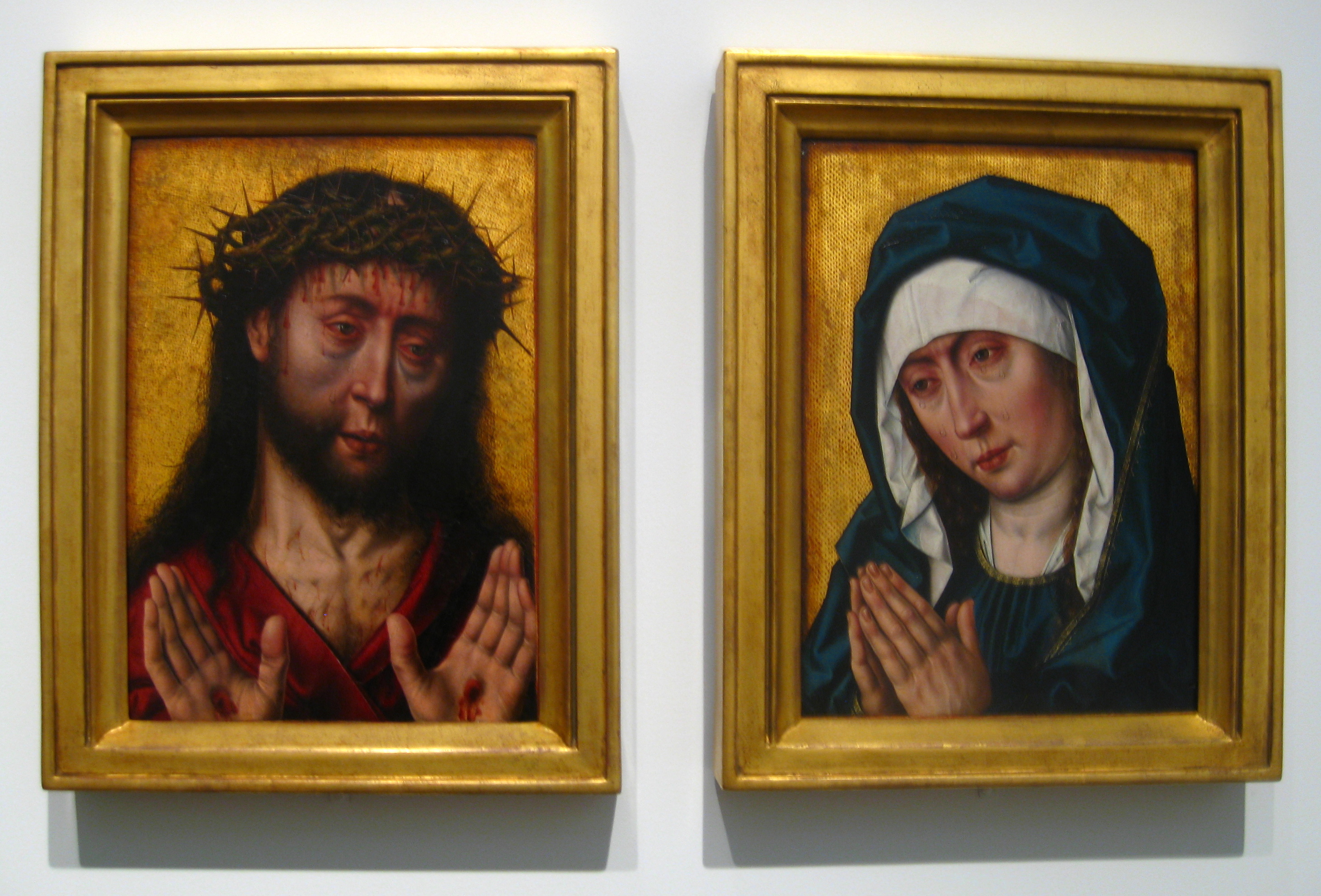
Aelbert Bouts (Netherlandish, ca. 1451/54-1549), The Man of Sorrows and The Mater Dolorosa, mid-1490s. Oil on oak panel, 37.9 x 26.5 cm. Harvard Art Museums/Fogg Museum, Cambridge, Massachusetts. Photo: Victoria Emily Jones.

This pair of images was painted in the Netherlands by Aelbert Bouts, from the famous Bouts line of painters. The Man of Sorrows and the Mother of Sorrows (Latin: Mater Dolorosa) were frequently paired together, so as to urge devotees to reflect on both the suffering of Christ and that of his mother. I found it really easy to enter into these two paintings; they drew me to worship, there in that gallery walkway.  Continue reading

Posted in Western Art | Tagged , , , | Leave a comment

Tee Time: Life is wasted without Jesus

WastedApparently a high school student in Canada got suspended from school in 2012 for wearing a T-shirt with this slogan—and not because of the veiled drug reference, but because the shirt was said to offend those who don’t share its wearer’s beliefs.

(T-shirt found at threadsquad.com.)

Posted in T-shirts | Tagged , | Leave a comment

Vintage Jesus, Part 10: Why Did Jesus Come to Earth?

This twelve-part series outlines the “Vintage Jesus” sermons of Mark Driscoll. See part 1 here.

3:29: To do the will of God, who sent him to earth as a missionary (John 6:38, 8:42)

4:20: To do everything anticipated in the Old Testament (Matthew 5:17-18)

5:37: There were three offices in the Old Testament, all of which Jesus filled: prophet (speaks), priest (serves), and king (rules). He demonstrated them in verifiable ways while on earth, and he continues to demonstrate them still from his seat in heaven.

6:21: Jesus as prophet: a bold, confrontational truth-teller

7:46: Unlike other prophets, Jesus says, “I tell you this” (not “God told me this”) or “I say to you”—I am the source and center and sum of truth. He appeals to his own authority as God, and people recognized that.

8:59: Jesus doesn’t just speak the word of God; he is the Word of God. (John 1)

10:38: Jesus was a preacher who pointed out sin and error and folly with the message “Repent.” He came to put his finger on the dark parts of our lives and release us from them.  Continue reading

Posted in Theology | Tagged , , , | 1 Comment

Tee Time: Seek His Face (No Shave November)

Seek Christ's faceFound at kerusso.com.

Posted in T-shirts | Tagged , | Leave a comment

Vintage Jesus, Part 9: How Did People Know Jesus Was Coming?

This twelve-part series outlines the “Vintage Jesus” sermons of Mark Driscoll. See part 1 here.

0:55-4:50 – Interview with Rabbi Mark Glickman: A Jewish Perspective on Who the Messiah Is

“The Messiah will usher in an era of universal peace and justice and righteousness and goodness, and a mere glance at the newspapers today shows that we haven’t reached that yet. Our world is far from the good, righteous, perfect place that our tradition has dreamt it can be. And therefore we very definitely live in a pre-Messianic world—a world in which the Messiah has not yet come.

. . .

“Reform Judaism, early on, rejected the notion of a person as the Messiah. We’re not looking for an individual but rather we see ourselves as God’s partner in working tirelessly in order to bring on the Messianic era, in order to make the world the good, perfect, just, righteous place we know it can become. So we’re not looking for the Messiah to be a person; we’re looking for the fulfillment, more generally, of the Messianic dream of our tradition, which promises peace and wholeness and completeness—the world as it might be.”  Continue reading

Posted in Uncategorized | Tagged , , , | 1 Comment