
 The ultimate high.
Found at ebay.com.
The ultimate high.
Found at ebay.com.
Track 1 on the album Joy Brand New. Words and music by Ben Keyes.
Ordinary Time is an independent folk acoustic trio rooted in the Christian tradition. For more information, visit their website, www.ordinarytimemusic.com.
 . . . and that’s how I roll!
Found at etsy.com.
I’m currently studying the book African Theology in Images by Martin Ott, a 600-page exploration of the African Christian art that has come out of the Kungoni Centre of Culture and Art in Mua, Malawi, since its founding in 1976. An excellent, excellent book—one to which I plan to devote future posts.
Here’s one excerpt (pp. 74-75) that has stood out to me thus far, mainly because it raises a concern that I’ve heard quite often: that Jesus was a Middle Eastern Jew, and so any artistic depictions of him should show him as such, so as not to demean his historicity. One Ugandan bishop used to agree with this line of reasoning, rejecting any images of Christ with African features . . . but then he changed his mind:
The establishment of authentic African art requires both personal adjustments and theological rethinking. Nowhere is this better illustrated than in two separate statements of Bishop Paul Kalanda of Moroto, Uganda. In an article written in 1960 Paul Kalanda had argued vehemently against the representation of Christ as “a black Christ with a short face, flat nose, thick lips and crisp hair. This form of presentation neglects the historical Jesus, and would rape him of his race and his personality; and, by the way, it is against the history and tradition of the church”. Exactly thirty years later, having been appointed Bishop, he issued another statement on the same subject. Continue reading

Color woodcut from the Habdank Bibel (Augsburg, Germany: Pattloch, 1995), by Walter Habdank.
The Church’s engagement with contemporary art, by Jonathan Evens: The church has been and is experiencing a renaissance of commissioned art, but so few people seem to be aware of it. Evens, who recently returned from a modern “Christian art” pilgrimage through Europe, discusses some of the causes, trends, and key figures related to this renaissance.
“The Gospel in Black and White: A Missiological Perspective on Ferguson” by Bob Bixby: OK, I’m pretty late on this one, but this white pastor’s response to the fatal shooting of Michael Brown is one of the most helpful I’ve heard. It examines in particular the tension between the predominant reaction of white Christians to this crisis and that of black Christians. If we profess the same gospel, why aren’t we more unified in our feelings about this case? It comes down to differences in shared understandings and shared values. Whereas blacks see themselves as a collective, whites do not—which has a tremendous impact on how each race interprets news such as this.
Artist Hirotoshi Ito can do some amazing things with rocks. Love it!
The Hound of Heaven trailer: Based on a nineteenth-century poem by Francis Thompson, this short film tells the story of a girl who believes that she is fleeing death, when she is actually running away from her only chance at life. The story is told through a combination of surreal visuals and spoken-word-style narration by LA hip-hop artist Propaganda. Directed by N. D. Wilson, the film premiered yesterday at the Raindance Film Festival.
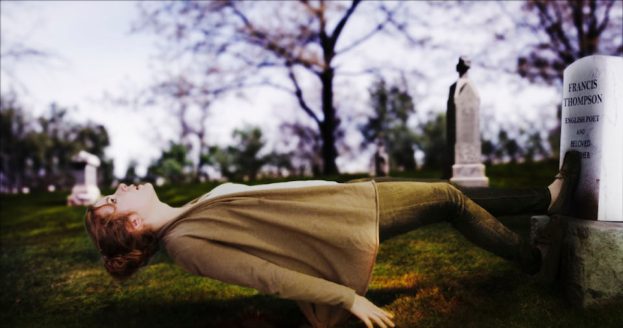
Still from the short film The Hound of Heaven, © 2014 Gorilla Poet Productions. Cinematography by Dane Saxon Wilson. (Click on the image to view more stills.)
The Bible Project just completed its latest video, “Messiah”:

Gustav Klimt, Farm Garden with Crucifix, 1912. Oil on canvas, 110 x 110 cm. (Click to enlarge)
Most famous for his gilded-style painting The Kiss, Gustav Klimt also painted many landscapes during his career. One of them shows a garden shrine to Christ, planted outside a farmhouse and covered in flowers of red, purple, and yellow. (It reminds me a bit of the Black Forest postcard I posted on last year!)
I love the rich color and thick brushwork in this painting. I also like the perspective, which leads the eye up that blossomy swell to the Mary figurine, and then up the body of the crucified Christ, where the flowers become all-golden, creating an aura about him and sanctifying the space. Traditionally Christ’s glory is signified by a halo or a mandorla, but here the natural environment does the job. It’s almost as if the flowers gather around him in worship! And they invite us to worship as well.



 The Jesus Question