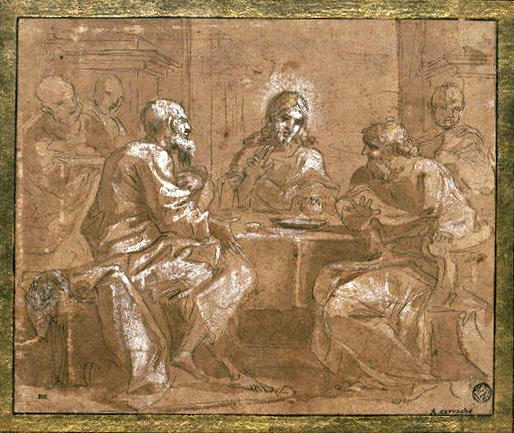
Circle of Annibale Carracci, “The Supper at Emmaus,” late sixteenth/early seventeenth century. Pen, brown ink, brown wash, white, and pierre noire on brown paper. Musée du Louvre, Paris.
Love bade me welcome. Yet my soul drew back
Guilty of dust and sin.
But quick-eyed Love, observing me grow slack
From my first entrance in,
Drew nearer to me, sweetly questioning,
If I lacked any thing.
A guest, I answered, worthy to be here:
Love said, You shall be he.
I the unkind, ungrateful? Ah my dear,
I cannot look on thee.
Love took my hand, and smiling did reply,
Who made the eyes but I?
Truth Lord, but I have marred them: let my shame
Go where it doth deserve.
And know you not, says Love, who bore the blame?
My dear, then I will serve.
You must sit down, says Love, and taste my meat:
So I did sit and eat.
“Tim Keller on Contextualization”: hmsarthistorian evaluates chapter 10 of Keller’s book Center Church: Doing Balanced, Gospel-Centered Ministry in Your City, giving two examples of indigenous Christian artists who have successfully contextualized the gospel through their art. Contextualization is not about accommodating every idea in a culture; it’s about affirming what Keller calls a culture’s “‘A’ beliefs”—those beliefs that roughly accord with gospel teachings—but also challenging the “‘B’ beliefs”—beliefs of the culture that lead listeners to find some Christian doctrines implausible or offensive.
“They killed Jesus because of his preaching”: In the video below, excerpted from the sermon “Jesus Preached the Gospel,” Mark Driscoll reminds us that Jesus was a preacher—it was one of his primary ministries. And yet people today, even Christians, often see him as more of a therapist. Let’s not forget the reason he was crucified: for preaching things like “I’m God,” “you’re a sinner,” “you need saving,” “repent.”
“Family Supper: Reclaiming Community through Communion” by Russell Moore: A challenge to evangelical churches to make Communion more, well, communal. “Part of the problem is with the way we present the elements themselves. Most contemporary evangelical churches distribute chewing-gum size pellets of tasteless and oppressively-textured bread along with thimble-sized plastic shot glasses of grape juice. This practice hardly represents the unity maintained by a common loaf and a common cup. It also strips away at the reality of the Supper as a meal for a gathering, not just a prompt for individual reflection.”
“How to Help Bereaved Parents in Your Church” by Jill Sullivan: When it comes to dealing with people who are experiencing grief over the loss of a loved one, we tend to either ignore them or offer up some unhelpful, even hurtful, cliché, like “she’s in a better place,” or “I understand what you’re going through.” Sullivan shares what comforted her most when she lost her sixteen-year-old daughter to brain cancer.
Controversial art piece forbidden in China, brought to Europe: SHOWstudio in London is exhibiting the Gao brothers’ bronze sculpture The Execution of Christ this month as part of an exhibition called “Death.” Based on Manet’s painting The Execution of Emperor Maximilian, the work shows eight life-sized Chairman Maos firing at Jesus, referencing the religious oppression that’s still going on in China as well as the artists’ own experience of losing their father when he was arrested and killed during Mao Zedong’s reign. Follow the link to see details of the sculpture. (Even just the standalone sculpture of Christ is very moving.)
Gao Zhen and Gao Qiang, “The Execution of Christ,” 2009. Bronze, life-sized.
The Gospel Coalition’s New England Regional Conference is coming up, and this year it’s in Boston! (Not only that, it will be co-hosted by my church, Citylife Presbyterian.) The plenary speakers are Tim Keller, John Piper, D. A. Carson, and my very own pastor, Stephen Um. The dates are October 19-20, and registration costs $100. For more information or to sign up, visit http://www.centerforgospelculture.org/tgcne/#.UBXxlPVQQk5.
There will be six main talks and two breakout sessions. Here are the two I signed up for, with descriptions from the website. I’m excited!
Manoel Oliveira – The Gospel Across Cultures
“In this session Dr. Oliveira explores the ways in which the Gospel speaks powerfully across cultures while also challenging diverse cultures in diverse ways. Of particular significance for Gospel-centered churches is to listen the voices of those who have left their home culture and found the Gospel in a different culture. It is these voices that can help the church understand her own cultural captivity and the Gospel means of being freed from those captivities.”
Richard Lints and Patrick Smith – The Gospel and Apologetics: Pressing Issues the Church Faces
“Even as our public discourse has become more polarized and partisan, the need to speak the Gospel into the Public Square has become more vital and yet more difficult. Learning to speak with courage, compassion and clarity to address pressing cultural issues is a skill ever more urgent for church leaders today. Come and engage these two apologists as they think through the pressing challenges the Church faces in our contentious public square.”
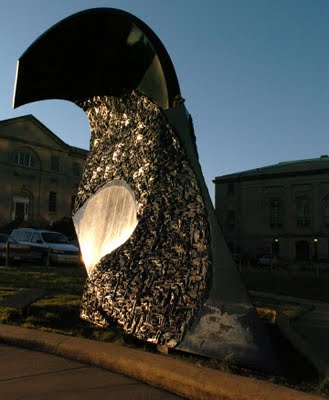
Isaiah 2:4 (cf. Micah 4:3) has inspired many artists and peace activists throughout history. The verse describes what the millennial reign of Christ will look like: “He will judge between the nations and will settle disputes for many peoples. They will beat their swords into plowshares and their spears into pruning hooks. Nation will not take up sword against nation, nor will they train for war anymore.”
Esther and Michael Augsburger, “Guns into Plowshares,” 1997. Steel and 3,000 handguns, 19 ft. long x 16 ft. tall. Evidence Control Facility, Washington, D.C.
Sculptor Esther Augsburger and her son, Michael, thought to illustrate this prophetic passage by literally beating guns (the twenty-first century equivalent of swords) into the shape of a plowshare, transforming the life-destroying weapons into a life-affirming work of art. They designed and built the four-ton steel structure themselves.
The 3,000 guns that make up this work were collected from the gun buyback program run by Washington, D.C.’s police department, which seeks to reduce gun violence by reducing gun ownership. Participants are granted amnesty and anonymity—that is, they are immune from prosecution; they are not even ID’ed. This no-questions-asked turn-in offer is ongoing, but sometimes incentives are provided, usually through corporate or private sponsors. In January 1994, for example, former heavyweight champion Riddick Bowe pledged to pay $100 in cash for each firearm turned in on the 15th of that month. “I think if you have one gun off the street, then maybe that’s a life that you saved,” Bowe said. Bowe ended up paying out $360,000—for 3,600 guns turned over and disabled (source). Having heard of the successful turnout, Esther Augsburger convinced then–Police Chief Fred Thomas to let her use some of these guns for her art piece (source).
Guns into Plowshares was installed in 1997 across from the Metropolitan Police headquarters in Judiciary Square but has since moved to the front of the District’s evidence control facility at 17 DC Village Lane SW. Continue reading →
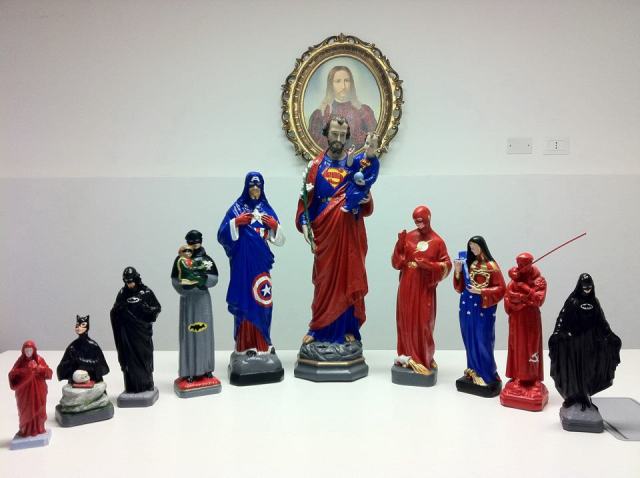
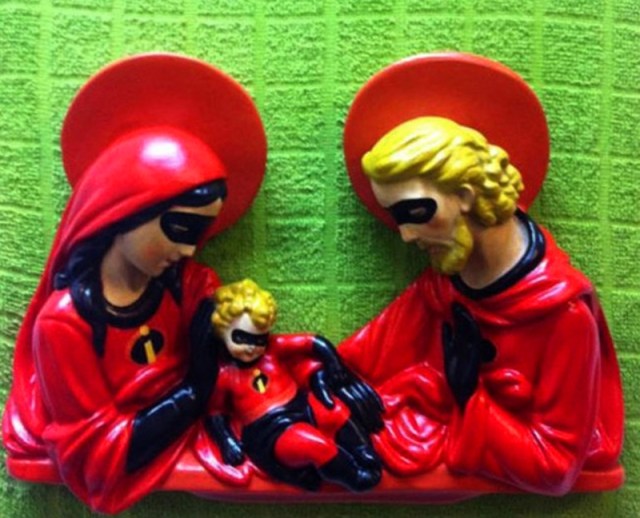
Italian artist Igor Scalisi Palminteri recently created a new art series titled Hagiographies. For this project, Palminteri purchased cheap Jesus and saint statuettes (and a framed painting) from the street markets of Palermo and transformed them into superheroes using acrylic paint. Jesus is thus reimaged as baby Superman, Robin, “Dash” the Incredible, Spider-Man, Captain America, and so on. And his parents and saint buddies are part of the superhero cast too: Mary is Catwoman and Elastigirl; Joseph is Superman and Mr. Incredible; Saint Anthony is Batman; Saint Rita is Wonder Woman and the Flash; and so on. For photos of these works, see here and here.
I think the artist meant these pieces to be more than just a playful exercise in recycling, but to provoke serious questions, like:
How do people, be they real or fictional, gain pop icon status?
What stories get canonized (either by church or culture), and why?
Are we willing to recognize and worship Jesus as human, and not just superhuman?
What is heroism, anyway? (What values do we use to define it?) Continue reading →
Here are a few posts by others that went up this week that I enjoyed reading.
“God Did Not Write the Bible…”by Kathy Vestal: I’ll have to wrestle with this one some more. It raises some provocative questions, like is “divinely inspired” really the same thing as “divinely authored”? (Can we really say that God wrote the Bible?) And if we hold to the view that the Bible was not dictated by God or handed down to us from heaven, but is the work of human individuals recording their unique experiences of God within the limitations of human language, then why do we insist that it must be without error, especially when the Bible makes no such claim of itself? Vestal says that some Christians make the Bible their god and worship it, instead of worshiping the one true God, which is why those Christians get so offended when people point out alleged errors in the Bible (they interpret that to mean that God has made a mistake). I don’t agree with everything in this article, but it did prompt me to consider what I mean when I use the terms “divine inspiration” and “inerrant.”
“The Secular Beatitudes”by Josh Harris: Cultural values often run counter to the values of Jesus. If today’s were to be formatted into a beatitudinal list (“Blessed are…”), it might read something like this: “1. Blessed are the self-confident because they rule the world. 2. Blessed are positive-thinkers because they don’t need anybody’s comfort.” And so on. (Read Harris’s eight in parallel with Matthew’s.)
“Should Churches Abandon Travel-Intensive Short-Term Missions in Favor of Local Projects?” by Brian M. Howell, David Livermore, and Robert J. Priest: This question has been on my mind for a while, as to me, the answer should be an obvious yes. I don’t deny the necessity of foreign missions, but I do question the value of some short-term mission trips, when the assigned work could easily and gladly be done by locals, and all the money spent on airfare could be put toward something more worthwhile. This article offers three thoughtful perspectives, though, which have helped me to round out my thinking on the topic.
“Making Sense of Scripture’s ‘Inconsistency’”by Tim Keller: “I find it frustrating when I read or hear columnists, pundits, or journalists dismiss Christians as inconsistent because ‘they pick and choose which of the rules in the Bible to obey.’ Most often I hear, ‘Christians ignore lots of Old Testament texts—about not eating raw meat or pork or shellfish, not executing people for breaking the Sabbath, not wearing garments woven with two kinds of material and so on. Then they condemn homosexuality. Aren’t you just picking and choosing what you want to believe from the Bible?’”
And now, just for fun, the trailer for the upcoming movie musical Les Misérables, starring Anne Hathaway and Hugh Grant. Set in nineteenth-century France, the story is chock-full of spiritual themes, among them redemption, sacrifice, and justice versus mercy. I can’t wait!





 The Jesus Question