“Where Can I Turn for Peace?”

A resident of Belmont, Massachusetts, I’m currently under police orders to stay inside my house until further notice. This morning, about a mile away from where I live, a rapid-fire shootout erupted between the two suspects in the Boston Marathon bombing case and several law enforcement officers. One of the suspects died as a result, and the other is at large and still armed, and being pursued by hundreds of local, state, and federal police officers and special agents. The public transportation system has been shut down for the day, and most buildings in the Greater Boston area are in lockdown. Everyone’s on edge waiting to see what will come of all this. And everyone’s asking a lot of questions.

Most of the beseeching right now is for FACTS. We want to know what happened in the early hours of this morning, what the suspects’ motives were, what leads the police are following, and so on. We want understanding. We want catharsis. But the question that isn’t being asked on the news coverage is: In the midst of all this chaos, where can I turn for peace?  Continue reading

Posted in Music | Tagged , , , | 2 Comments

Tee Time: Jesus, Sweet Savior

Jesus, Sweet Savior

Found at christiantshirtshop.com.

Posted in Jesus Kitsch | Tagged , , | Leave a comment

Boston bombings 4/15/13

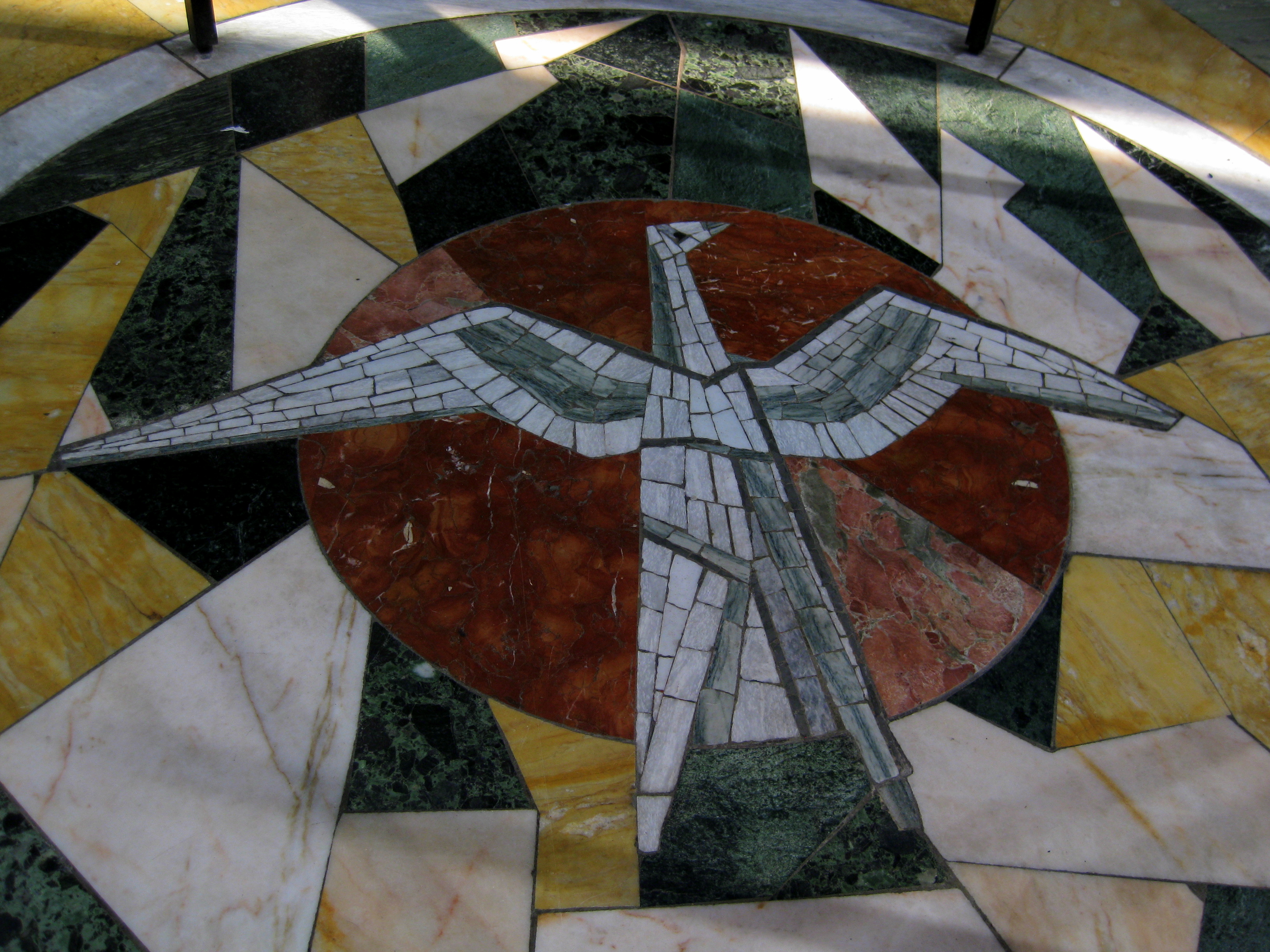
Unity Chapel mosaic

Mosaic floor design by Swedish artist Einar Forseth, Chapel of Unity, Coventry Cathedral, England. Photo: Victoria Emily Jones.

Whenever tragedy strikes, no matter the scale, I find it difficult to form verbal prayers to God. Sometimes all I can do is sit and incline my heart in silence toward the One who knows all and is all, knowing that he hears what I cannot voice—questions, confusions, sympathies, and pleas.

May God’s Spirit be with all those affected by today’s events.

Posted in Death / tragedy / suffering, Western Art | Tagged , | Leave a comment

Tee Time: Don’t Be One of the Lost Ones

Jurassic Park Christian T-shirt

. . . find Jesus!

Found at ebay.com.

Posted in Jesus Kitsch | Tagged , | Leave a comment

Celebrating Christ in All Seasons: Liturgical Bentwood Boxes by Charles W. Elliott

This is the seventh and final post in a series on Christian art of the Pacific Northwest Coast. Read part 1 here.

St. Andrew’s Cathedral in Victoria, British Columbia, is home to a hand-carved yellow cedar altar by Tsartlip artist Charles W. Elliott. The base consists of two bentwood boxes with a design carved onto each of the eight faces. These boxes rotate throughout the liturgical year so that the front-facing images correspond to the current seasons in the church calendar.

Altar by Charles Elliott

Charles W. Elliott, Eucharist and Spiritual Nourishment, 1987. Yellow cedar altar box carvings, St. Andrew’s Cathedral, Victoria, British Columbia. Photo: Trish Simpson-Boulsbee.

The bentwood box is a traditional Northwest Coast art object, typically used to store food or clothing. They are made out of a single plank of wood that is kerfed, steamed, and bent into shape—hence the name. (The bottom and lid, however, are separate pieces. To read a more detailed description of the creation process, see pages 89-92 of Hilary Stewart’s Cedar: Tree of Life to the Northwest Coast Indians.) St. Andrew’s does not store anything inside the boxes, choosing to use them not for utilitarian purposes, but for the purpose of inspiring spiritual meditation.

St. Andrew’s commissioned this carved altar in 1987 to commemorate the twenty-fifth anniversary of Remi De Roo’s ordination as Bishop of Victoria in 1962. Having served in that position until retirement in 1999, De Roo is Canada’s longest-serving Catholic bishop. He is known for being a proponent of social action and liberation theology.

The artist, Charles Elliott, is self-taught and works in the mediums of drawing, painting, woodcarving, printmaking, and clothing design. He has dedicated his life to reviving the Coast Salish art tradition, which he says is the least known of all the Northwest Coast styles. To this end, he mentors young artists and teaches in classroom and organizational settings. He lives on the Saanich Peninsula on southern Vancouver Island.

Charles W. Elliott, artist

Charles W. Elliot at the Second International Marine Conservation Congress in Victoria, British Columbia, in May 2011. He designed the congress’s logo, depicting an orca, human, and raven in conversation with one another (top left). Photo © kipevansphotography.com.

To see a sampling of works by Elliott, visit the Victoria International Airport website. To see details of the totem pole he carved for the University of Victoria in 1990, see the photography blog Burnt Embers.

The following thumbnails are courtesy of Saint Andrew’s Cathedral, and the descriptions are based loosely on those they supplied me with in this PDF, presumably written by the artist.   Continue reading

Posted in Non-Western Art | Tagged , , , | 1 Comment

One with Christ: Prints by Roy Henry Vickers

This is part 6 of a series on Christian art of the Pacific Northwest Coast. Read part 1 here.

The word “inspiration” comes from the Latin word in spiritu. The translation is “the breath of the creator coming into us.” We are inspired by the very breath of the one Great Creator, and it is no wonder that we are compelled to create whatever we can with the gifts that are given when the Creator’s breath comes into us. Roy Henry Vickers

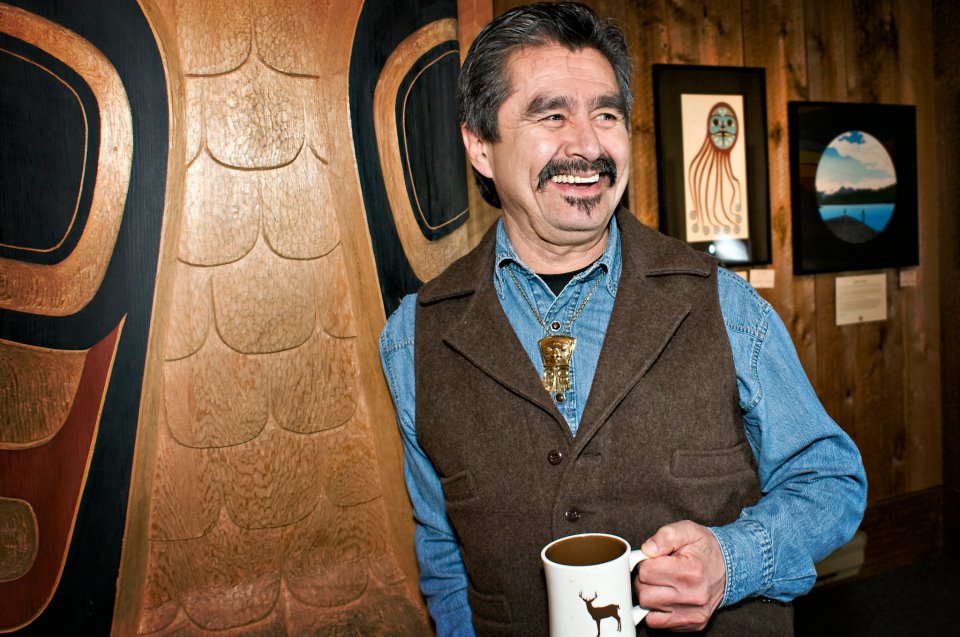
Roy Henry Vickers

Roy Henry Vickers grew up in an Anglican Church community in the Tsimshian village of Kitkala, British Columbia. At age 12, he “accepted Christ into my heart,” but the relationship faltered, and he left the church more than once . . . only to return again with renewed faith. “Christ never forsakes you,” he said. “The Holy Spirit never stops speaking to you, convicting you.”

Vickers’s father was a fisherman of Tsimshian, Haida, and Heiltsuk blood. His mother was a British schoolteacher. His mixed heritage influences his art style, which tends to blend traditional Northwest Coast abstraction (he studied at the Gitanmaax School of Northwest Coast Indian Art in Hazelton, BC) with European realism (as in his landscape paintings).

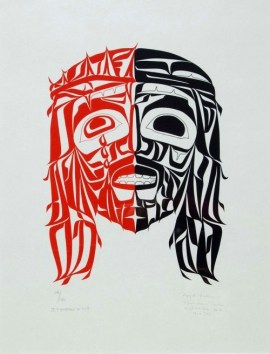
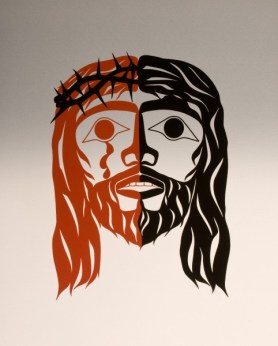
Of special interest to me are his Head of Christ prints. Here are two of them:

Northwest Coast Christ

Serigraph by Roy Henry Vickers, 1976, edition 66/100. Inscription: II Timothy 2:11, 12.

Northwest Coast Christ

Roy Henry Vickers, Easter 1985, 1985. Lithograph, 9.25 x 7.25 in.

Of these, he wrote the following:  Continue reading

Posted in Non-Western Art | Tagged , , , , | 7 Comments

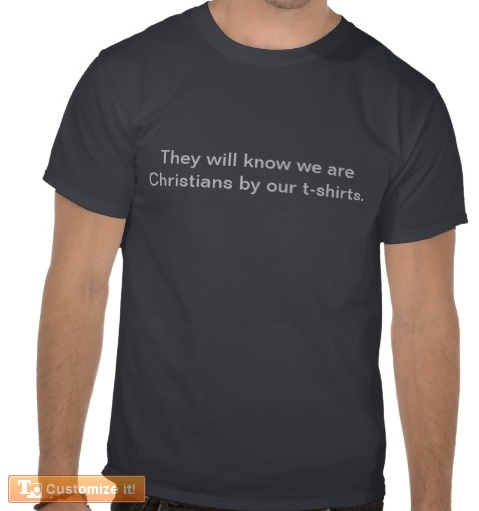
Tee Time: They will know we are Christians by our T-shirts

They'll know that we're Christians by our T-shirtsFound at zazzle.com.

Posted in Jesus Kitsch | Tagged , | Leave a comment

Off to England!

From April 7-15, I will be visiting England for the first time. So excited! My husband will be presenting his research at a microscopy conference at Oxford—just the impetus I needed to finally make the trip over to the country whose literature I studied for four years in college.

I’ve arranged to meet up with artist Nicholas Mynheer while I’m there. He works in painting, sculpture, and glass design and is one of my favorite artists.

Deposition by Nicholas Mynheer

Nicholas Mynheer, The Deposition of Christ, 2011. Caen stone sculpture, 57 cm tall.

If you know of any special exhibitions going on while I’m there or have any recommendations for must-sees or must-do’s, let me know! I’m overwhelmed by all the beauty the country has to offer and could use some guidance in creating an itinerary.

I’ll be staying in Oxford for the first four days and London for the last four.

Posted in Western Art | Tagged | Leave a comment

Bringing Easter hope to the margins

Today Pope Francis deviated from tradition and instead of washing the feet of twelve fellow priests as part of the annual Holy Thursday ritual, he washed the feet of twelve imprisoned youth. These individuals ranged in age from 14 to 21 and included two females as well as non-Catholics. Unheard of!

According to a Vatican report, Jorge Bergoglio often celebrated Mass in prisons and hospitals when he was archbishop of Buenos Aires. He has washed and kissed the feet of drug addicts, AIDS patients, and other downtrodden individuals before, to convey to them a posture of service in keeping with Christ’s, a commitment to meeting their needs and a respect for their persons. But this is the first time that a pope has ever done so as part of the Holy Thursday Mass. Furthermore, it’s the first time that the Holy Thursday Mass was held outside St. Peter’s or St. John Lateran. (Rather, it was held on site at the Casal Del Marmo Youth Detention Centre on the outskirts of Rome.)

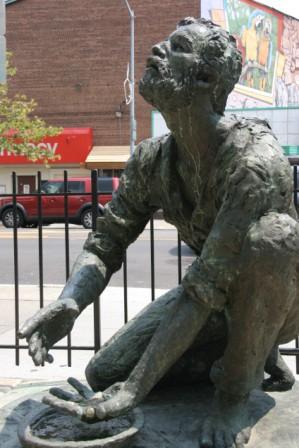
Servant Christ by Jimilu Mason

Jimilu Mason, Servant Christ, 1986. Bronze sculpture, approx. 4 ft. tall. Christ House, Washington, DC. A contemporary depiction of Christ as a kneeling male figure dressed in a sweatshirt and pants, but no shoes, installed outside a medical facility for the homeless.

In a public address yesterday in St. Peter’s Square, the pope said that following Christ “means learning to come out of ourselves . . . in order to meet others, in order to go toward the edges of our existence, to take the first steps towards our brothers and sisters, especially those who are farthest from us, those who are forgotten, those who need understanding, consolation and assistance.”

By reaching out to these young people outside the clerical elite, including people of the female gender and the Muslim faith, Pope Francis has affirmed that Jesus’s love and sacrifice, which we commemorate tomorrow, is for all of humankind—and likewise his command for us to be givers and servants puts on the receiving end not just those within our own Christian circles, but more especially those without.

Watching the pope’s kisses on the news footage was so sweet to me. I pray for those twelve—and for the thirty-something others detained there this Easter. I pray that the pope’s actions will lead them, and us all, into a fuller understanding of the gospel.

Posted in Uncategorized | Tagged , | Leave a comment

Jesus as Chief: “Baptism Mural” by Tony Hunt

This is part 5 of a series on Christian art of the Pacific Northwest Coast. Read part 1 here.

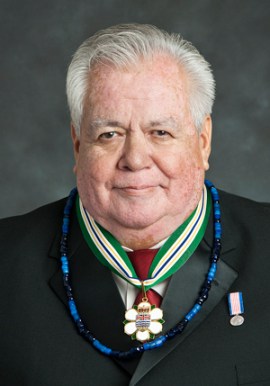
In recognition of his extraordinary artistic contributions to the province, in 2010, Tony Hunt was invested into the Order of British Columbia, the province's highest honor.

In recognition of his extraordinary artistic contributions to the province, in 2010, Tony Hunt was invested into the Order of British Columbia.

Chief Tony Hunt is the hereditary chief of the KwaGulth people of Fort Rupert and Kingcome Inlet, British Columbia, and a master carver. At age 12, he started training in woodcarving with his maternal grandfather, the legendary Chief Mungo Martin, who is probably most well known for building the traditional Kwakwaka’wakw “big house” in Thunderbird Park in Victoria, BC.

Hunt has designed more than 100 full-scale totem poles—more than any other First Nations artist—which are exhibited in countries throughout the world, including Mexico, England, Greece, New Zealand, China, Japan, and, of course, his native Canada. (The largest concentration of his totem poles is found in Thunderbird Park.) He also designed the Hunt Family Big House inside the Royal BC Museum and the KwaGulth ceremonial Big House at Fort Rupert, the largest traditional native structure ever built in the Pacific Northwest.

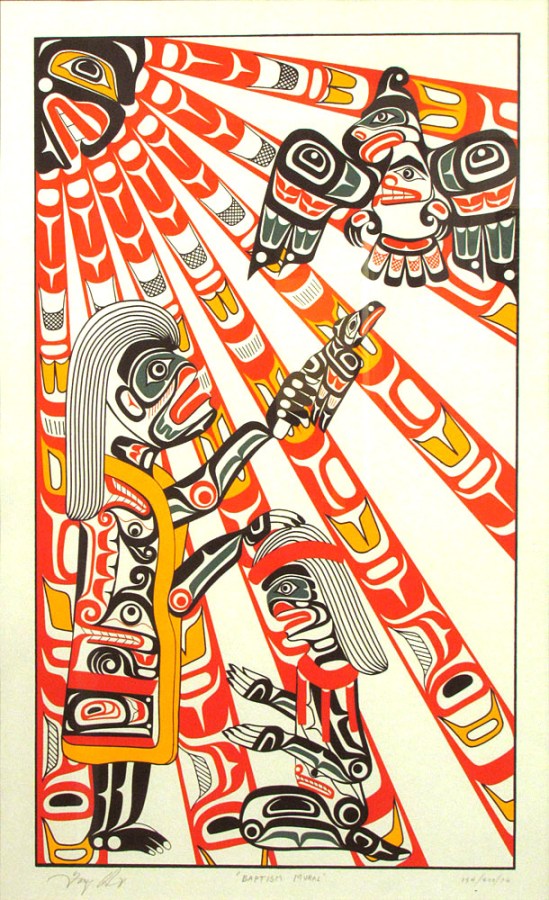
Hunt works in two dimensions as well, as shown by the serigraph below.

Baptism of Christ by Tony Hunt

Chief Tony Hunt Sr., Baptism Mural, 1976. Serigraph, edition 184/400, 22 x 12.8 in. (55.9 x 32.5 cm).

Like the Totem Cross by Stanley Peters, this work was commissioned by the Canadian Conference of Catholic Bishops in 1975. The original design is carved and painted on a red cedar panel measuring 152.2 x 90.9 x 4.9 cm.  Continue reading

Posted in Non-Western Art | Tagged , , , , | 2 Comments