
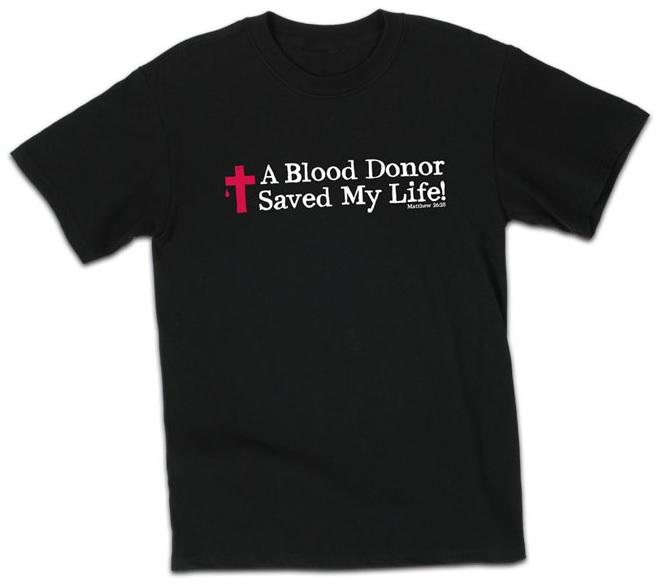
Found at churchsupplier.com, religioustshirts.co.uk, and creativestreams.net.
Professor emeritus of Religion, Society, and the Arts at United Theological Seminary of the Twin Cities, Wilson Yates says that the arts can serve as . . .
 Found at zazzle.com.
This twelve-part series outlines the “Vintage Jesus” sermons of Pastor Mark Driscoll. See part 1 here.
Click here to watch the sermon “Did Jesus Rise from Death?”
“[The resurrection of Christ] is the fact upon which the Christian faith is built. Christianity is not built just on good teaching or moral principles or philosophical inquiries; Christianity is rooted in this historical fact. . . . If you can disprove the resurrection of Jesus, you literally pull the bottom piece out of the Christian Jenga game, and the entirety of our religion crumbles and falls apart.”—Mark Driscoll
To answer the question of Jesus’s resurrection, we have to consider three lines of evidence: biblical evidence, circumstantial evidence, and historical evidence.
6:45: BIBLICAL EVIDENCE FOR JESUS’S RESURRECTION
Jesus repeatedly, clearly, and emphatically said that he would die and rise again (Matthew 12:38-40; Mark 8:31, 9:31, 10:33-34; John 2:18-22). And according to the biblical accounts, that’s just what he did.
7:50: Jesus died. Some people actually try to refute this fact, holding to what’s called the “swoon theory,” which states that Jesus only fainted on the cross, was buried in this unconscious state, and then was later revived in the tomb in the same mortal body. But this theory is untenable for the following reasons:
It’s impossible for one to survive under these conditions. And even if he had, he would have been in such bad shape that his disciples would never have put their faith in him as the triumphant one who had the power to conquer death. Continue reading

This T-shirt draws on imagery from the Book of Revelation in its characterization of Jesus.
Found at truevineart.com.
“For those of us with no desire to dispense with theology in the name of some kind of religiously or spiritually inflected art, the question really comes down to what we mean by ‘Christian’ when it comes to Christian art. Must the artist be a Christian? Must the art depict Christian themes? Many commentators have argued the pros and cons of such axiomatic approaches to church-based art, and yet, as might be expected, no definitive answer has been forthcoming.
“Could we say, for example, that art is Christian when it shows concern for the politically dispossessed, disenfranchised, and distraught? That is the mainstay of Doris Salcedo’s work. If so, then her installation in Liverpool’s Anglican Cathedral in 1999 might be considered ‘Christian’ regardless of her own beliefs. These sculptures, employing her signature amalgam of domestic furniture, disconcertingly spliced together and sealed with concrete, stand in solemn testimony to the political violence of her native Colombia, and as mute witnesses for the disappeared and done-away-with. Continue reading
 Found at jcdivinedesigns.com.
Located just off Leicester Square in London’s West End, this round church is tucked cozily between a movie theater and (when I was there in April) a construction site. I knew about the Cocteau mural, and so my husband, Eric, and I set off in search of it, taking a few wrong turns before arriving. (We were looking for a rotunda, not knowing that it’s hidden behind a flat brick facade!)
Inside, what a change of pace from the noise and flashiness of Piccadilly Circus! The pews stretch wide to invite people to pray, reflect, hear God—or even just to take a rest, as several were doing while we were there.

Serving as a mission for the French (and French-speaking) community in London, Notre Dame de France has existed at this site for a century and a half. In 1865, the Marist Father Charles Faure bought a late-eighteenth-century panorama building (an entertainment venue where people came to see long scroll paintings displayed along the cylindrical walls in a 360-degree view), and architect Louis Auguste Boileau transformed it into a church. The church suffered bomb damage during World War II but was reconstructed in 1953 by Hector Corfiato of the École des Beaux-Arts in Paris. During this time of reconstruction, new art was commissioned for the interior and exterior.
Stone Relief Carvings: The Life of Mary
On the two pillars outside is a series of eight scenes from the life of Mary, carved by students from the École des Beaux-Arts. Notice the different styles of the different artists.
What stood out to me as unique is that in the Annunciation carving, the artist depicts a whole flock of doves rather than just a single one to represent the Holy Spirit sweeping in.

The Annunciation.
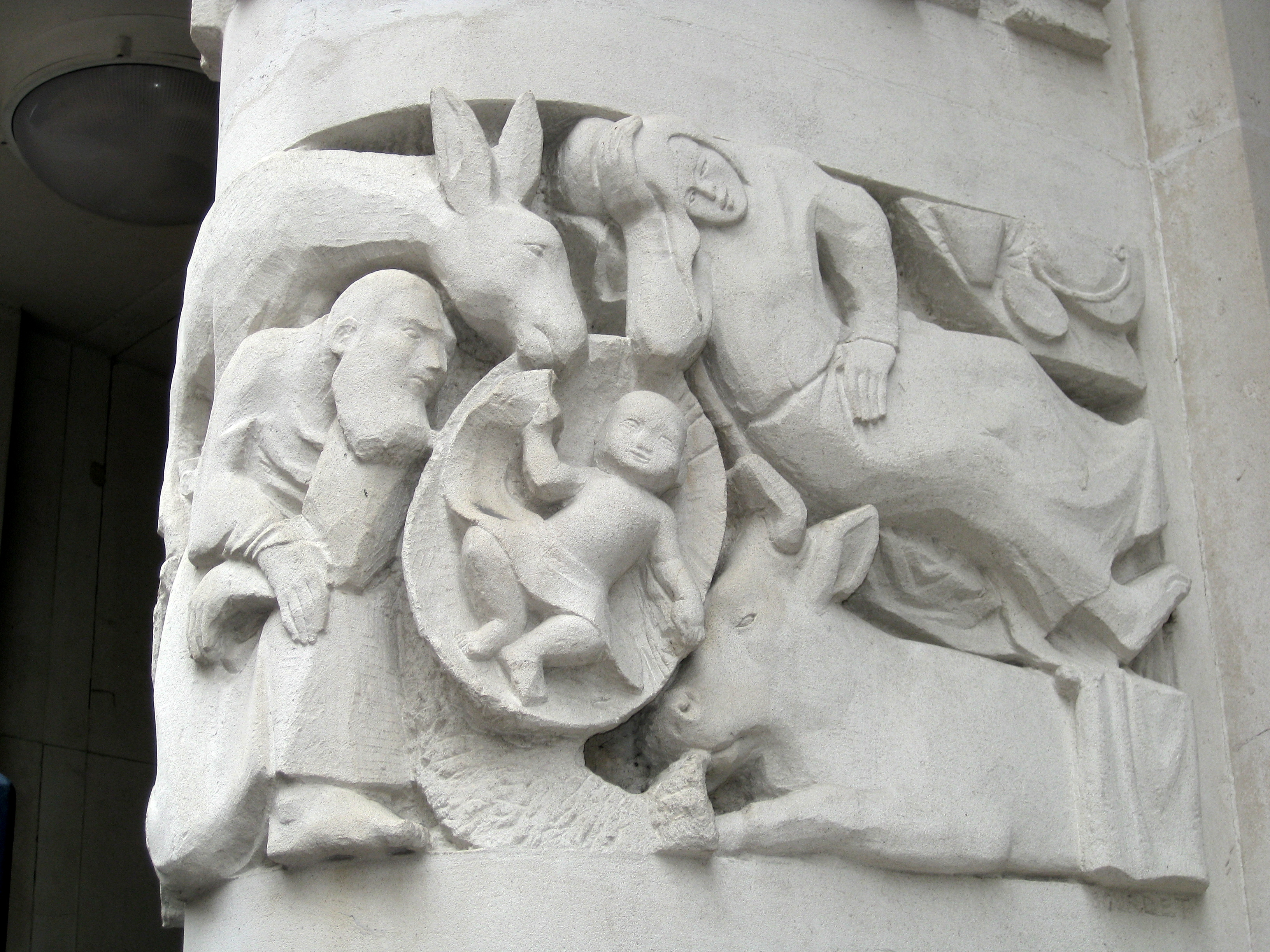
The Nativity. Signed “Bourdet-Bulioz.”
“Nothing before, nothing behind;
The steps of Faith
Fall on the seeming void, and find
The rock beneath.”
—excerpt from “My Soul and I” by John Greenleaf Whittier (1807-92)
 The Jesus Question