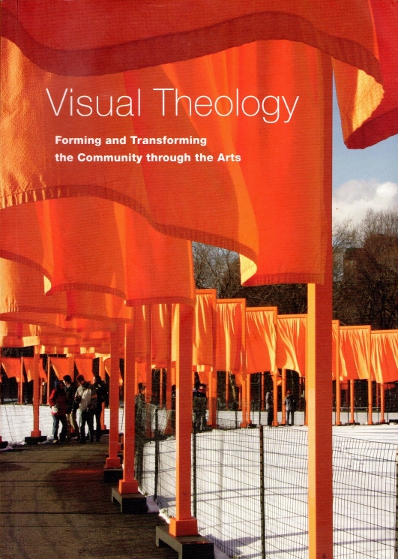
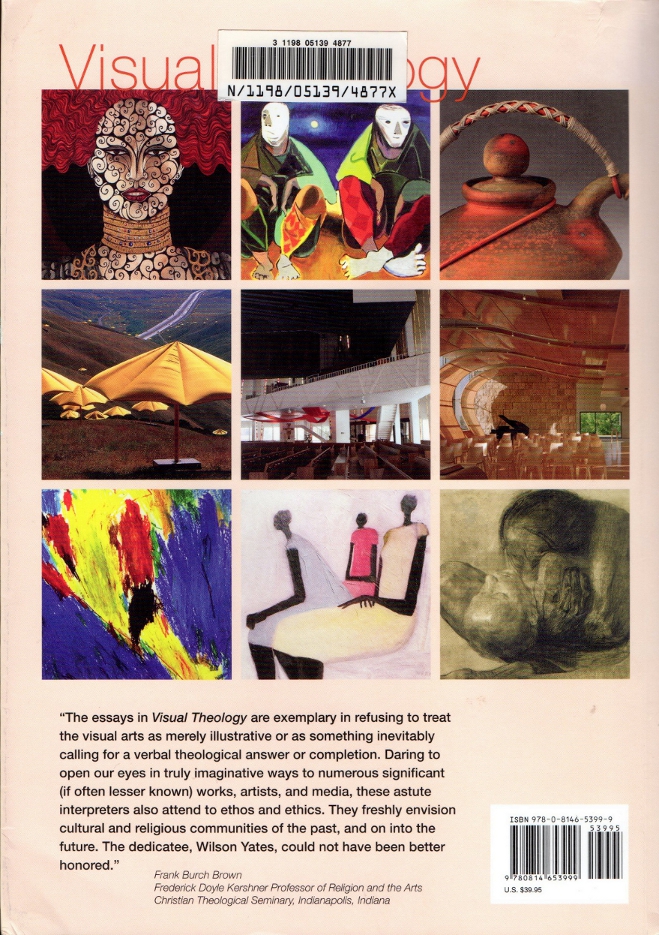
I highly recommend the book Visual Theology: Forming and Transforming the Community through the Arts. Click here to read my review, and see below for chapter summaries.
VISUAL THEOLOGY AND THE TRADITIONAL
1. “Art’s Last Icon: Malevich’s Black Square Revisited” by Charles Pickstone
Pickstone sees Kazimir Malevich’s oil painting Black Square (ca. 1923-30) as expressive of the apophatic tradition of spirituality, which finds God in silence, in darkness, in absence of speech. Using the Russian icon tradition as his discussion framework, Pickstone examines the topics of power, presence, and democracy as they relate to the image.
2. “‘Living on the Outside of Your Skin’: Gustav Klimt and Tina Blondell Show Us Judith” by Sarah Henrich
Here Henrich contrasts two portraits of the same subject: the apocryphal Judith, an Israelite widow who, through courage and cunning, decapitates the Assyrian general Holofernes and so saves her people. Whereas Klimt’s painting depicts Judith as a femme fatale—exotic, erotic, and deadly—Blondell depicts her as an angel “fallen into reality, scarred by her experience of tension and grief and able to challenge viewers, male and female, to see her as she is” (26). The paintings’ disparate meanings derive in part, says Henrich, from the artists’ different uses of nakedness and ornamentation.
3. “Wholly Porcelain: Mimesis and Meaning in the Sculpture of Ginger Henry Geyer” by Deborah Sokolove

Ginger Henry Geyer, Holy Roller, 2000. Adaptation of Giotto’s Pentecost from Scrovegni Chapel, Padua. Glazed porcelain with platinum, 2.3 x 10.5 x 17.2 in.
Geyer’s art juxtaposes, often humorously, the ordinary stuff of daily life (toys, kitchen utensils, bedding, etc.) with reproductions of religious works of art from earlier periods of history. For example, her Holy Roller is a glazed porcelain paint tray with a roller that is either picking up an entire scene out of the tray or spreading it down there. By drawing on religious symbols in this nontraditional way, she challenges viewers to consider the relationship between everyday life and the life of faith. Other works discussed in this essay are Cookie Cutter Christ and Faith and Reason Sleeping Together. Continue reading →

 Found at ebay.com.




 The Jesus Question