Starting tomorrow and going through the 26th, I’m going to post daily selections from Luke’s Gospel account of Jesus’s conception and birth, along with a piece of modern religious art for each passage. My hope is that as you read the story in small portions, you will take time to meditate on the sweetness, the awesomeness, of each detail, and that seeing the story unfold in color and form will stimulate your heart and mind as you commune with God this Christmas and lead you more deeply into the truth of the incarnation.
The reading plan is as follows:
December 19: Luke 1:26-31:The Annunciation
December 20: Luke 1:39-45: The Visitation
December 21: Luke 1:46-56: The Magnificat
December 22: Luke 2:1-5: The Journey to Bethlehem
December 23: Luke 2:6-7: The Nativity
December 24: Luke 2:8-14: The Annunciation to the Shepherds
December 25: Luke 2:15-18: The Adoration of the Shepherds
December 26: Luke 2:19: After the Shepherds’ Visit . . .
The passages will be taken from the English Standard Version (ESV) of scripture.
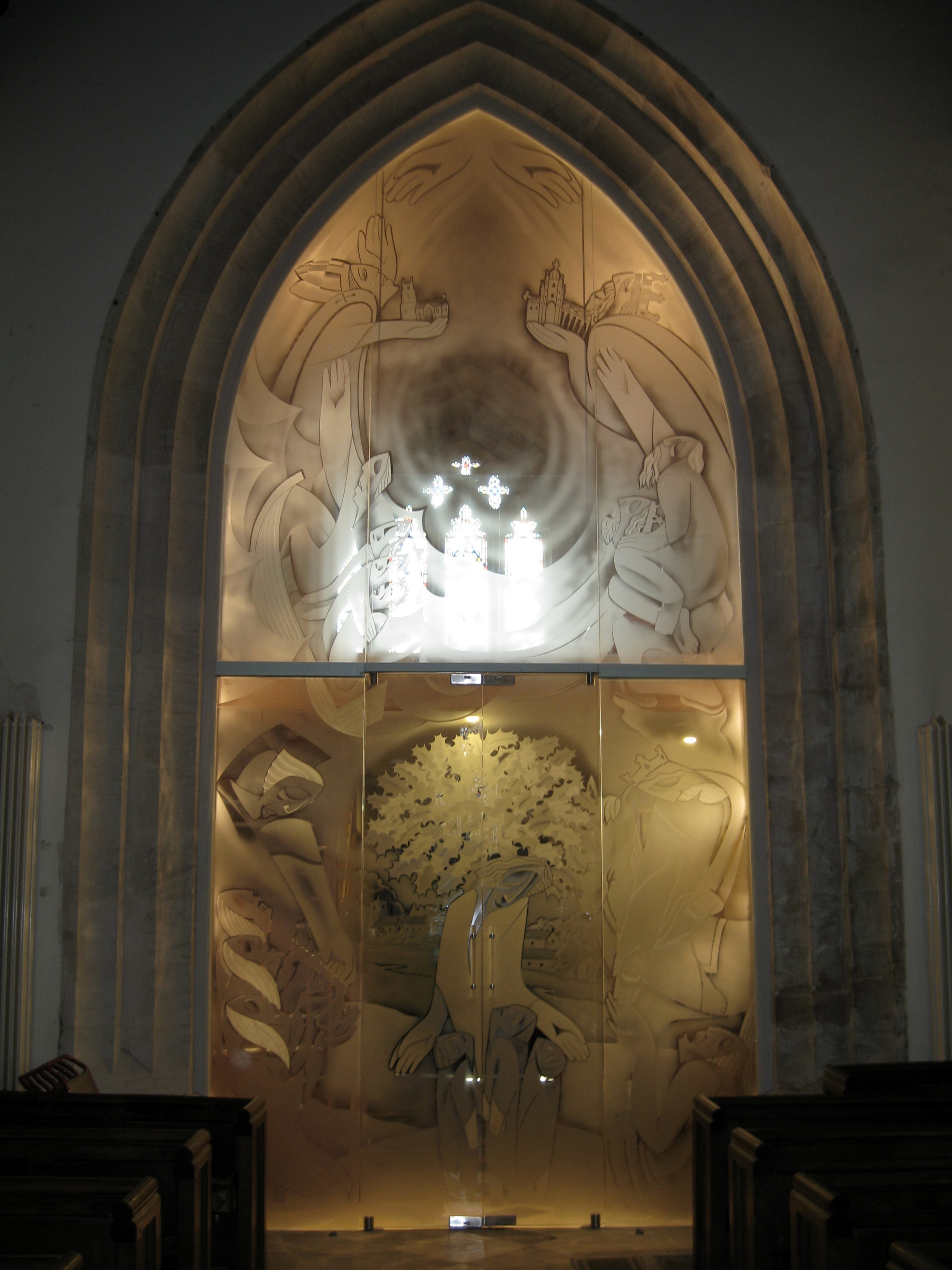
While visiting Oxford in April, I had the pleasure of meeting artist Nicholas Mynheer and, what’s more, of having him talk me through some of his works on location. One of my favorites was the glass screen he designed for Saint Nicholas’s Church in nearby Islip, installed in 2011.
Sandblasted glass screen at the west end of the Church of St. Nicholas, Islip, Oxfordshire, England. Designed by Nicholas Mynheer and made by Davia Walmsley of Daedalian Glass, 2011.
The screen depicts scenes from the life of St. Nicholas, a fourth-century bishop from Asia Minor and the prototype for Santa Claus, and the life of St. Edward the Confessor, who was born in Islip and reigned as King of England from 1042 to 1066. Though separated by seven centuries and a continent, the lives of these two men mirror each other in several ways—because they both mirror Christ. Key episodes unfold in parallel up each side of the screen, with the blessing hands of God the Father at the top, and the blessing hands of Christ at the base, behind whom lies the village of Islip. Continue reading →
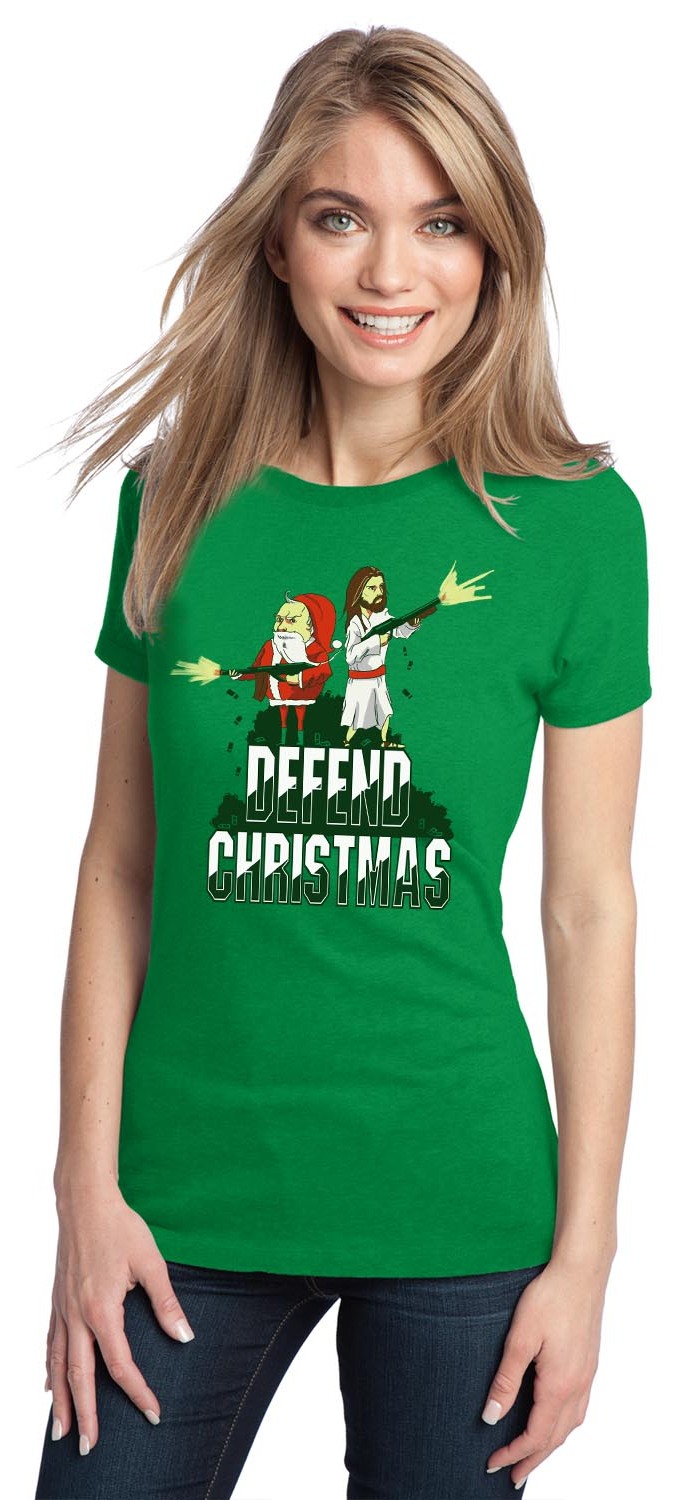
Seller’s description: Features “Santa and Jesus holding back the rising tide of pointy-toothed, Christmas-eating atheists and their liberal overlords in Americatown, USA.”
It’s nice to see Jesus and Santa on the same team!
Gentile da Fabriano, St. Nicholas of Bari, 1425. Panel from the Quaratesi Polyptych. Tempera on wood, 200 × 60 cm. Uffizi Gallery, Florence, Italy. In his right hand, St. Nicholas holds three golden balls, alluding to the episode of the three destitute maidens. His vestment is decorated with scenes from the life of Christ.
Santa Claus: fact, or fiction?
The answer is, a little bit of both. The Santa Claus of American lore is based on the real-life Nicholas of Myra, a Greek Christian living in Asia Minor during the third and fourth centuries. (Myra is modern-day Demre, Turkey.) Little is known for sure about St. Nicholas, but tradition tells us that he was born the only child of a wealthy, pious couple in a town called Patara. His parents died in an epidemic when he was young, after which he went to live with his uncle in a monastery. There he continued to grow in his knowledge of and love for Christ, and after some time, he was elected Bishop of Myra. He is most known for his acts of generosity, including anonymous gift giving, which gave rise to all the various December gift-giving traditions that are carried out throughout the world today.
The Provision of the Three Dowries
The most famous story associated with St. Nicholas is the story of his saving three impoverished sisters from a life of prostitution. Their father could not afford dowries for them, which made them unmarriageable, and it had come to the point where he could no longer support them. Out of desperation, he decided that the only thing left to do was to have them prostitute themselves, so then at least they could earn enough money to keep themselves clothed and fed. But Nicholas would not stand for this. Having heard of the family’s misfortune, he stole away under shade of night to their home and tossed a bag of gold through the girls’ bedroom window—which landed in the eldest daughter’s stocking (or some versions say shoe). The next morning, the family discovered the gift and rejoiced, for now the eldest daughter was able to get married. Another night soon thereafter, Nicholas visited the house again and threw another bag of gold through the window, which enabled the middle daughter to likewise marry. Wanting to figure out the source of these mysterious gifts, the father stayed up all night, night after night, until Nicholas returned again with a third bag of gold. This time, the father caught him after the act and thanked him profusely. Nicholas told him to direct his thanks to God instead, for it is God who provides, and not to tell anyone who the gifts had come from. Continue reading →
Text by Bertha Anderson Kleinman (1877-1971). Music by Wanda West Palmer (1930-).
I discovered this song on The Lower Lights’ latest album, Sing Noel, which released this week. Their rendition, with three-part harmonies and guitar accompaniment, is lovely indeed: reverent, earthy, and sweet. Follow the link to purchase the track, or if you have a Spotify account, you can listen below.
For non-Spotify users, here is a video performance by YouTube user iammischief:
“Mary’s Lullaby” really humanizes the Nativity event. All the grand, flashy details that are so familiar to passers-on of the story—of angels and kings, shepherds and stars—are deemed secondary to the profound yet simple intimacy shared between mother and son. Mary knows that Jesus belongs to the world—“but tonight,” she says on the night of his birth, “you are mine.” Let angel, man, and beast adore you in their own ways, but I give you the adoration of a mother.
As she sings Jesus to sleep, Mary pleads with God to delay for as long as possible the agony that she knows they will both one day face. She tries to suppress the portents of her son’s death so that for at least this one night, all will be perfect. Continue reading →
Blessed be the Creator
and all creative hands
which plant and harvest,
pack and haul and hand
over sustenance —
Blessed be carrot and cow,
potato and mushroom,
tomato and bean,
parsley and peas,
onion and thyme,
garlic and bay leaf,
pepper and water,
marjoram and oil,
and blessed be fire —
and blessed be the enjoyment
of nose and of eye,
and blessed be color —
and blessed be the Creator
for the miracle of red potato,
for the miracle of green bean,
for the miracle of fawn mushrooms,
and blessed be God
for the miracle of earth:
ancestors, grass, bird,
deer and all gone,
wild creatures
whose bodies become
carrots, peas and wild
flowers, whose bodies
give sustenance
to human hands, whose
agile dance of music
nourishes the ear
and soul of the dog
resting under the stove
and the woman working over
the stove and the geese
out the open window
strolling in the backyard.
And blessed be God for all, all, all.
This is the tagline of an ad campaign that launched last month in Lubbock, Texas. Billboards depict a bare-chested Jesus tattooed with words like “Outcast,” “Addicted,” and “Fear,” and direct passersby to the website JesusTattoo.org, where a fuller explanation of this image is given in video narrative form.
In this video, Jesus is a basement tattoo artist who is approached by a string of people who bear shameful tattoos, which they want removed. One by one, Jesus applies his pen to their bodies, transforming their marks into works of beauty. For example, a tattoo that reads “Useless” is replaced by one that reads “Purpose.” After the people leave, an exhausted Jesus removes his shirt to reveal that all their former tattoos have been transferred to his own body. From fingertip to fingertip, he is covered with marks of shame and suffering.
The message is this: Our experiences, our society, our own minds mark us in ways that hurt, that we want to hide. But Jesus does not define us by our past or by our own perception of ourselves; rather, he gives us a new identity that’s based on his own. He marks us as accepted, cherished, confident, free. These words can describe us because they describe him, and at the cross, the Great Exchange took place, transferring all our hurts and unrighteous deeds to him and all his consolations and righteous deeds to us, so that God now sees us in the same way he sees Jesus. This is the “good news” (Old English: godspel) at the heart of Christianity.
Although I can understand that the group behind this video wanted to make the gospel message explicit, I feel that the words that start in at three and half minutes detract from the overall video package. The visuals tell it all. Even if the viewer didn’t have a Christian background, I think that the story told in the first half would be sufficient to communicate the full intent.
Nevertheless, I applaud the folks at Jesus Tattoo for putting together all these materials to tell the gospel in this unique, provocative, culturally appropriate idiom. It’s a clever way of showing people what salvation means, and I can tell from the media coverage that it has been successful in reaching a large number of people and sparking discussion.






 The Jesus Question