Book Review: The Cross and the Lynching Tree by James H. Cone

As a schoolgirl, I was taught plenty about slavery and segregation in the US; I was taught that both were gross injustices, shameful times in our nation’s past. There was so much emphasis on the civil rights movement in our elementary school curriculum that whenever anyone asked me who my hero was, I always said “Rosa Parks.”

What I don’t remember ever being taught about, though, was lynching—at least not in very much detail. I didn’t learn about it in school, and I certainly didn’t learn about it in church. I was aware that in the Jim Crow South, white mobs sometimes brutalized black men and even killed them by hanging, but that was about the extent of my knowledge of lynching. I didn’t know how common and widespread it was. Nor that women and children were among the victims. Nor that burning and mutilation were almost always involved. Nor that lynchings were considered community-wide entertainments, replete with food vendors, souvenir salesmen, and free passes from school.
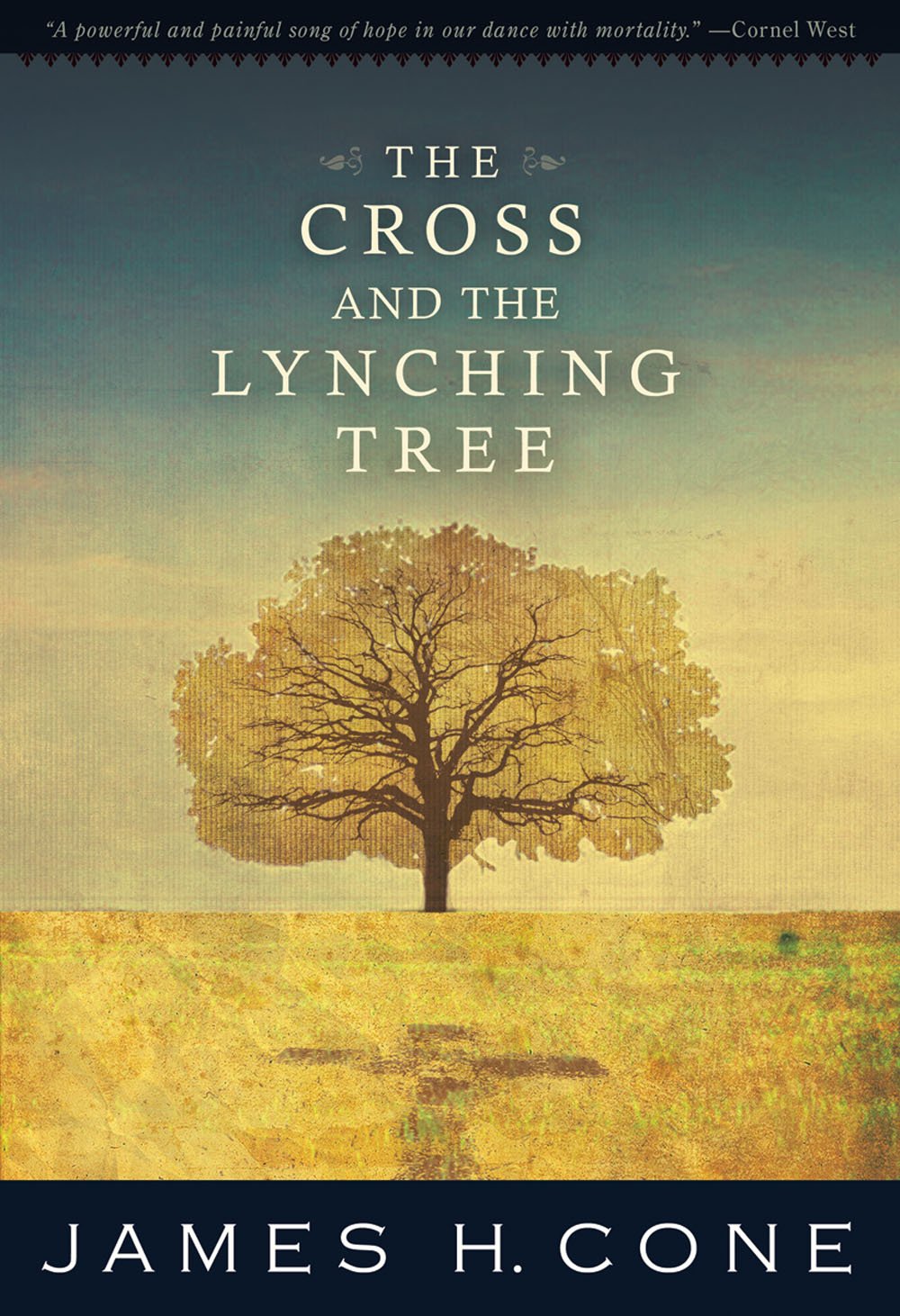
The Cross and the Lynching TreeJames H. Cone’s book The Cross and the Lynching Tree (Orbis, 2013) is both history lesson and sermon—a harrowing look at America’s national crime (as Ida B. Wells called it) and the ways it was (and was not) confronted as well as a brotherly rebuke of the white church’s silence on the issue and a proposal for how to move forward.

The two most representative and emotionally charged symbols of black experience in America, the cross and the lynching tree interpret each other, Cone says. The black community understood this; they embraced the cross of Christ in all its paradox, finding hope and empowerment in knowing that just as death did not determine Christ’s final meaning, so neither would lynching have the final word for them. But this symbolic link doesn’t serve only African Americans; people of all races would do well to ponder it and flesh it out, as it promotes a rich theology of suffering and a helpful base for race relations within the church. And in fact Cone doesn’t see such reflections as optional; he considers them necessary for the sake of the gospel:

The cross and the lynching tree are separated by nearly two thousand years. One is the universal symbol of the Christian faith; the other is the quintessential symbol of black oppression in America. Though both are symbols of death, one represents a message of hope and salvation, while the other signifies the negation of that message by white supremacy. Despite the obvious similarities between Jesus’ death on the cross and the death of thousands of black men and women strung up to die on a lamppost or tree, relatively few people, apart from the black poets, novelists, and other reality-seeing artists, have explored the symbolic connections. Yet, I believe this is the challenge we must face. What is at stake is the credibility and the promise of the Christian gospel and the hope that we may heal the wounds of racial violence that continue to divide our churches and our society. . . .

Until we can see the cross and the lynching tree together, until we can identify Christ with a “recrucified” black body hanging from a lynching tree, there can be no genuine understanding of Christian identity in America, and no deliverance from the brutal legacy of slavery and white supremacy. (xiii-xiv, xv)
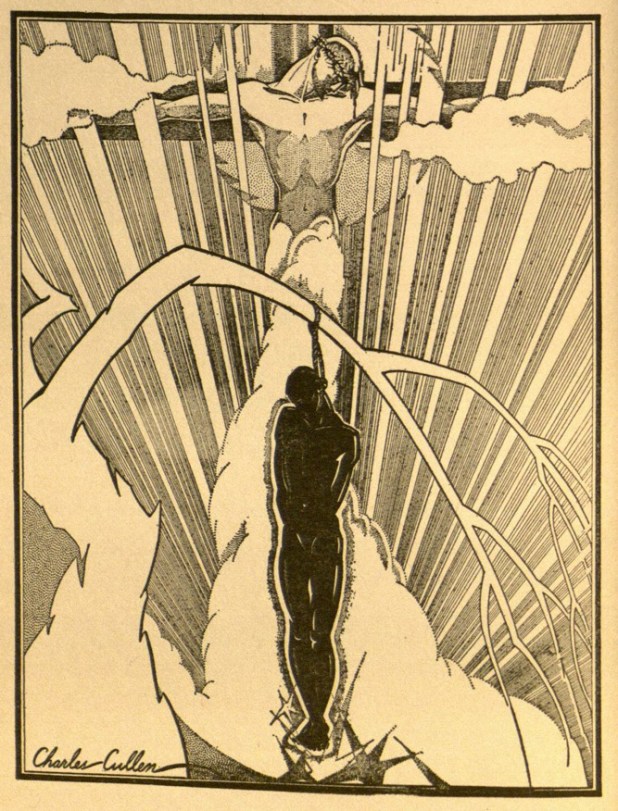
Illustration by Charles Cullen. Frontispiece to Countee Cullen's The Black Christ and Other Poems, 1929.

Illustration by Charles Cullen. Frontispiece to Countee Cullen’s The Black Christ and Other Poems, 1929.

The Cross and the Lynching Tree integrates four different modes of writing—historical analysis, polemic, literary and visual art exegesis, and theological treatise—woven together into one vibrant, seamless cloth. I will examine each of these below.  Continue reading

Posted in Books, History, Politics | Tagged , , , , , , | 10 Comments

Tee Time: Jesus. That is my final answer.

T-shirt_Jesus is my final answerFound at rakuten.com.

Posted in T-shirts | Tagged , | Leave a comment

Art news updates

Who Is My Neighbor?

In February I promoted a two-day visual arts conference organized by Eyekons called “Who Is My Neighbor?”, to take place the Friday and Saturday after Easter in Grand Rapids, Michigan. Now all the speakers and topics are confirmed, and a video promo has been produced, so I just want to encourage you to look into this opportunity again if it’s something you’re interested in.

I really want to go, but though the actual conference cost is reasonable, the airline ticket and hotel room costs make it unaffordable for me. If it were in Boston, I’d be all-in! (Eyekons, if you’re reading this, I can hook you up with some Boston-area churches for next year!)

Two artists whose work I have long admired—Steve Prince and Linda Witte Henke—will be there, plus many more, representing a wide range of media, including painting, printmaking, mosaic, paper cutting, calligraphy, and textile art. Continue reading

Posted in Western Art | Tagged , , , | Leave a comment

Tee Time: Called to Duty

T-shirt_Called to DutyFound at kerusso.com.

Posted in T-shirts | Tagged , | Leave a comment

“O Christ, What Burdens Bowed Thy Head”

I love discovering old hymns of the faith and incorporating them into my private worship. I’ve realized only in the last few years how vast the trove is, and I’m grateful for contemporary musical artists who sift through it, dusting off old gems and making them shine for today.

Thanks to Aaron Hale, whose retuning of “O Christ, What Burdens Bowed Thy Head” has made the hymn more accessible to modern ears and has really drawn out the beauty of the original text. He released the song in April 2011 on his album Lenten Hymns, Vol. 1, available for free download from his website.  Continue reading

Posted in Music, Poetry | Tagged , , , , | Leave a comment

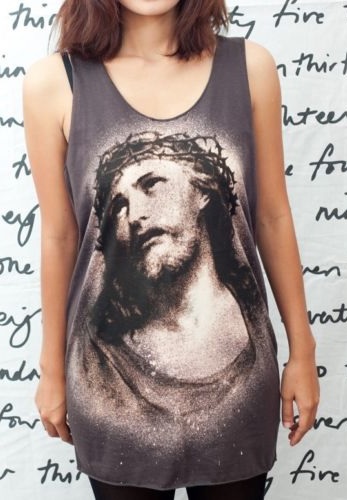
Tee Time: Man of Sorrows

T-shirt_Man of SorrowsThis one’s not technically a tee, it’s a tank, but I think it merits inclusion.

Found at ebay.com.

Posted in T-shirts | Leave a comment

A Brief History of Chocolate Jesus

Jesus and chocolate. I love both. So when I heard the song “Chocolate Jesus” for the first time last week (on a podcast about religious kitsch), it sounded yummy. The song is satirical, but as I listened to it, I thought, I bet candy makers have actually tried this. And sure enough, they have.

Besides making a splash in the folk rock world (in the world of candy sales, not so much), chocolate Jesus has also cropped up in at least three works of visual art in the last twenty years, the most recent one garnering a firestorm of media attention.

This list is not comprehensive, but here’s what I could dredge up in the way of chocolate Jesuses.

Chocolate Jesus in the Visual Arts

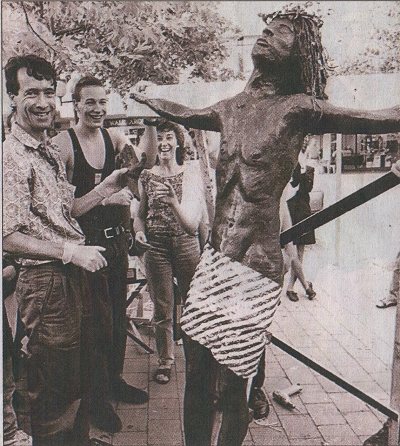
Trans-substantiation 2, sculpture by Richard Manderson (1994)

In 1994, philosophy student Richard Manderson created one hundred jam-filled, Jesus-shaped chocolates, which he sold at an arts center gift shop in Canberra, Australia. No one thought much of it . . . until a condemnatory headline in a US newspaper prompted Manderson to do something more outrageous: create a life-size chocolate Jesus for public consumption. He did so by filling a plaster mold with fifty-five pounds of melted chocolate. He used chocolate-dipped strings for hair and plastic Easter wrap for a loincloth. After Easter, Manderson invited people to come eat the immaculate confection.

Irony was behind his production of the original candies, and it was behind his decision to go large scale as well. Although not a Christian, Manderson said he was disappointed that secular culture has turned Lent and Easter from a time of solemn spiritual reflection into a time of sugary indulgence. The title of his sculpture, Trans-substantiation 2, is a reference to the Catholic doctrine that states that during the Eucharist, the sacramental bread and wine turn into the literal body and blood of Christ. During this time of year, suggests Manderson, Jesus’s body transubstantiates into chocolate; the awesome weight of his death and resurrection is edged out by airy, candy-based festivities in schools, stores, and homes. This ought not to be.

Manderson’s sculpture challenges us to join those who use this time to fast rather than consume. That’s not to say we must be anti-sweets but only realize that sweets are not the true substance of Easter.

Continue reading

Posted in Books, Controversial Art, Jesus Kitsch, Music, Pop Culture | 1 Comment

Tee Time: All I need today is a little bit of coffee . . .

All I need today. . . and a whole lot of Jesus!

Found at skreened.com.

Posted in T-shirts | Tagged , | Leave a comment

“Faith in Drag” podcast: on the role of images in Christianity and Hinduism

Encounter is a Sydney-based radio documentary feature program that seeks to explore the connections between religion and life. Two weeks ago they aired an episode, hosted by Allison Chan, that includes interviews with religious gift shop workers, Christian and Hindu clergypersons and lay practitioners, and artists—all of whom had something to say about the use of religious objects, from statues to bread stampers, in daily life. Click here to listen to the audio. I highly commend it to you—it has really reshaped my attitude toward kitsch and has given me a better understanding of Hindu spirituality.

Here is an annotated outline with guest names and time stamps.

Religious Merchandise

1:10: Noni Daniels, joint CEO of the store Holy Kitsch!, explains the appeal that devotional objects have for her, even though she’s not religious.

2:21: Sister Christine Pisani of the Sister Disciples of the Divine Master in Sydney talks about the artwork of Sister Angelica Ballam, for sale at their Liturgical Center, and about the Catholic theology of images.

Sensory Experience in Protestant Church Interiors

4:30: Bishop Robert Forsyth of the Anglican Diocese of South Sydney comments on Protestants’ justified caution toward images.

5:18: Rev. Dr. Rod Pattenden, pastor, art historian, and Chair of the Blake Prize, reflects on the church’s history of violence against religious images. He describes the sparse, white-walled churches that came out of the Protestant Reformation as “utterly boring” and a hindrance to experiencing transcendence.  Continue reading

Posted in Non-Western Art, Pop Culture, Popular Art, Theology, Western Art | Tagged , , , , , | 1 Comment

Tee Time: Jesus . . . he scares the hell out of you!

Jesus scares the hell out of youFound at zazzle.com. (Incidentally, a middle school student from Missouri was sent home for wearing a shirt with this saying, because it was deemed offensive.)

Posted in T-shirts | Tagged , | Leave a comment