“Kumbaya” began as the sincere plea of a generation of African Americans for God’s intervention, but since entering popular culture in the 1950s it has become a metaphor of naive optimism or corny camaraderie and thus a term of derision, levied most often against peace activists and politicians. How did this happen? And why do we tolerate this disparagement of the black religious experience in America?
The precise origins of the song are unclear, but most ethnomusicologists believe it originated with the Gullah people (also called Geechee), the descendants of enslaved Africans who live on the Sea Islands and in the coastal regions of South Carolina and Georgia. (Perhaps you remember the kids’ TV show Gullah Gullah Island? I do! With much fondness.) The Gullah developed their own creole language, based on English but with strong influences of West African languages. The words “Kum ba yah” mean “Come by here”in Gullah. “Come by here, my Lord,” the Gullah people sang as they suffered under the Jim Crow regime. “Come by here.” Continue reading →
“Unfortunately, the past century has systematically produced a culture of artists who believe their greatest responsibility is to be true to themselves, and not to a truth which exists outside of them. They are taught that to grow as artists they need to enter more and more into their own emotions and values, whereas the great artists of the past immersed themselves in universal values and spent a lifetime pursuing absolute truth. They strove to learn what their culture had to teach them, and then gave back this wisdom through their art.
“Today’s artists too are learning and giving back, but rather than being formed according to objective truth, they are being convinced that truth is relative. Their art reflects this relativism, which is especially harmful to the communication of morals and human values. This relativism creates stories that devalue human beings and provide the foundation for social ills.”
Here are a few noteworthy articles on sex-related topics: prostitution, human trafficking, sex addiction, masturbation, and pornography—they’re all tied together. And then there’s one that considers physical release as a husband’s primary motivator for pursuing sex—is this good, bad, or neither?
“Pretty Woman and Why You Judge ‘Prostitutes’” by Lore Ferguson: Prostitution is never chosen, never glamorous, and if you think you’re helping a young woman make a living by paying her for sex, think again. It’s time to let go of the Pretty Woman myth and to own up to your enablement of the modern-day slave trade.
“Masturbation and the Spiritual Life” by T. C. Ryan: With openness and sensitivity, Ryan posits that masturbation, for the most part, is an unhealthy practice that runs counter to the function of human sexual expression. In its one-sidedness, it is selfish and isolating. A God-honoring sexuality, on the other hand, is focused more on giving than receiving; it is kind and protective of others and promotes intimacy.
“The Thing About Sex” by Tim Challies: Pastor Challies lays out a Bible-based theology of sex, using this oft-posed question as his starting point: “You speak of sex like it is a pure and holy thing. Yet when my husband wants to have sex with me, I feel like he is just responding to bodily urges and wants to use me as a way to relieve those urges. It’s all about the release. What is holy about this?”
This is a guest post written by David Kwabi, a PhD candidate in mechanical engineering at MIT, and Tout Wang, a PhD candidate in physics at Harvard University. Both men are interested in exploring the intersection between science and faith.
This past Sunday, Christians around the world celebrated Easter. The occasion recalls a time two thousand years ago when, according to the New Testament accounts, a man named Jesus was condemned to death by crucifixion in Jerusalem. It would be strange to make a celebration out of such an event, except the accounts also record that three days later, Jesus rose from the dead, leaving behind an empty tomb and an initially bewildered but ultimately emboldened group of disciples who began announcing his resurrection to the rest of the world.
On a campus committed to rigorous scholarship, an occasion like Easter raises questions for believers and skeptics alike. What are we left with, for instance, when we read a holy book like the Bible under the unforgiving light of rationalism instead of according to religious dogma? Does the resulting portrait of Jesus look anything like that of Christian tradition? How are we to think about the resurrection of Jesus, which lies at the very heart of the celebration of Easter but which defies our scientific understanding of how the world works?
By the standards of a modern biography, we know almost nothing about Jesus. We have no descriptions of his appearance, nor do we know much about his family life beyond the names of his parents and four brothers. The New Testament accounts describe his birth, include a lone anecdote about a childhood episode at the temple, and then skip ahead by more than two decades to the final few years of his life. With so much lacking in the portrait we have of Jesus, there are those who would go as far as to suggest that he was an entirely mythical figure, conjured out of thin air as a deity not unlike one of the Greek gods.
Yet in the context of serious historical research, we know more about Jesus than about any other individual from that era. Whereas we derive our knowledge of ancient rulers sometimes from just a single coin inscription or a scrap of papyrus, there are more than forty different authors who mention Jesus within 150 years of his life—the writers of the New Testament, early church figures, a prominent Jewish historian named Josephus, several Roman intellectuals, and more. To put this in perspective, we have many more sources writing about Jesus than about the Roman emperor at the time, Tiberius Caesar. Moreover, in perhaps one of the great ironies of history, the only mention by any Roman historian of Pontius Pilate, the governor of Palestine, was in reference to his role in the crucifixion of Jesus. Consequently, the consensus among credible scholars of the New Testament is that there was most certainly a man named Jesus who roamed the region of Palestine, teaching, preaching, amassing a substantial following, and eventually being condemned to death by crucifixion as an enemy of Rome. This is as much a fact of history as anything from the ancient world can be. Continue reading →
Water shows up a lot in the Christian scriptures and, along with bread and wine, is central to the sacramental life of the church. In the rite of baptism, it signifies purification or cleansing, even as it signifies too the burial of the old man and the rising of the new.
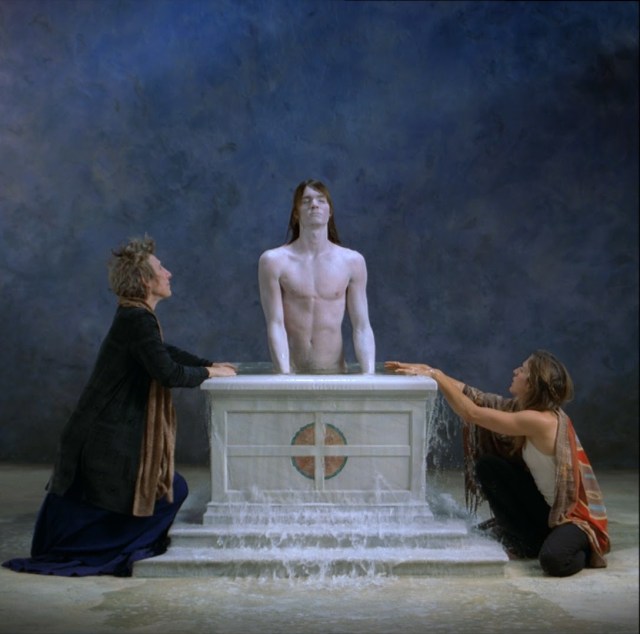
Bill Viola riffs on these and other connotations in his video art piece Emergence, created in 2002 at the commission of the J. Paul Getty Museum. The piece is part of The Passions series, the aim of which is to explore the power and complexity of human emotion.
Click here to see a nine-photo study for Emergence. (Warning: contains nudity.)
The video shows two women sitting on either side of a large marble receptacle, each absorbed in her own grief. Then to their surprise, a man starts rising up out of it, pale and nude, unleashing a cascade of water. He stands at full height, then totters and falls; the women catch him and help him gently to the ground. They then cover him with a cloth, one overcome by tearful emotion, the other tenderly embracing his body.
These actions unfold in extreme slow motion over a span of eleven minutes and forty-nine seconds. Viola uses this slow playback technique in much of his work because, he says, he wants the viewer to notice every subtle shift of movement and emotional expression. In our fast-moving world and even in film, such things are barely perceptible.
In the original installation, the video was rear-projected on a wall-mounted screen in a dark room. A low-quality YouTube clip viewed on a computer is a poor substitute, but I show it here to give you an idea of Viola’s vision.
CONTENT ADVISORY: Video contains nudity.
A child of postmodernism, Viola embraces ambiguity; he said he doesn’t want to lock his works into any one meaning but rather prefers their meaning to remain fluid and unstable.
This expansive approach to imagery is evident in Emergence, a work that poses more questions than answers. Where is the scene taking place? Who are the two women? What is their relationship to each other, and to the man? From where is the man emerging? Is he alive—a newborn? or one being reborn?—or is he dead, a victim of drowning? The water can support either reading, being seen as either an agent of life—that is, the amniotic fluid that cushions and nourishes the child in preparation for his birth—or an agent of death, a flood that fills the lungs, chokes the breath, and crushes the body. Continue reading →










 The Jesus Question