The Henna Gospel

Christian blogger hmsarthistorian wrote a great post recently featuring the art of Kimberly Stephens. The post includes a transcript of his missiologically focused interview with her. Read it here.

Last October, Stephens exhibited a series of 18 paintings at the L&P Hutheesing Visual Arts Centre in Ahmedabad, India. The exhibition was called “A True Story,” and it documented, through symbols, different Christward-pointing stories from the Bible. But what is unique about the paintings is that they are acrylic and mehndi on canvas. Mehndi is the Hindi word for “henna,” a powder taken from the leaves of a henna plant and made into a paste, then applied to the skin as a form of decoration.

Henna handsMehndi body art is popular throughout the Middle East, Africa, and South Asia, especially in India. It is used for special occasions. For example, in traditional Indian weddings, the bride will have a henna party the night before the ceremony, during which her hands and feet are painted with fine-lined lacy, floral, and paisley patterns. Other occasions for use include pregnancies, births, circumcisions, and religious holidays. Continue reading

Posted in Non-Western Art | Tagged , , , , , , | 1 Comment

‘Submerged and shining’

Andres Serrano, Piss Christ, 1987. Cibachrome, silicone, plexiglas, wood frame, 60 x 40 in.

Andres Serrano, Piss Christ, 1987. Cibachrome, silicone, plexiglas, wood frame, 60 x 40 in.

Last week, Andres Serrano’s photograph Piss Christ, on display at the Lambert Gallery in Avignon, was vandalized by Christian fundamentalists. The three vandals physically threatened museum guards, then took a hammer to the plexiglass in front of the artwork and slashed the photograph with a screwdriver or an ice-pick. (See news photo and story here.)

The photograph, created in 1987, shows a plastic crucifix submerged in a glass of the artist’s urine. Serrano, a Catholic, said that he meant it as a criticism of the “billion-dollar Christ-for-profit industry” and a “condemnation of those who abuse the teachings of Christ for their own ignoble ends.” Many Christians, though, take serious offense at the piece, as they consider it blasphemous.

My initial reaction when I saw this photograph for the first time, in high school, was offense. Not outrage, just offense. And really, that offense stemmed more from my disgust with how the piece was created, not necessarily because I had moral objections.

Sister Wendy Beckett, an art expert of BBC fame, said in a 1997 interview with Bill Moyers that she’s not going to automatically dismiss the work as blasphemous because she believes that it can have a devotional impact, an upbuilding effect, on viewers if they let it. She said, for example, that seeing it makes her want to reverence the death of Christ even more, because it reminds her, and makes her feel ashamed, that people (herself included) so often scorn his sacrifice through their actions. “This is what we are doing to Christ,” she says. “We’re not treating him with reverence, his great sacrifice is not used, we live very vulgar lives, we put Christ in a bottle of urine, in practice.” While the work is not great art, she says, it is at least admonitory.

Continue reading

Posted in Controversial Art | Tagged , , , | 3 Comments

Peanut Butter Banana Jesus

Banana Jesus“Whoso eateth my soft, pulpy, banana flesh…” (John 6:54)

Found at Jesus Needs New PR.

Posted in Jesus Kitsch | Tagged , | 1 Comment

Alive Because He Is

I am the resurrection and the life.  He who believes in me will live, even though he dies; and whoever lives and believes in me will never die. Do you believe this?”  -John 11:25-26

“Don’t you know that all of us who were baptized into Christ Jesus were baptized into his death?  We were therefore buried with him through baptism into death in order that, just as Christ was raised from the dead through the glory of the Father, we too may live a new life.”  -Romans 6:3-4

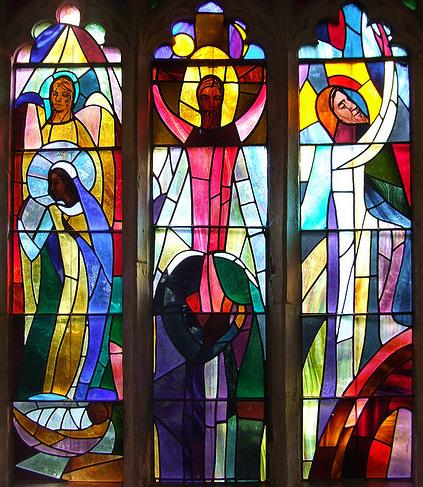
Jesus resurrection

Rosemary Rutherford, "The Empty Tomb, Crucifixion, Resurrection," c. 1971, St. Mary's Church, Hinderclay, Suffolk, England

The death and resurrection of Jesus form the entire basis of Christianity, for it is through these two historical events that God reconciled mankind to himself—crushing the power of sin and death, which had held us separate, once and for all—and laid the foundation for the New Creation.  There are a lot of theological buzzwords associated with the Easter message—atonement, redemption, justification, imputation of righteousness, regeneration—but today I’d like to single in, just for a moment, on the liberating impact of Jesus’ death and resurrection.  Continue reading

Posted in Theology, Western Art | Tagged , , | Leave a comment

Gethsemane, Part 8: Indigenous Interpretations

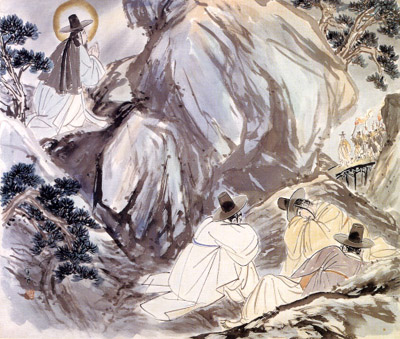
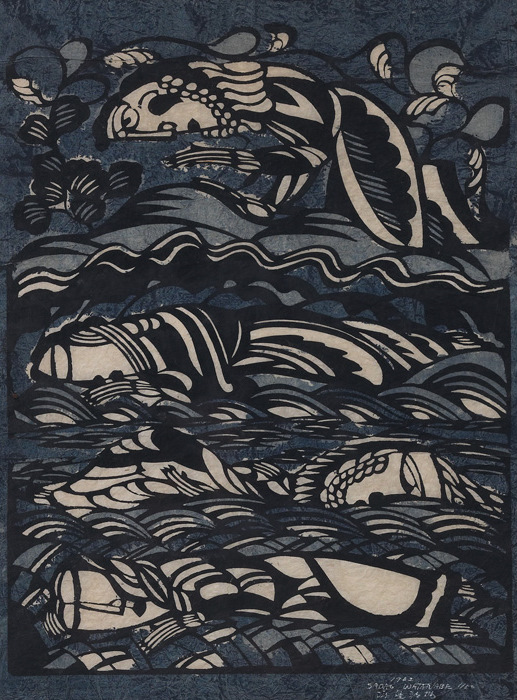
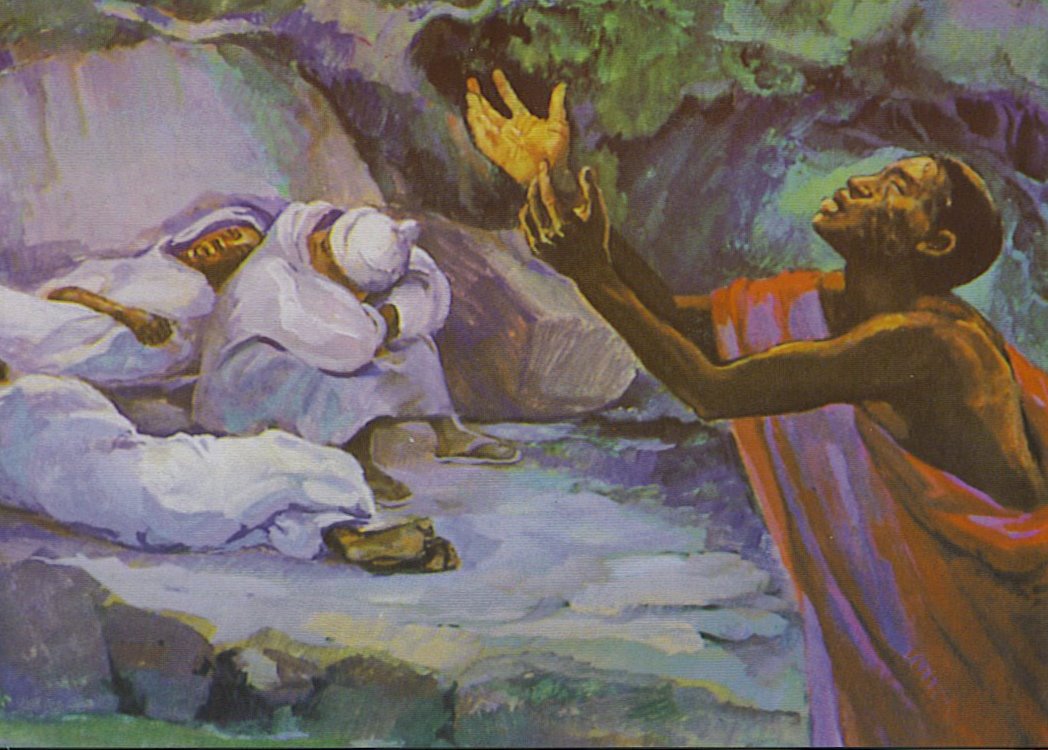
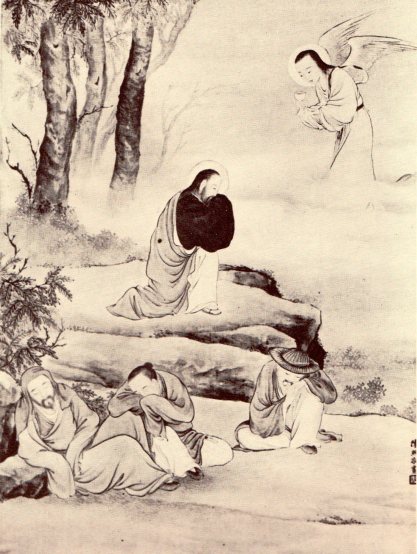
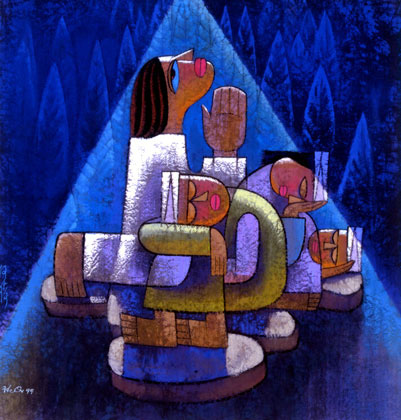
This is my last post on Gethsemane, and I’d like to devote it to the presentation of some indigenous interpretations of the event.  In the Christian art of other countries, Gethsemane is treated far less frequently than other events in the life of Christ, like the nativity and the last supper.  (Madonna and Child portraits, though, tend to be the most common.)  But I was able to find these few pieces of art on the topic (in addition to the two contemporary paintings I discussed in a previous post—from Indonesia and Uganda).  Note how each artist gives Jesus native features, clothes him in native dress, and places him in a native environment.
Christ in Gethsemane

Luke Ch’en, “Gethsemane,” 1928 (China). Source: Each With His Own Brush by Daniel Johnson Fleming
Christ in Gethsemane

He Qi, “Praying at Gethsemane,” 1999 (China). Source: HeQiGallery.com

Christ in Gethsemane

Ki-chang Woonbo Kim, “Christ in Gethsemane,” 1952-53 (Korea). Source: woonbokorea.co.kr

Christ in Gethsemane

Sadao Watanabe, “Garden of Gethsemane,” 1962 (Japan). Source: liveauctioneers.com

Christ in Gethsemane

Jyoti Sahi, “Gethsemane,” 1983 (India).  Source: jyotiartashram.blogspot.com

Christ in Gethsemane

“Gethsemane,” 1973 (Cameroon). Source: Jesusmafa.com
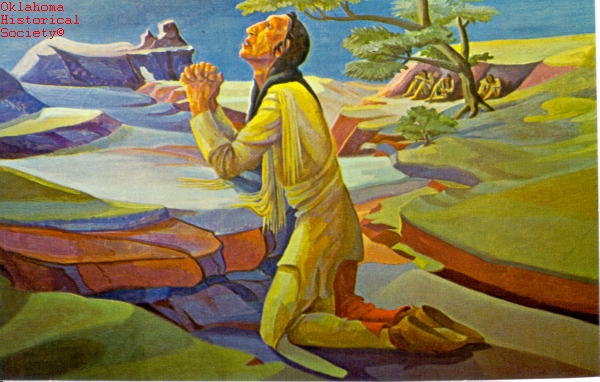
Christ in Gethsemane

Walter Richard West, “Gethsemane,” 1954 (American Indian, Cheyenne). Source: Oklahoma Historical Society’s Encyclopedia of Oklahoma History & Culture

You may find it odd that these artists have chosen to depict Christ as Chinese, Japanese, and so on, but they probably find it just as odd that Americans depict him as American—white-skinned, wavy-haired, and blue-eyed—or cling instead to the Italianate Jesuses of the Renaissance.  What makes the American or European version of Christ any more valid than another country’s or people’s?  The majority of Christians have fixed Jesus in their minds as a Westerner, forgetting (or ignoring) the fact that he was Middle Eastern—a Jew from Palestine.  So is it right to displace him from his racial and cultural context so that we might adapt him to our own, and make him look just like ourselves?

This question is a loaded one, and I’m posing it now so that you can think about it for a while, as it is one of the main questions I hope to answer over the course of this blog.  For now, I just want you to start thinking about your picture of Jesus, and how much it is shaped by the culture you live in.  (And by “picture” I mean a visual idea, yes, but I’m also talking about your picture of Jesus’ whole person—personality, goals, values, and all.)

Posted in Non-Western Art | Tagged , , , , , | 1 Comment

Gethsemane, Part 7: An Abstract Perspective

Christ in Gethsemane

3TTman, “First Station: Jesus in the Garden of Gethsemane,” 2010

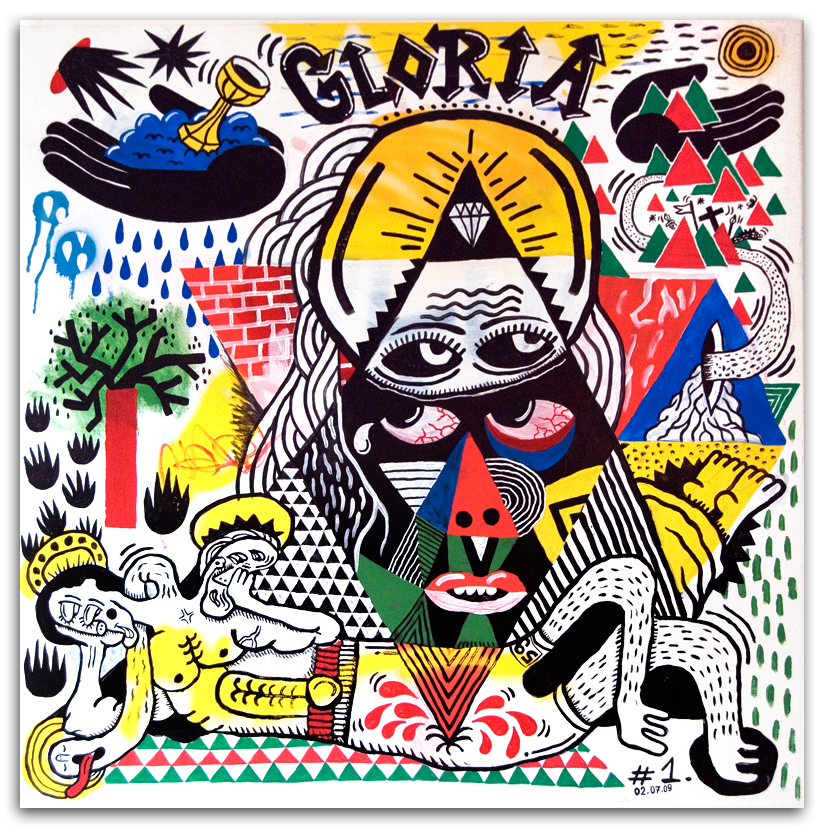
This painting is part of a Stations of the Cross series by French street artist 3TTman.  He said he’s intrigued by religious symbology, the art of expression by symbols, which is why he chose to tell the story of Christ’s crucifixion wholly through them.

Although I can’t say definitively what the artist meant to represent with each of these symbols, the painting as a whole obviously represents the sorrow that was experienced, by Son and Father, in Gethsemane—but also the glory that accompanied it.  (And lest you think I’m a clever interpreter of abstract art—no, not really, the title just tipped me off.)  Continue reading

Posted in Western Art | Tagged , , , | 2 Comments

‘Sweet Jesus,’ it’s a PEEPshow!

Jesus made of peeps

Heather Hodge and Brad Conn, "Sweet Jesus," 2011

Here’s a timely Jesus, made up entirely of marshmallow Peeps!  Found by Marcus G.  (Thanks, Marcus!)

This Peep art was sponsored by the Carroll County Arts Council of Maryland.  Check out their flickr page for the other entries in last week’s fourth annual PEEPshow.

And take a minute to thank Jesus for being such a sweet Savior.  🙂

Posted in Jesus Kitsch | Tagged , , | 2 Comments

Gethsemane, Part 6: Covered by Angels

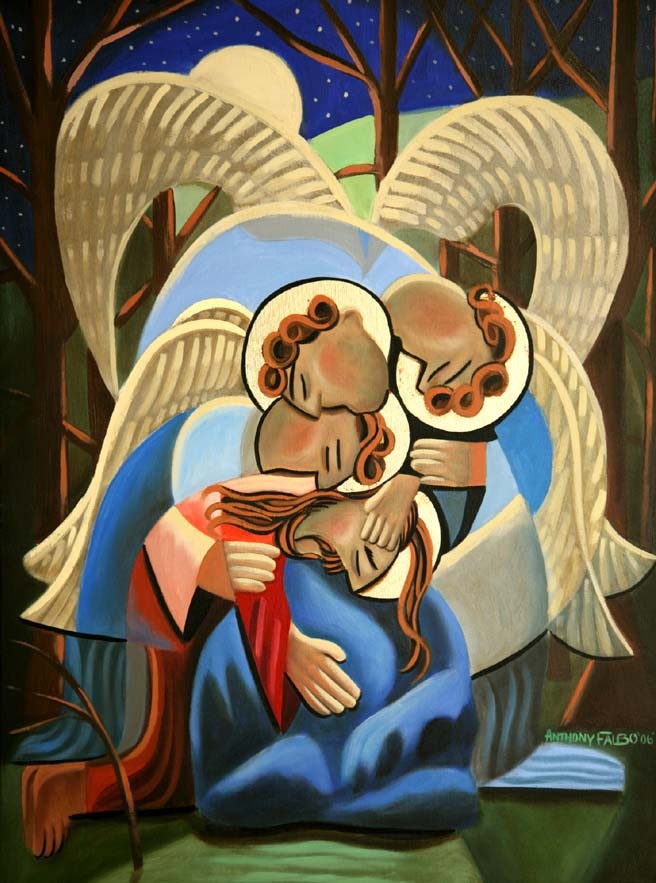
“Jesus went out as usual to the Mount of Olives, and . . . an angel from heaven appeared to him and strengthened him.” —Luke 22:39, 43

Christ in Gethsemane

Anthony Falbo, Gethsemane (The Hour is Near), 2006. Oil on canvas.

Luke is the only one of the Gospel writers to mention that in response to Jesus’s pained pleas in Gethsemane, an angel came down to strengthen him. American artist Anthony Falbo renders this moment of heavenly condescension in his painting Gethsemane (The Hour is Near). Unlike other artistic depictions of the same event, this one seems profoundly personal. The angels are not smiling on from a distance, enclosed in a giant orb of light, with arms outstretched but making no contact. To the contrary: the weight of these angels’  bodies falls firmly but gently on Christ as they enwrap him round about. They close their eyes, as if they’re trying to absorb his pain, to feel it along with him. They’re conduits of the Father’s comfort, for it is he who sent them down, to strengthen his Son in his moment of weakness. Continue reading

Posted in Western Art | Tagged , , | 2 Comments

Gethsemane, Part 5: Angry Jesus, Rockin’ It Out in the Garden

We’ve heard what the Gospel writers said about Jesus in Gethsemane. Now it’s time to examine a Hollywood perspective. In 1973, the rock opera Jesus Christ Superstar hit the big screen, with actor-singer Ted Neeley playing Jesus. One of the most tension-filled scenes in the movie is the scene in Gethsemane, during which Jesus expresses his bitterness, anger, and confusion toward God the Father. (The lyrics can be found here.) This movie is definitely worth watching, if for nothing else, then simply to consider the contemporary portrait it paints of Jesus.

Continue reading

Posted in Film | Tagged , , , | 2 Comments

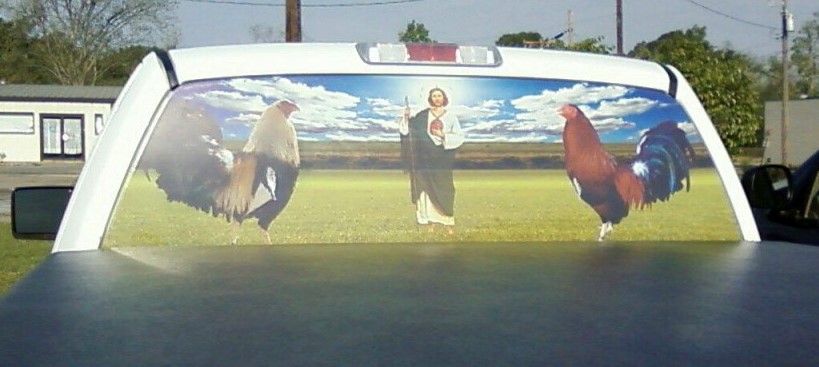
‘I Now Pronounce You Rooster and Hen’

A favorite daily amusement of mine is visiting the blog Jesus Needs New PR, maintained by Christian author Matthew Paul Turner. Among other things, Matthew posts photos of all the Jesus junk he encounters, many of which are submitted by his readers.

Here are just a few from this week:

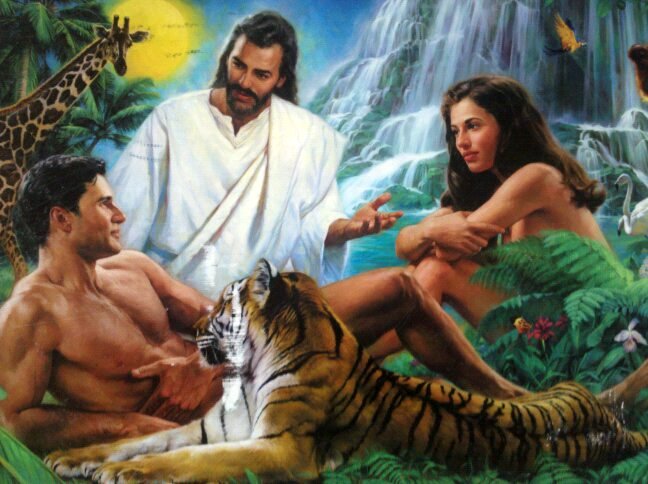
Jesus with Adam and Eve

I . . . don’t even know how to respond to these. I’ll just let the comments on Matthew’s posts speak for me.

OK, one more:

Update, 10/23/13: I discovered that the second image is a painting by Nathan Greene called The Introduction. On another note, Jesus Needs New PR is now defunct; Turner now blogs at www.matthewpaulturner.com.

Posted in Jesus Kitsch | Tagged , , | Leave a comment