
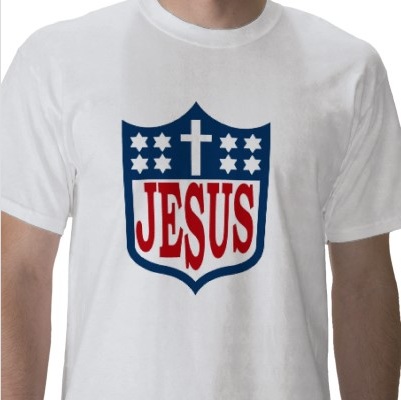
 I’m not sure I understand the comparison here. Jesus is like football . . . in what ways?
Found at zazzle.com.
I’m not sure I understand the comparison here. Jesus is like football . . . in what ways?
Found at zazzle.com.
 My latest read is Imaginary Jesus by Matt Mikalatos.
Here’s the book description from Amazon:
Imaginary Jesus is an hilarious, fast-paced, not-quite-fictional story that’s unlike anything you’ve ever read before. When Matt Mikalatos realizes that his longtime buddy in the robe and sandals isn’t the real Jesus at all, but an imaginary one, he embarks on a mission to find the real thing. On his wild ride through time, space, and Portland, Oregon, he encounters hundreds of other Imaginary Jesuses determined to stand in his way (like Legalistic Jesus, Perpetually Angry Jesus, and Magic 8 Ball Jesus). But Matt won’t stop until he finds the real Jesus—and finally gets an answer to the question that’s haunted him for years. Be warned: Imaginary Jesus may bring you face-to-face with an imposter in your own life.
And the book trailer:
I came across the book’s website when I was searching for something or other a few weeks ago. I was intrigued by the concept: a host of Jesus imposters, in the flesh, trying to win the loyalty of one Matt Mikalatos. This concept, however, is very oddly executed in the book. Continue reading
(To find out more about Charles Sheldon’s novel In His Steps, the inspiration behind the WWJD craze, read Part 1.)
Some people object to even asking the question “What Would Jesus Do?”, for various interrelated reasons. Charles Sheldon didn’t ignore these objections. In fact, he gave voice to a lot of them through his characters, all of whom express reservations, not just at the start, but throughout the novel, as they struggle to ask and answer this question in a consistent and honest way.
Here are five common objections to the question “What Would Jesus Do?”:
1. It’s impossible to answer definitively and without bias.
We don’t know what Jesus would do, and it’s as simple as that; any answer would just be our best guess, based, most likely, on our own preferences and beliefs, which color our interpretation of the Scriptures and of the character of Jesus. It’s presumptuous and arrogant, and it’s bad theology, to assume that your decided course of action is exactly the course that Jesus would take under your given circumstances.
In chapter 2 of In His Steps, singer Rachel Winslow admits to Pastor Maxwell, “I am a little in doubt as to the source of our knowledge concerning what Jesus would do. Who is to decide for me just what He would do in my case? It is a different age. There are many perplexing questions in our civilization that are not mentioned in the teachings of Jesus. How am I going to tell what He would do?” Pastor Maxwell responds by quoting John 16:13-15: “But when he, the Spirit of truth, comes, he will guide you into all truth. He will not speak on his own; he will speak only what he hears, and he will tell you what is yet to come.” In other words, the only way to arrive at an accurate answer is to listen to the promptings of the Holy Spirit, our “Counselor” and guide. Continue reading
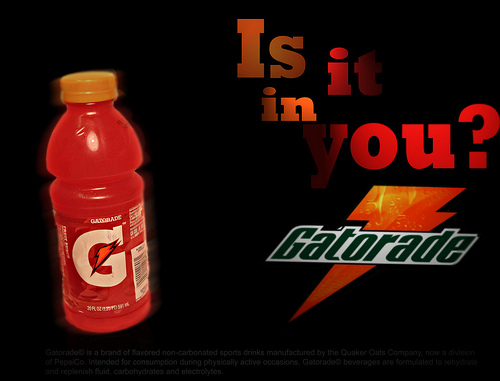
 This Virtuous Planet T-shirt brings together 1 John 4:4 and the Gatorade slogan.
From its beginnings in 1988, “WWJD” evolved from a simple motto teens used to cope with peer pressure, to a secular fashion fad, to a Christian market craze with endless spin-offs, to a much more loaded question that adults now use to try to influence public policy.
(For an introduction to this series, read Part 1: Origin of the Phrase.)
(NOTE: This post was updated on February 5 to reflect new information gathered from a phone interview with Ken Freestone on January 28, after his comment below. The original post incorrectly identified Janie Tinklenberg as the creator of the first WWJD bracelets. Tinklenberg, who took credit for the idea in interviews with The Independent, Scripps Howard, Christianity Today International, and other publications, did not respond to my interview request after one week. Dan Seaborn was unavailable for comment.)
______________________________________________________________
 When I was in fourth grade (’97/’98), WWJD bracelets were all the rage. All the cool kids were wearing them, Christian or not. For most people, they were more fashion statement than moral guide. I had two—one navy blue, and one rainbow-colored—and I guess for me, they were a little bit of both.
These bracelets first appeared in 1988, on the wrists of teenagers from Central Wesleyan Church in Holland, Michigan. Dan Seaborn, who was the youth pastor at Central at the time, had been using the phrase “What would Jesus do?” as a sort of slogan for his youth group, inspired by Charles Sheldon’s novel In His Steps. He wanted to have this slogan printed onto something that he could give the teens in his charge, something small that they would see regularly and be reminded of the commitment they had made to follow Jesus.
So he approached Mike Freestone of Packard Advertising Specialties to help him develop the idea. Mike’s brother, Ken Freestone, founder and owner of the company, also got involved. Together, the three men came up with the idea of reducing the slogan to a four-letter acronym and printing it on woven bracelets. The bracelets were manufactured by Woven-Line in Wisconsin, with a minimum order of 100. Continue reading
There’s not much else I can add to these two well-stated calls to authentic discipleship. I’ll only emphasize the importance of personal touch in Jesus’ ministry, something that many Christians tend to avoid. We like our ease and our comfort too much. If we serve “the untouchables” at all, it’s often by proxy.
God, please forgive me for my selfishness and my apathy. Give me the courage to be the disciple you called me to be. Help me to look outward always with compassion in my heart, healing in my hands, and gospel hope in my mouth.
Now hear from pastor Charles M. Sheldon:

Nyoman Darsane, “Give Me a Taste of Rice,” 2004. Acrylic on canvas, 32.5 x 29 in.
“The depth of winter found Chicago presenting, as every great city of the world presents to the eyes of Christendom, the marked contrast between riches and poverty, between refinement, luxury, ease, and ignorance, depravity, destitution and the bitter struggle for bread. It was a hard winter but a gay winter. Never had there been such a succession of parties, receptions, balls, dinners, banquets, fetes, gayeties. Never had the opera and the theatre been so crowded with fashionable audiences. Never had there been such a lavish display of jewels and fine dresses and equipages. And on the other hand, never had the deep want and suffering been so cruel, so sharp, so murderous. Never had the winds blown so chilling over the lake and through the thin shells of tenements in the neighborhood of the Settlement. Never had the pressure for food and fuel and clothes been so urgently thrust up against the people of the city in their most importunate and ghastly form. Night after night the Bishop and Dr. Bruce with their helpers went out and helped save men and women and children from the torture of physical privation. Vast quantities of food and clothing and large sums of money were donated by the churches, the charitable societies, the civic authorities and the benevolent associations. But the personal touch of the Christian disciple was very hard to secure for personal work. Continue reading
“What would Jesus do?” Christians have been asking themselves this question in one form or another since Christianity was founded. But in the 1890s, these four particular words became a household phrase for members of Central Congregational Church in Topeka, Kansas, who heard them preached Sunday after Sunday as the refrain of a series of “sermon stories” by pastor Charles Sheldon.
After these stories were published in 1896, “What Would Jesus Do?” became a worldwide trend among churches. The book sold millions of copies. A century later, the phrase became a secular craze, after being reduced to the acronym “WWJD” and printed on bracelets.
Now the phrase is a snowclone, which you can find adapted to everything from “What Would Jesus Drive?”, to “Who Would Jesus Bomb?”, to “What Would Bear (Grylls) Do?”. Most recently, it has been used as a slogan for the Occupy Wall Street movement. _____________________________________________________________
In His Steps is born
The imatio Christi ideal—imitating Jesus in his purposes, thoughts, and behavior—is as old as Jesus himself. “Follow me,” Jesus told his would-be disciples; “do as I do.” This idea is repeated throughout the New Testament. Continue reading
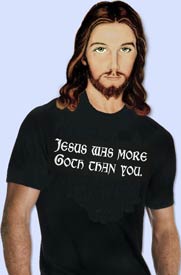

Here’s a transcription of the text on the T-shirt (the font is a bit hard to read):
Jesus was more Goth than you.
– he is referred to as Lord Jesus.
– he was into fishnet.
– he went to dens of iniquity.
– he had the gaunt look down.
– he was big on crucifixes.
– he was into body piercing.
– he was fascinated with the occult.
– he spent time in tombs.
– he was secretly a vampire.
– he was obsessed with Death.
Found at EvolveFish.com.


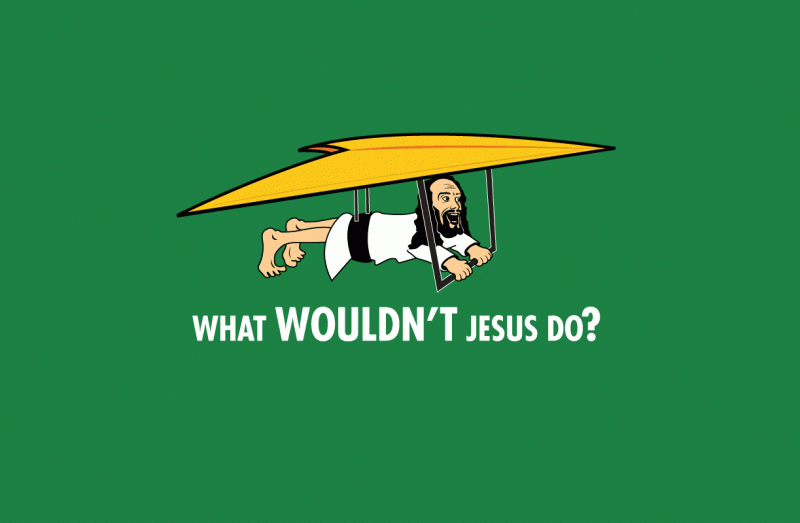
 The Jesus Question