Tee Time: Hii Saved Me

Hii Saved MeFound at goodnewsclothing.com.

Posted in Jesus Kitsch | Tagged , | Leave a comment

Jesus the Dancer, Part 4: Snakes and Maize

This is a guest post by an American artist who has an interest in nonwestern art but prefers to remain anonymous. I asked him to share some of his work with us.

‘He will crush [the serpent’s] head’

Dancing Jesus

Dancing Jesus, 2003. Acrylic on brown papyrus, 12 x  8.75 in.

Krishna subdues Kaliya

Krishna dances over the subdued Kaliya Naag in river Yamuna. From a Bhagavata Purana manuscript, c. 1640.

This painting is primarily a visual experiment based on South Asian Hindu art and Tibetan Buddhist thangkas. Jesus is dancing on (crushing) the head of Eden’s serpent (Genesis 3:15), much as Krishna does on the serpent Kaliya.

The body position of Jesus is derived from temple carvings at Angkor Wat in Cambodia, while his face is based on the site’s monumental smiling faces.  Continue reading

Posted in Non-Western Art, Theology | Tagged , , , , | 5 Comments

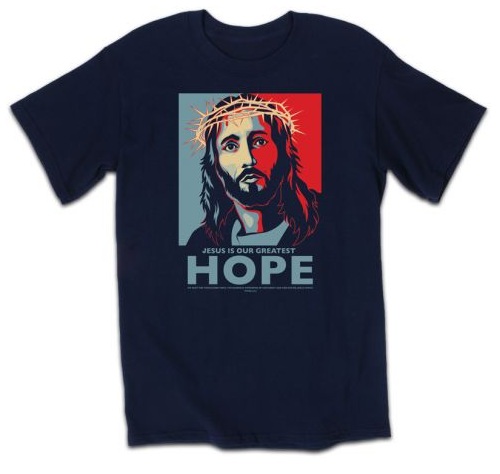
Tee Time: HOPE (a la the Obama campaign poster)

Jesus/Obama Hope posterA throwback to the 2008 U.S. presidential race.  And a reminder that we shouldn’t put all our trust in political officeholders to change the world.  They can do good, yes, but they can never offer the kind of lasting change and total world redemption that Jesus does.


T-shirt found at Christian T-shirts Planet.

Posted in Jesus Kitsch | Tagged , | Leave a comment

Jesus the Dancer, Part 3: “Tomorrow Shall Be My Dancing Day”

Here’s another English hymn—a Christmas carol, really—that characterizes Jesus as a dancer.  It’s medieval in origin, perhaps from a mystery play, but it wasn’t published until 1833, in William B. Sandys’s Christmas Carols, Ancient and Modern.  Since then, it has been adapted by several composers, the most well-known adaptation being John Gardner’s.


The hymn has eleven verses; the first one is a prologue, and the other ten recount significant events from Jesus’ life:  his conception, birth, baptism, desert temptations, ministry, betrayal, trial, crucifixion, resurrection, and ascension.  The speaker is Jesus, and he’s presumably speaking the day before his conception.  Tomorrow, he says, I will dance into a human womb, and grab the hands and hearts of my true love (his chosen bride, his church), as I invite her to dance with me.  As the lyrics point out, this is the motivation, the objective, behind all Jesus’ acts:  “to call [his] true love to [his] dance.”  Continue reading

Posted in Music | Tagged , , , | 2 Comments

Tee Time: I’m Coo-Coo for Christ!

Coo Coo for ChristFound at CoolFaith.com.


Posted in Jesus Kitsch | Tagged , | Leave a comment

Jesus the Dancer, Part 2: The Art of Jyoti Sahi

Our Lord is the Dancer, who, like the heat latent in firewood, diffuses His power in mind and matter, and makes them dance in their turn.
Tiruvatavurar Puranam (stanza 75), a fifteenth-century sacred text written by Kadavul Mamunivar; translated by Nallasvami Pillai (source)

The Supreme Intelligence dances in the soul . . . for the purpose of removing our sins. By these means, our Father scatters the darkness of illusion (maya), burns the thread of causality (karma), stamps down evil (mala, anava, avidya), showers Grace, and lovingly plunges the soul in the ocean of Bliss (ananda). They never see rebirths, who behold this mystic dance.
Unmai Vilakkam, vv. 32, 37, 39 (source)

The ‘Lord of the Dance’ or ‘Nataraja’ in the Shaivite tradition, is the Creator who is both a giver of life, but also a destroyer of all that stops us from being set free. He carries the fire of destruction and transformation, while at the same time assuring his disciples that they should not fear, and beating the drum of the rhythms of the Cosmos. As he dances he steps across the demon of darkness and blindness, showing the way to a new life.
—Jyoti Sahi (source)

Last week we looked at how an Englishman (Sydney Carter) perceived of Jesus as Lord of the Dance—how all Jesus’s activity, from his first creative act until today, is part of a series of rhythmic, patterned movements that express who he is, in an artistic and joyful way. And how he invites us all to join this dance, to be swept up into its steps, with him as the leader, showing us how to move, where to step, where to place our hands and feet, etc., while at the same time allowing us the freedom of spontaneous expression.

Today I will explore how Hindus perceive of Shiva as Lord of the Dance, and then consider how we might apply a similar characterization to Jesus, as does Indian Christian artist Jyoti Sahi in his woodcuts and paintings. First, though, it’s important to note that not all the characteristics of the dancing Shiva can be said to belong to Jesus. I am being purposely selective for the sake of focus.

Try not to get too bogged down by the foreign words and symbols. Just let Sahi’s art be your guide through this discussion. He is one of my favorite artists, and although some background information will likely enhance your appreciation of his art, you can still enjoy the art without it. Continue reading

Posted in Non-Western Art | Tagged , , , , , , | 7 Comments

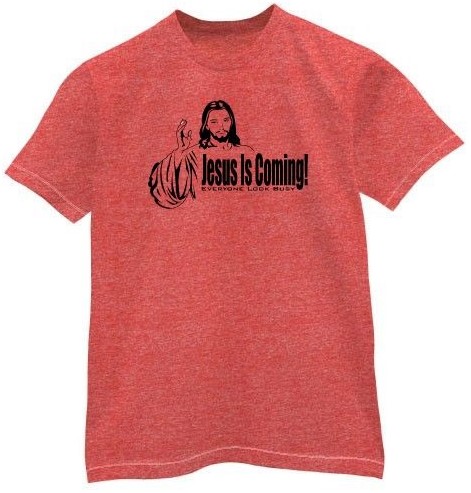
Tee Time: Jesus is coming! Everyone look busy.

Jesus is coming! Everyone look busy.Found at crazydogshirts.com.

Posted in Jesus Kitsch | Tagged , | Leave a comment

Jesus the Dancer, Part 1: Sydney Carter’s “Lord of the Dance”

When you think “Lord of the Dance,” perhaps the first image that comes to mind is this (or something of the like):

Lord of the Dance

This is what a Google search will spit out, at least.

But before it was the title of an internationally acclaimed Irish musical and dance production, “Lord of the Dance” was an English folk song written by Sydney Carter, adapted from the nineteenth-century American Shaker tune “Simple Gifts” by Joseph Brackett.  Carter wrote the song in 1963 and had it published in 1967.  Ronan Haridman adapted Carter’s song for Michael Flatley’s Lord of the Dance in 1996; the melody is used as a recurring theme throughout the show.

YouTube hosts several different video recordings of Carter’s song, but my three favorite are embedded below.

  1. The Dubliners:  This rendition is loud, animated, and raw, and I love it.  Jim McCann captures the celebratory spirit of the song perfectly.  The performers are, from left to right, Barney McKenna (banjo), John Sheahan (fiddle), Jim McCann (lead vocals, guitar), Sean Cannon (guitar), Paddy Reilly (guitar), and Eamonn Campbell (guitar).

Continue reading

Posted in Music, Non-Western Art, Western Art | Tagged , , | 10 Comments

Tee Time: I Can Do All Things Through Christ

I Can Do All Things through ChristFound at c28.com.

Posted in Jesus Kitsch | Tagged , , | Leave a comment

“In No Strange Land” by Francis Thompson

“The Kingdom of God is within you.”

O world invisible, we view thee,
O world intangible, we touch thee,
O world unknowable, we know thee,
Inapprehensible, we clutch thee!

Does the fish soar to find the ocean,
The eagle plunge to find the air—
That we ask of the stars in motion
If they have rumor of thee there?

Not where the wheeling systems darken,
And our benumbed conceiving soars!—
The drift of pinions, would we hearken,
Beats at our own clay-shuttered doors.

The angels keep their ancient places—
Turn but a stone and start a wing!
Tis ye, tis your estrangèd faces,
That miss the many-splendored thing.

But (when so sad thou canst not sadder)
Cry—and upon thy so sore loss
Shall shine the traffic of Jacob’s ladder
Pitched betwixt Heaven and Charing Cross.

Yea, in the night, my Soul, my daughter,
Cry—clinging to Heaven by the hems;
And lo, Christ walking on the water,
Not of Genesareth, but Thames!

When Francis Thompson wrote this poem in the 1880s, he was a homeless opium addict.  He slept every night on the streets of London—on the bank of the River Thames, or at Charing Cross junction. And yet despite all his suffering, he was still able to see and rejoice in the beauty of God.  Continue reading

Posted in Poetry | Tagged | 15 Comments