This is part 3 of a series on Christian art of the Pacific Northwest Coast. Read part 1 here.
“In the absence of a written language, the Indians of the Northwest had preserved their stories and events carved from cedar logs. They were the nearest thing people had to books. The characters on a totem pole provide an outline so that, after hearing the story, listeners can read the pole for themselves.”
—David K. Fison (quoted in an article by Mike Dubose, United Methodist Communications, November 13, 2000)
The greatest story ever told . . . now available in totem pole.
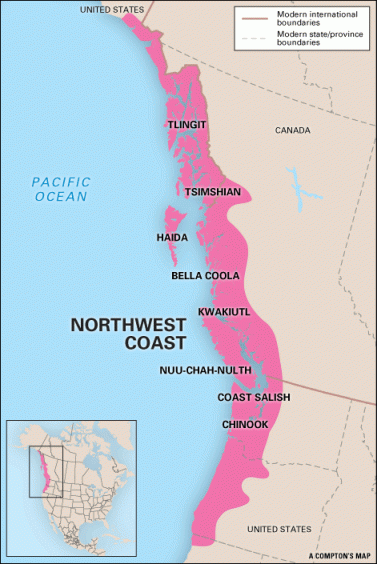
In 1965, near the end of his tenure as pastor of First United Methodist Church of Ketchikan, Alaska, the Rev. David K. Fison was asked to serve as an interim pastor in the nearby Tsimshian village of Metlakatla. (The Christian community there has been longstanding; the village was founded in 1887 by missionary William Duncan and a large group of Tsimshian converts who followed him there from “Old” Metlakatla, British Columbia.)
While in Metlakatla, Fison fell in love with the Tsimshian people and their culture. He was especially interested in their use of totem poles to tell stories and to commemorate important events. But he noticed a void: among all the magnificent poles they had erected, where were the ones that told the story of their encounter with Christ?
In Western culture, a visual language for telling the Jesus story has long been established. The word “nativity” instantly generates a standard image in the Western mind—a baby in a manger inside a barn, surrounded by an adoring Mary and Joseph, shepherds, three kings, angels, and a smattering of domesticated animals. The words “crucifixion” and “resurrection” likewise carry automatic visual associations. That’s because these events from the life of Christ have been the subject of much of the corpus of Western art since the Middle Ages. But the Tsimshian had no such precedent to follow. Their artistic tradition consists mainly of highly stylized and compressed depictions of humans, birds, fish, and mammals, stacked on top of or within one another. How might they go about rendering the gospel story in their own visual language?
After leaving his post in Metlakatla, Fison spent years studying Tsimshian culture at the University of Alaska, Fairbanks. He decided to translate the gospel into a visual format that the Tsimshian could identify with. He wanted them to know that Jesus’s birth, life, death, and resurrection were historical events that could be part of their tribal history if they wanted to claim them.
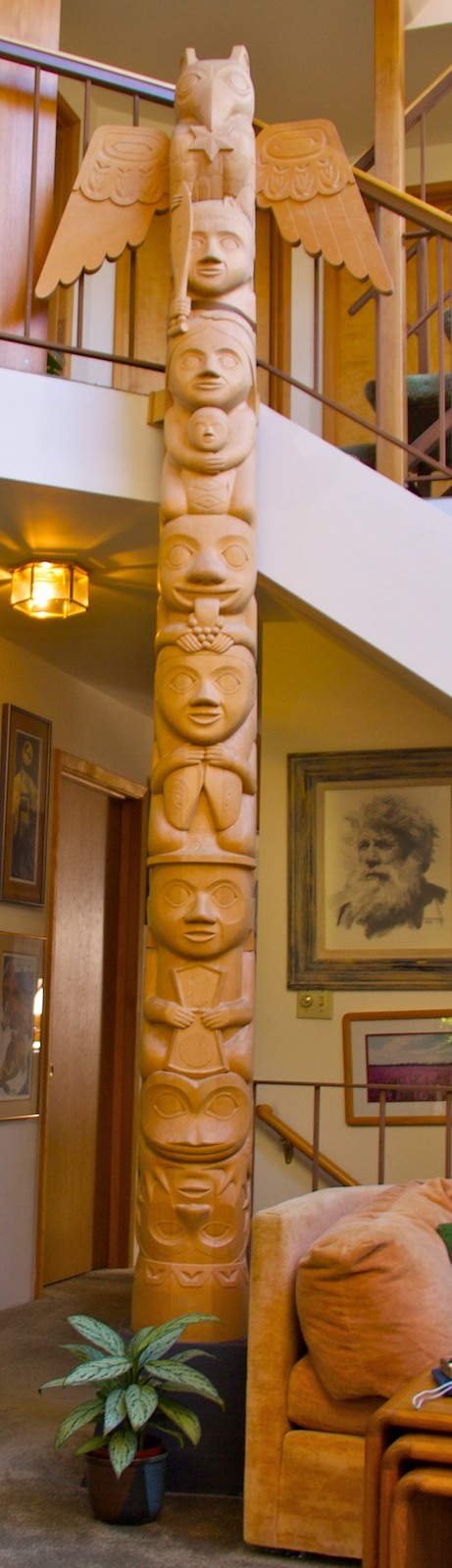
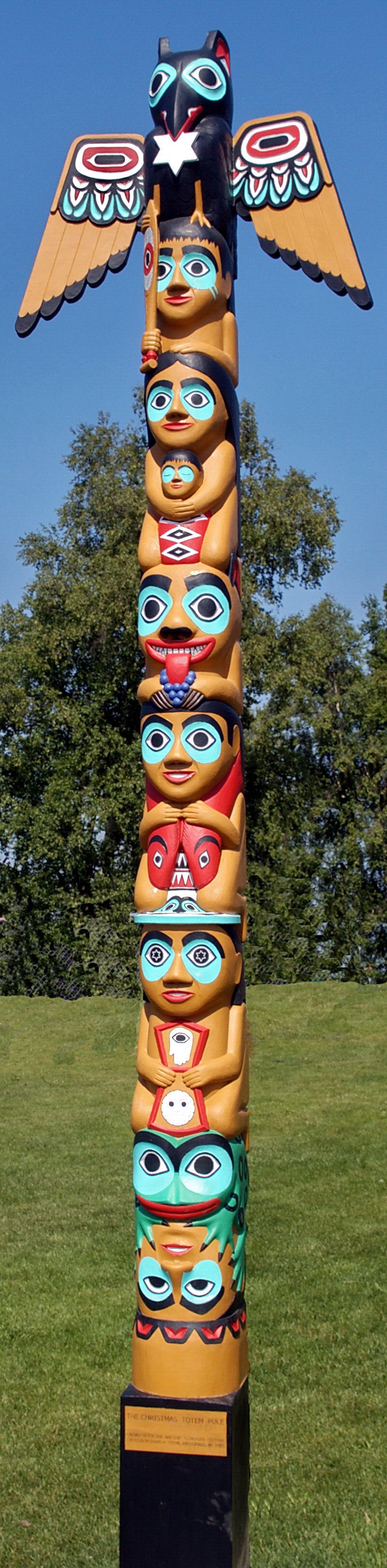
The Christmas Totem Pole
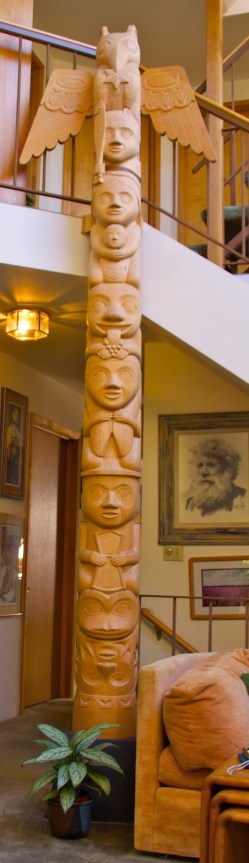
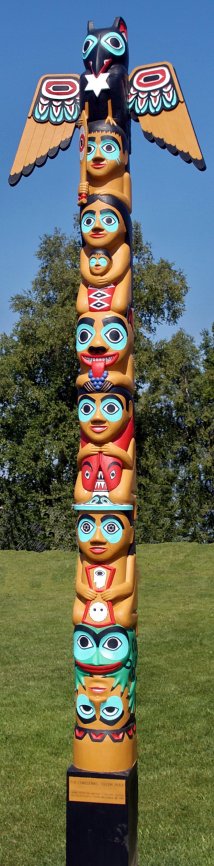
Left: David K. Fison, The Christmas Totem Pole, 1987. Yellow cedar, 12 feet tall. Home of the artist. Photo by David Mendosa.
Right: Painted fiberglass replica of the 1987 yellow cedar original by David K. Fison. 12 feet tall. Erected June 7, 2010, on the front lawn of Saint John United Methodist Church in Anchorage, Alaska. Inscription: “The Christmas Totem Pole, carved after ancient Tsimshian culture by David K. Fison, Anchorage, AK, 1987.” Photo courtesy of Saint John UMC. Continue reading →

 Found at littlewitnesswear.com.





 The Jesus Question