Two ivory panels from the V&A

The Crucifixion

Ivory crucifixion panel

The Crucifixion, 860-70. Ivory panel from Reims, France. Victoria & Albert Museum, London. Photo: Victoria Emily Jones.

In this ninth-century panel from France, Jesus has just breathed his last breath. A retinue of angels hovers above the cross with open hands, about to receive his spirit and transport it back up to the Father. Above them are a king and a crescent-crowned queen, who personify the sun and the moon. A common feature in medieval art, they are said to symbolize the old and new covenants—which through Christ’s death are brought together, the one illuminating the other.

Underneath the crossbeam on the left, Mary lifts up her arms to embrace her dead son while a Roman soldier (traditionally named Longinus) thrusts a spear into Jesus’s side to confirm that he is indeed dead. On the right, another soldier (traditionally named Stephaton) lowers the vinegar-soaked sponge he had offered to Jesus for drink, as John stands by in mourning.

At the base of the cross, Satan (in the form of a snake) sinks his fangs into Christ’s feet, literalizing the prophecy of Genesis 3:15, in which God tells Satan, “I will put enmity between you and the woman, and between your offspring and hers; he [Jesus, the seed of a woman] will crush your head, and you will strike his heel.” On this same plane of action, pairs of deceased saints sit up in their tombs, having been raised to newness of life via the death of Christ (Matt. 27:51-53). They resemble, fittingly, Christian worshipers in their pews, looking upward in pious devotion as they consider the salvific impact of the crucifixion scene that unfolds above them.

The Deposition

Descent from the Cross

The Deposition from the Cross, c. 1150. Ivory panel, probably from Hereford, England. Victoria & Albert Museum, London. Photo: Victoria Emily Jones.

This panel was most likely carved in England during the twelfth century. Joseph of Arimathea lowers Jesus’s body down from the cross, while Nicodemus removes the nail from his foot. Mary, Jesus’s mother, coddles his lifeless limbs, and Mary Magdalene throws back her arm in grief.

According to tradition, Golgotha is the place where Adam was buried. Thus in crucifixion art, a skull is often found at the foot of the cross, as a reminder of the fall and a picture of redemption.

Above the scene are two angel attendants with burial cloths in hand.

I’m not sure what the two symbols on the cross signify—do you know?

Posted in Western Art | Tagged , , , , | 4 Comments

Tee Time: Death on a Tree

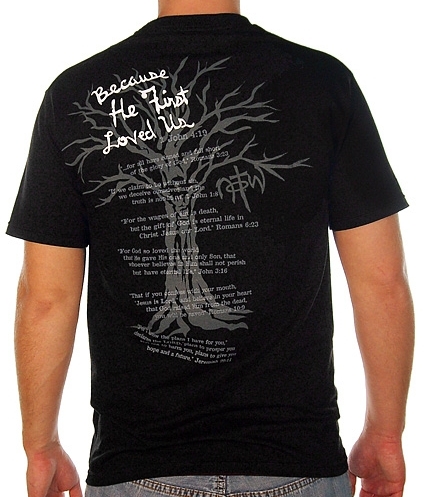
Jesus died on a treeJesus died on a treeFound at c28.com.

Posted in T-shirts | Tagged , | Leave a comment

Vintage Jesus, Part 2: How Human Was Jesus?

This twelve-part series outlines the “Vintage Jesus” sermons of Pastor Mark Driscoll. See part 1 here.

“The Church has had as much difficulty in showing that Jesus Christ was man, against those who denied it, as in showing that he was God.”—Blaise Pascal

Click here to watch the sermon “How Human Was Jesus?”

Traditional Christian creeds hold in tension the two truths that Jesus was both fully God and fully man. We must not prefer either truth over the other but maintain both vigorously. This is the most controversial and confusing teaching in all of Christianity, and it has resulted in many church splits throughout history. The groups deemed heretical (at least in part) because of their misunderstanding of this doctrine are the Docetists, Gnostics, Monophysitists, Eutychians, Ebionites, Nestorians, modalists, monarchianists, Sabellianists, Unitarians, Arians, Jehovah’s Witnesses, Mormons, Adoptionists, Kenotics, and Apollonarians.  Continue reading

Posted in Western Art, Who is Jesus? | Tagged , , , , , | 1 Comment

Roundup: On finding hope in this broken world

“The Glorious Cross of Jesus”: An exhibition of 70 photographs by Jason Lock. Each photo captures the shape of the cross occurring in everyday surroundings—in sidewalks, fences, doors, and kitchens—some more subtly than others, and is thoughtfully paired with a verse of Scripture that speaks to an element of the photo. Though the cruciform shape in some photos is no doubt staged, in most it occurs naturally. I love how the artist is able to see the message of the cross being proclaimed by such mundane things as cracked paint, chain links, hydrants, and fruit flesh.

Image of the cross

Jason Lock, Consuming Fire, 2011-12. Heb. 12:28-29: “Therefore, since we are receiving a kingdom that cannot be shaken, let us be thankful, and so worship God acceptably with reverence and awe, for ‘our God is a consuming fire.'”

Image of the cross

Jason Lock, Lion of Judah, 2011-12. Rev. 5:5: “Then one of the elders said to me, ‘Do not weep! See, the Lion of the tribe of Judah, the Root of David, has triumphed. He is able to open the scroll and its seven seals.'”

“My Bright Abyss: Meditation of a Modern Believer” by Christian Wiman, New York Times book review by Kathleen Norris: In this “daring and urgent” memoir, well-known poet and Poetry magazine editor Christian Wiman recounts his journey into and through the Christian faith. Written after his cancer diagnosis, this book, he says, is where he hopes to “speak more clearly about what it is I believe.” In it he reflects on human longing, art, imagination, suffering, tradition, and modernity. Thanks to Emily G. for flagging this to my attention!  Continue reading

Posted in Books, Death / tragedy / suffering, Western Art | Leave a comment

Tee Time: To be the man, you gotta know Jesus

To be a man, you gotta know Jesus… Are you da man?

Found at christiangear.com.


Posted in Jesus Kitsch | Tagged , | Leave a comment

Writing to Learn

These four writing quotes were compiled by Justin Taylor in his recent blog post “On Writing Well.” They remind me of one of the primary reasons I started this blog—to learn! It’s so true what these folks say: writing helps you to form and clarify your thoughts on a subject. I strongly encourage it!

Calvin, citing Augustine: “I count myself one of the number of those who write as they learn and learn as they write.”

Ed Welch: “I find that there are three levels of clarity. When I only think about something, my thoughts are embryonic and muddled. When I speak about it, my thoughts become clearer, though not always. When I write about it, I jump to a new level of clarity.”

John Piper: “Writing became the lever of my thinking and the outlet of my feelings. If I didn’t pull the lever, the wheel of thinking did not turn. It jerked and squeaked and halted. But once a pen was in hand, or a keyboard, the fog began to clear and the wheel of thought began to spin with clarity and insight.”

Arthur Krystal: “Like most writers, I seem to be smarter in print than in person. In fact, I am smarter when I’m writing. I don’t claim this merely because there is usually no one around to observe the false starts and groan-inducing sentences that make a mockery of my presumed intelligence, but because when the work is going well, I’m expressing opinions that I’ve never uttered in conversation and that otherwise might never occur to me. Nor am I the first to have this thought, which, naturally, occurred to me while composing. According to Edgar Allan Poe, writing in Graham’s Magazine, ‘Some Frenchman—possibly Montaigne—says: “People talk about thinking, but for my part I never think except when I sit down to write.”’ I can’t find these words in my copy of Montaigne, but I agree with the thought, whoever might have formed it. And it’s not because writing helps me to organize my ideas or reveals how I feel about something, but because it actually creates thought or, at least supplies a Petri dish for its genesis.”

Posted in Uncategorized | Tagged , | Leave a comment

Christian art at the Ashmolean Museum

I’m still sorting through, labeling, and editing all the photos I took in England last month. I can’t wait to share them with you!

In the meantime, here are a few pieces art that I really liked from the Ashmolean Museum of Art and Archaeology in Oxford. I’ve arranged them from the oldest date of creation to the most recent.

The Resurrection of Christ

Resurrection of Christ

Ceramic wall tile with scene of the Resurrection, ca. 1450. From Great Malvern, Worcestershire. Ashmolean Museum, Oxford, UK. Accession no.: AN1967.672. Photo: Victoria Emily Jones.

Jesus emerges from his coffin, his hands raised in a gesture of blessing and proclamation. “Look at my wounds, where the nails used to be,” he seems to say. “See how I’ve conquered death.” His crown of glory lies just overhead, waiting to be assumed. He is the only one worthy of it, this King of Kings, who is sovereign over all, even over the physical laws of life and death.

The Dragon and the Lamb

Lamb of God

Ivory and metal crosier head, measuring 15 cm in diameter, thought to date to the twelfth or thirteenth century. Ashmolean Museum, Oxford, UK. Accession no.: AN1685A.600. Photo: Victoria Emily Jones.

This crosier head features Christ as the Paschal Lamb, standing opposite the Mouth of Hell. (Hell, death, evil, and Satan are all conflated in the symbolism of the dragon.) On the cross, Jesus stared death in the face—looked straight into its jaws, and never recoiled. Here in the firm gaze of the Lamb you can see his sense of purpose and resolve. Even though it looks as if he’s about to be swallowed up by Death, as we all know, Jesus pulled a reversal and ended up doing the ultimate swallowing.  Continue reading

Posted in Western Art | Tagged , , , , | 2 Comments

Tee Time: Jesus is open 24/7

24/7 JesusFound at zazzle.com.

Posted in Jesus Kitsch | Tagged , | Leave a comment

Vintage Jesus, Part 1: Is Jesus the Only God?

Jesus Christ today is the most extraordinary, the most loved and hated, the most widely considered person in all of human history. More songs have been sung to him, more paintings painted of him, and more books written about him, than anyone who has ever lived in the history of the world.

—Mark Driscoll

Vintage Jesus by Mark Driscoll“Vintage Jesus” is a twelve-part sermon series given by Pastor Mark Driscoll of Mars Hill Church in Seattle in 2006. In 2007 the series was published as a book by Crossway, coauthored with Gerry Breshears. Because it covers the major questions people tend to ask about Jesus, I thought it a fitting series for this blog. As I move through each sermon video, I will be highlighting only a few main ideas, so please, watch the videos and/or read the book for a fuller treatment of the question “Who is Jesus?”

Disclaimer: Mark Driscoll has a polarizing personality. He’s orthodox in his theology but unorthodox in his preaching style, which is casual and contains humor that’s sometimes crass. (He uses slang expressions and likes to make fun of people.) Even though I don’t endorse everything he says or how he says it and am particularly turned off by his machismo, I have learned from his teachings over the years. He very clearly asserts and explains the evangelical perspective (or one of them, anyway) on a variety of issues and makes Christian history and theology interesting. Furthermore, he’s not afraid to preach parts of Scripture that offend our modern-day sensitivities, and for that I commend him.

The first sermon in the “Vintage Jesus” series addresses the question “Is Jesus God?”, and if so, “Is Jesus the only God?” Driscoll, of course, answers in the affirmative. He focuses on twelve different claims Jesus made during his earthly ministry, each one more extraordinary than the next, that differentiate him from all the other spiritual leaders in the history of the world. He demonstrates that Christians are narrow because Jesus was narrow; his claims to Godhood were singular, exclusive, and still remain unparalleled: I alone am perfect. I alone have the power to forgive sin, and the right to judge it. I alone am the way to heaven. And so on. No wonder they killed him!

Driscoll opens up with some Jesus-inspired quotes by pop culture icons and political and religious figures, ranging from Gandhi to Hitler to Pamela Anderson, but then he lets Jesus speak for himself. If you were a victim of slander, he points out, you’d want the opportunity to tell people who you really are and what you have and have not done and said and believe. We should afford to Jesus that kindness, he says, and so we turn to the Gospels. Some of you might object: How do we know that the four canonical Gospels accurately record what Jesus said and did? Couldn’t Christians have added those bits about Jesus’s divinity later on, for ideological reasons? This is a very good and important question, one on which there is a great breadth of scholarship, but I am going to save it for another series. For now, let’s just work from the assumption that the words attributed to Jesus in the canonical Gospels were really his own.

Back to the question at hand: Did Jesus ever claim to be God?  Continue reading

Posted in Books, Pop Culture, Theology, Who is Jesus? | Tagged , , , | 11 Comments

Tee Time: Jesus is the best thing . . .

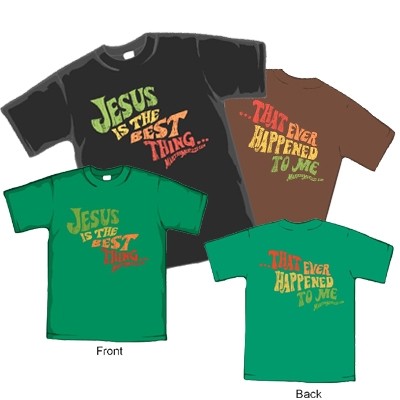
Jesus is the best thing that ever happened to me

. . . that ever happened to me.

Found at marthamunizzi.com.

Posted in Jesus Kitsch | Tagged , | Leave a comment