A Brief History of Chocolate Jesus

Jesus and chocolate. I love both. So when I heard the song “Chocolate Jesus” for the first time last week (on a podcast about religious kitsch), it sounded yummy. The song is satirical, but as I listened to it, I thought, I bet candy makers have actually tried this. And sure enough, they have.

Besides making a splash in the folk rock world (in the world of candy sales, not so much), chocolate Jesus has also cropped up in at least three works of visual art in the last twenty years, the most recent one garnering a firestorm of media attention.

This list is not comprehensive, but here’s what I could dredge up in the way of chocolate Jesuses.

Chocolate Jesus in the Visual Arts

Trans-substantiation 2, sculpture by Richard Manderson (1994)

In 1994, philosophy student Richard Manderson created one hundred jam-filled, Jesus-shaped chocolates, which he sold at an arts center gift shop in Canberra, Australia. No one thought much of it . . . until a condemnatory headline in a US newspaper prompted Manderson to do something more outrageous: create a life-size chocolate Jesus for public consumption. He did so by filling a plaster mold with fifty-five pounds of melted chocolate. He used chocolate-dipped strings for hair and plastic Easter wrap for a loincloth. After Easter, Manderson invited people to come eat the immaculate confection.
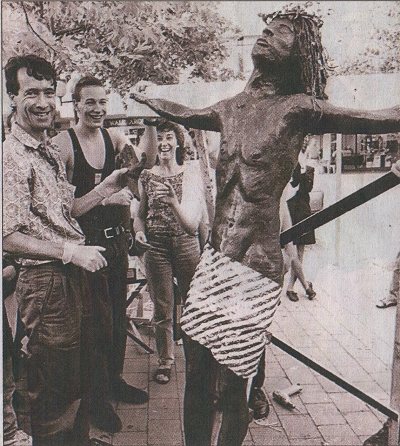
Irony was behind his production of the original candies, and it was behind his decision to go large scale as well. Although not a Christian, Manderson said he was disappointed that secular culture has turned Lent and Easter from a time of solemn spiritual reflection into a time of sugary indulgence. The title of his sculpture, Trans-substantiation 2, is a reference to the Catholic doctrine that states that during the Eucharist, the sacramental bread and wine turn into the literal body and blood of Christ. During this time of year, suggests Manderson, Jesus’s body transubstantiates into chocolate; the awesome weight of his death and resurrection is edged out by airy, candy-based festivities in schools, stores, and homes. This ought not to be.

Manderson’s sculpture challenges us to join those who use this time to fast rather than consume. That’s not to say we must be anti-sweets but only realize that sweets are not the true substance of Easter.

Continue reading

Posted in Books, Controversial Art, Jesus Kitsch, Music, Pop Culture | 1 Comment

Tee Time: All I need today is a little bit of coffee . . .

All I need today. . . and a whole lot of Jesus!

Found at skreened.com.

Posted in T-shirts | Tagged , | Leave a comment

“Faith in Drag” podcast: on the role of images in Christianity and Hinduism

Encounter is a Sydney-based radio documentary feature program that seeks to explore the connections between religion and life. Two weeks ago they aired an episode, hosted by Allison Chan, that includes interviews with religious gift shop workers, Christian and Hindu clergypersons and lay practitioners, and artists—all of whom had something to say about the use of religious objects, from statues to bread stampers, in daily life. Click here to listen to the audio. I highly commend it to you—it has really reshaped my attitude toward kitsch and has given me a better understanding of Hindu spirituality.

Here is an annotated outline with guest names and time stamps.

Religious Merchandise

1:10: Noni Daniels, joint CEO of the store Holy Kitsch!, explains the appeal that devotional objects have for her, even though she’s not religious.

2:21: Sister Christine Pisani of the Sister Disciples of the Divine Master in Sydney talks about the artwork of Sister Angelica Ballam, for sale at their Liturgical Center, and about the Catholic theology of images.

Sensory Experience in Protestant Church Interiors

4:30: Bishop Robert Forsyth of the Anglican Diocese of South Sydney comments on Protestants’ justified caution toward images.

5:18: Rev. Dr. Rod Pattenden, pastor, art historian, and Chair of the Blake Prize, reflects on the church’s history of violence against religious images. He describes the sparse, white-walled churches that came out of the Protestant Reformation as “utterly boring” and a hindrance to experiencing transcendence.  Continue reading

Posted in Non-Western Art, Pop Culture, Popular Art, Theology, Western Art | Tagged , , , , , | 1 Comment

Tee Time: Jesus . . . he scares the hell out of you!

Jesus scares the hell out of youFound at zazzle.com. (Incidentally, a middle school student from Missouri was sent home for wearing a shirt with this saying, because it was deemed offensive.)

Posted in T-shirts | Tagged , | Leave a comment

Stations of the Cross art exhibition in London

Through April 17, St. Marylebone’s Parish Church in London is hosting an exhibition on the Stations of the Cross, curated by Art Below founder Ben Moore to raise proceeds for the Missing Tom Fund. Admission is free, but donations are accepted, and all the works are for sale.

For some of the artists—like Chris Clack, Paul Fryer, and Wolfe von Lenkiewicz—the figure of Jesus has served for years as a recurrent subject in their bodies of work. Other artists, however, are treating it here for the first time. You’ll find a mixture of media and styles on display at St. Marylebone’s, from oil paintings to minimalist works to digital collage. One of the aims of the exhibition, it appears, is to strip the Stations of their traditional dress and give them a more up-to-date look, so as to stimulate fresh perceptions (a tactic known as defamiliarization).

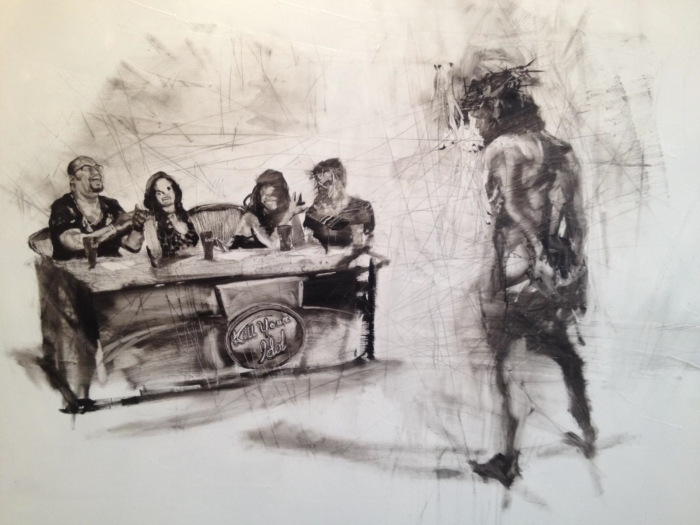
For example, Antony Micallef’s take on Station 1, Jesus is condemned to death, shows Jesus standing before an American Idol judges’ panel instead of before Pontius Pilate. Having just performed his audition for the chance to become America’s favorite singer, he now stands trial before four judges. Their sentence? “It’s a no”—four times over. He doesn’t have the right image. And they don’t like the tune that he sings.

Antony Micallef Jesus before Pilate

Antony Micallef, Kill Your Idol, 2014. Oil on linen, 100 x 150 cm.

By presenting this passion event within the framework of a reality TV show competition, Micallef challenges us to consider a few things: What happened to Jesus’s career after that first fatal judgment was passed? Is he someone that the public would cast its vote for today? Are we idolizing the right people, the right things, in our lives?  Continue reading

Posted in Western Art | Tagged , , | 3 Comments

Tee Time: Jesus is real

Jesus is realFound at avazar.co.uk.

Posted in T-shirts | Tagged , | Leave a comment

The Homeless Jesus sculpture is at it again

Provoking discussion, that is.

Last April I wrote about a sculpture by Timothy Schmalz that depicts Jesus as a homeless man on a street bench.

Well, another cast of it has been purchased by and installed outside St. Alban’s Episcopal Church in Davidson, North Carolina—and again it is meeting with varied reactions from neighbors. CNN interviewed one woman who finds it inappropriate and theologically indefensible: “Jesus is not a vagrant. Jesus is not a helpless person who needs our help. We need someone who is capable of meeting our needs, not someone who is also needy.” This quote saddens me, not only because it demonstrates a self-centered attitude, one that is more concerned with getting one’s own needs met than meeting the needs of others, but also because it fails to take into account the biblical parable of the sheep and the goats that inspired the artist to create this sculpture in the first place. When I heard the interview, what I heard was this: the church doesn’t need and doesn’t want needy people; it just wants Jesus. Now that is something that I find theologically indefensible, because when you follow Jesus, you get both, and you serve the one by serving the other. The Christian call is, in large part, to look out for and take care of the needy. Jesus told his disciples that giving shelter to a homeless individual is the same as giving shelter to him.

Also telling of this woman’s cheap brand of Christianity is that on first seeing the sculpture, she called the police because she was concerned about the safety . . . of the neighborhood! (Not of the hungry person on the bench, sleeping outside, unguarded, in twenty-something-degree temperatures.) This is just one of many unfair stereotypes given to homeless people: that they are a danger to society; that they are violent, thieving drunks.

Thankfully, the gospel helps us break through such stereotypes.

CNN also interviewed the rector of St. Alban’s, David Buck, who acknowledges the challenging nature of the Homeless Jesus sculpture but sees its message as positive and necessary. Buck said that church members sometimes use the sculpture as an aid in prayer. (The bench has an empty spot beside the feet of Christ for pray-ers to sit.)

Click here to watch the CNN video story.

Posted in Controversial Art, Politics | Tagged | 1 Comment

Vintage Jesus, Part 6: What Will Jesus Do upon His Return?

This twelve-part series outlines the “Vintage Jesus” sermons of Pastor Mark Driscoll. See part 1 here.

Click here to watch the sermon “What Will Jesus Do upon His Return?”

6:35: Jesus is coming back. (Jn. 14:3; Acts 1:11; etc.)

7:51: We don’t know when. (Matt. 24:44, 25:13)

8:49: What pop culture figures say about the Second Coming

WHAT SCRIPTURE SAYS

11:15: Jesus will judge everyone who has ever lived. (Ecc. 12:14; Mt. 12:36-37, 16:27; Jn. 5:22; Rom. 14:10-12; 1 Cor. 4:5; 2 Cor. 5:10; Rev. 12:11-13, 22:12)

Memling, Hans_Last Judgment

Hans Memling, The Last Judgment, 1466-73. Oil on panels. National Museum, Gdańsk, Poland.


14:22: There will be different judgments for Christians and non-Christians.  Continue reading

Posted in Theology | Tagged , , , , | 1 Comment

Tee Time: Super Jesus

Superhero JesusFound at shirtmandude.com.

Posted in T-shirts | Tagged , | Leave a comment

Illuminations from an Armenian Gospel book

Before the Roman Empire adopted Christianity as its official state religion, Armenia did. Sometime around 286 an Armenian Christian man named Gregory (venerated in the Armenian Church as St. Gregory the Illuminator) was imprisoned for his faith by King Tiridates III. In 301 Gregory succeeded in converting the king, and Tiridates in turn imposed Christianity on his people—the first monarch ever to do so. Armenia is thus the oldest Christian nation in the world.

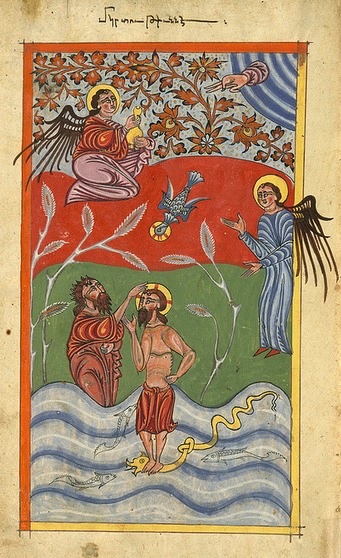
In addition to khatchk’ars (large stone crosses erected as memorials), Armenia is known for its sophisticated manuscript illuminations. Although they bear Byzantine and Persian influences, many also demonstrate originality. Take, for example, the iconography of the Baptism of Christ.

Baptism of Christ (Armenia)

The Baptism of Christ, from an Armenian Gospel book (Ms. W.543), 1455. Walters Art Museum, Baltimore.

One unique feature of Armenian Baptism paintings is the depiction of Christ standing on a dragon. This is because the Armenian Church interprets Psalm 74:13 as a prediction of Christ’s baptism: “Thou didst divide the sea by thy strength: thou brakest the heads of the dragons in the waters” (KJV). The following prayer, ascribed to Basil of Cappadocia, is recited in Armenian churches each year on the Feast of the Epiphany as part of the ritual blessing of the water of baptism:   Continue reading

Posted in Non-Western Art | Tagged , , | Leave a comment