Vintage Jesus, Part 7: Why Should We Worship Jesus?

This twelve-part series outlines the “Vintage Jesus” sermons of Pastor Mark Driscoll. See part 1 here.

3:00: American football and Hindu idol worship—not so different from each other

8:57: Broad picture of worship

  • What one culture considers just a hobby, entertainment, or recreational activity another culture might recognize as a worship event.
  • Popular American idols include sports teams, video games, televisions, cars, bands, sex, and fashion. Or more elusive ones like beauty, popularity, success, financial security, romantic love, education, and so on.

9:33: Four things worship is not

  1. Worship is not exclusively religious.
  2. Worship is not a style of music.
  3. Worship is not something that starts and stops. (It’s ongoing; it’s a lifestyle.)
  4. Worship is not tied to a time or a place. (As John 4 tells us, it’s a question not of when or where, but of who or what.)

12:23: Worship defined (Romans 11:36-12:1): whatever you hold in a position of glory  Continue reading
Posted in Theology | Tagged , , , , | 2 Comments

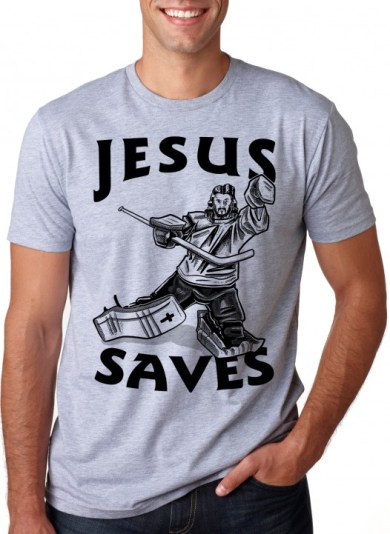
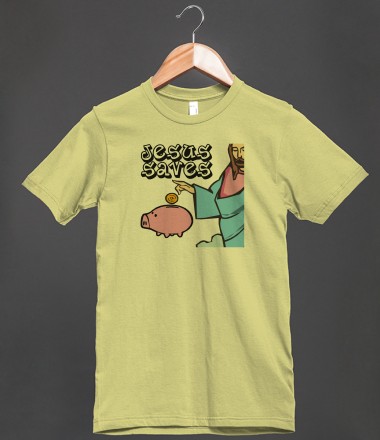
Tee Time: Jesus Saves (Raves, and Shaves)

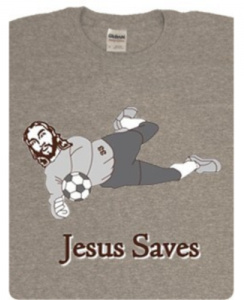
Here are several humorous T-shirt designs based on the popular Christian slogan, from the worlds of . . .

sports

T-shirt_Jesus saves (soccer).png

T-shirt_Jesus saves (hockey)

finance

T-shirt_Jesus saves in his piggy bank  Continue reading

Posted in T-shirts | Tagged , | Leave a comment

Roundup: Jesus balloon, Oprahdoxy, minimalist Bible, Augustine, cave churches, and sugar sphinx

– Did you hear about the giant World Cup Jesus balloon that online gambling company Sportsbet floated over Melbourne two weeks ago? Resembling the famous Christ the Redeemer statue in Brazil, the balloon showed Jesus wearing an Australian soccer jersey with the hashtag #keepthefaith. (I hope he didn’t coax too many overly trusting souls into placing their bets on the Socceroos!)

“Oprah, Rob Bell, and Faux Self-Empowerment for the Self-Centered” by Joseph Sunde: This article laments the shift of certain segments of the church from orthodoxy to Oprahdoxy, a sort of “Chicken Soup for the Self-Indulgent” that teaches that to get the life you want, all you need to do is follow your “emotional GPS” and say yes to this moment.

Story of God design series by Vincent Lee: A retelling of the Bible’s grand narrative sweep through 60 minimalist designs. Can you guess which event each of these four images represents?

Story of God by Vincent LeeStory of God by Vincent Lee


Story of God by Vincent Lee

Story of God by Vincent Lee


(Joseph Novak has created a similar graphic design collection—one design for each book of the Bible, which was reviewed by John Brownlee of Fast Company. On a smaller scale is a series of five basic Bible-inspired designs by Jithin Babu.)

“Should Augustine’s name be pronounced AW-gus-teen or Aw-GUS-tin?”: I’ve heard both, but mostly the latter from scholars, so that’s what I’ve been using (with slight hesitance for fear of sounding pretentious!).

– Check out the interiors of some of the world’s most amazing cave churches in this series of photos compiled by the Huffington Post: “The Mysterious Cave Churches and Monasteries Totally Rock.”

A Subtlety by Kara Walker: This week is your last chance to see Kara Walker’s monumental sugar sphinx on display at the soon-to-be-demolished Domino Sugar Factory in Williamsburg, Brooklyn. Commissioned by Creative Time to fill the space with art, Walker looked into its history and eventually landed on the idea of a giant sphinx-like mammy, built with a Styrofoam core and coated in sugar, surrounded by fifteen smaller statues of molasses-made African boys carrying baskets, which have been slowly melting over the course of the installation. The work invites reflection on the history of America’s sugar industry, which relied on slave labor. The video below is from Art21, but BBC News also has one. And Hyperallergic has a bunch of photos of the exhibition.

Posted in Popular Art, Theology, Western Art | Tagged , , | 3 Comments

New Arab face of Christ

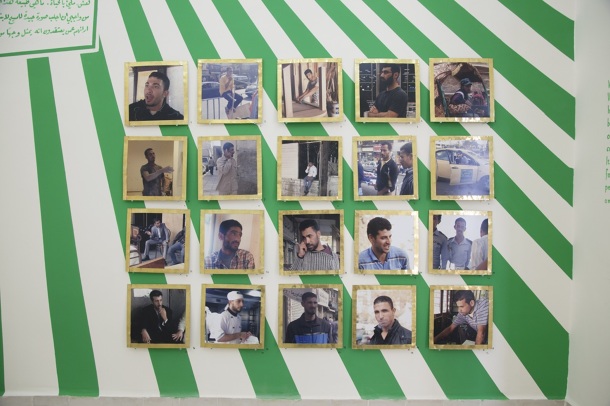
While fulfilling an artist residency at Darat Al Funun in Amman, Jordan, Brazilian artist Jonathas De Andrade developed a project called Looking for Jesus, which involved him photographing local men and then taking those photos around with him as he interviewed other locals about Jesus’s appearance. His aim was to find a contemporary Arab face of Christ to supplant the white-skinned, fair-haired image of him that’s so familiar worldwide.

The installation opened on May 30 in the crypt of Museo Mariano Marini in Florence, Italy, and it closed just yesterday. It consisted of a wall painting, 20 photographs, 16 handwritten comments on white boards (in Arabic and English), a hanging tray of dates offered to viewers, and a wooden voting box into which viewers were invited to cast their date pit for their favorite face.

Looking for Jesus

Some of the featured responses from Jordanians include:

  • “I’m insulted by these possibilities. It’s ridiculous.”
  • “I suggest you look for him in a better neighborhood.”
  • “So you’re telling me that in Brazil they have a Jesus who is very good looking, green eyes and that kind of thing? But that’s how we need him to be.”

Continue reading

Posted in Non-Western Art | Tagged , , , | 1 Comment

Tee Time: Jesus saved my life

Jesus saved my lifeFound at divinecotton.com.

Posted in T-shirts | Tagged , | Leave a comment

Movie Review: Higher Ground (2011)

Higher Ground movieDirector: Vera Farmiga
Screenwriter: Carolyn S. Briggs (with Tim Metcalfe), based on her memoir This Dark World
Starring: Vera Farmiga
MPAA Rating: R, for some language and sexual content

Most films that center on Christianity fall into one of two categories: either they are terribly trite, dull, and of no interest to non-Christians, or they are irreverent parodies that make fun of Christians by way of caricature. This film falls into neither category but rather tells the story of one woman’s faith journey across three decades, and how different people and life events act on it. I have never seen my evangelical faith tradition portrayed on-screen with such fairness and depth. The Christian characters are not dumbbells or hypocrites or Bible-thumping jerks (though the real-life body of Christ does have some of those); they are people with hopes and fears and personal struggles and intellect and love. They are three-dimensional. They are authentic. They live life together in community, laughing and crying together, studying the Bible together, and supporting one another through acts of kindness and prayer. But they are not perfect: the well-meaning admonitions of one elder sister in Christ contribute to Corinne’s growing feelings of isolation and doubt, and her church’s failure to honor those feelings and honestly engage them results in her decision to leave.

The movie is divided into six titled parts—“Summons,” “Renegade,” “Consumed,” “Wilderness,” “Wrestling until Dawn,” and “The Book of Life”—each one marking a milestone in the spiritual formation of lead character Corinne: her acceptance of Jesus into her heart as a child at Vacation Bible School; her backsliding as a teenager; her return to the faith with renewed passion as an adult; her experience of tragedy; a period of processing that tragedy and its implications on her belief system; and an ambiguous ending in which she literally stands at the threshold of her church sanctuary, looking in.  Continue reading

Posted in Film | Tagged , , , , , , | Leave a comment

Tee Time: JesUSAves

Jesus Saves patrioticFound at Amazon.com.

Posted in T-shirts | Tagged , | Leave a comment

Folding Passion icon from Ethiopia, ca. 1900

Last week I posted photos of some of the Yoruba Christian art housed at the SMA African Art Museum. Now I’d like to share a few from the museum’s Ethiopian collection.

Christianity has existed in Ethiopia since the first century AD. The Ethiopian Kingdom of Aksum adopted it as its official state religion around 324 at the decree of King Ezana, making Ethiopia the only country in sub-Saharan Africa to have accepted the Bible before the arrival of Western missionaries.

Ever since its founding by Frumentius, the Syrian traveler who converted King Ezana, the Ethiopian Orthodox Church has played a prominent role in the cultural development of the country. Ethiopian literature and art, for example, were born in the Church and traditionally are religious in content.

Below are a few detail photos of a twelve-panel folding icon, or chain manuscript, created around 1900. This form, called a sensul, first appeared in Ethiopia in the sixteenth century. It involves a cycle of pictures painted on a single strip of parchment, which can be folded for portability, for use either in processions or in private devotions.

The inscriptions, as in almost all Ethiopian Christian art, are in Ge’ez, the ancient Ethiopian ecclesiastical language. Like Latin in the Roman Catholic Church, Ge’ez is no longer widely spoken but continues to be used for scripture, prayers, hymns, and devotional literature.

Scourging of Christ

This image shows Jesus tied to a wooden stake, being whipped by two servants of Pontius Pilate.  Continue reading

Posted in Non-Western Art | Tagged , , , , | Leave a comment

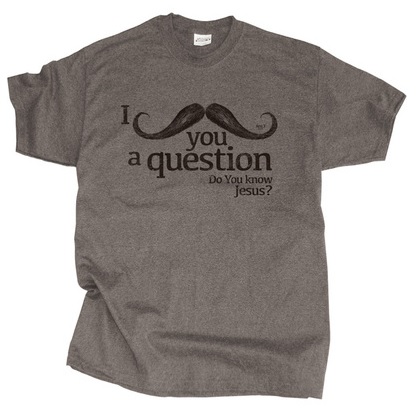
Tee Time: I mustache you a question . . .

T-shirt_I mustache you a questionDo you know Jesus?

Found at divinecotton.com.

Posted in T-shirts | Tagged , | Leave a comment

“Africanizing Christian Art” exhibition in Tenafly, NJ

Through July 30, 2014, the African Art Museum of the Society of African Missions is hosting an exhibition called “Africanizing Christian Art,” curated by Nicholas J. Bridger. About a half-hour drive from New York City, the museum is located in Tenafly, New Jersey, the American headquarters of the SMA (the acronym is taken from the Latin Societas Missionum ad Afros). It is one of five museums maintained by the organization worldwide, the other four being in France (two), Italy, and the Netherlands.

I had the privilege of viewing this special exhibition two weeks ago. It focuses—though not exclusively—on the legacy of Father Kevin Carroll and his artistic collaborations with the Yoruba people of Nigeria. These collaborations began in 1947, when Carroll was recruited to the position of manager of the newly formed Oye-Ekiti Workshop, founded by the Rev. Dr. Patrick M. Kelly with the aim of developing a new Yoruba Christian style of art.

The Holy Family. Part of a crèche set carved by Yoruba artist Joseph Imale in 1974, with beadwork by Jimoh Adetoye. Collection of the SMA African Art Museum. To view the full set, see page 2 of theSMA sculpture guide.

The Holy Family. Part of a crèche set carved by Yoruba artist Joseph Imale in 1974, with beadwork by Jimoh Adetoye. Collection of the SMA African Art Museum. Photo: Victoria Emily Jones. To view the full set, see page 2 of the SMA sculpture guide.

Continue reading

Posted in Non-Western Art | Tagged , , , , , , , , , | 10 Comments