Tee Time: I Work on Commission

The Great CommissionFound at divinecotton.com.

Posted in T-shirts | Tagged , | Leave a comment

Art Roundup: Gomez-Prince collaboration, Viola in St. Paul’s, pothole mosaics, and digitization initiatives

Gomez-Prince collaboration: At last month’s Eyekons conference, artists Sergio Gomez and Steve Prince participated in a live drawing performance on the theme “Who Is My Neighbor?” They started drawing from opposite sides of an eight-by-thirteen-foot piece of paper and then crossed over into each other’s work after reaching the middle. Follow the link above to see the final work, including detail images, and watch the time lapse video below.


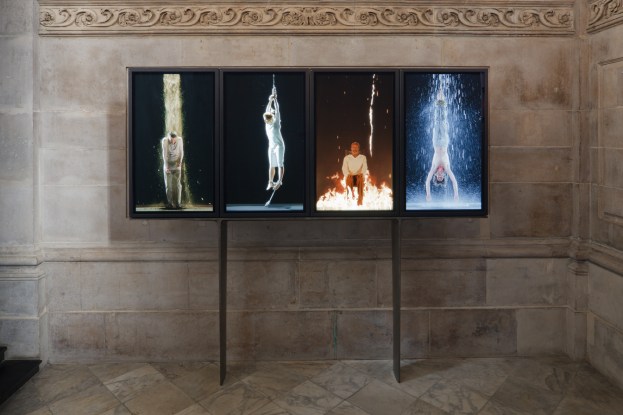
New Viola video installation at St. Paul’s Cathedral: Last month I wrote about a piece from Bill Viola’s Passions series. Well, last week a new work of his was unveiled, this time on a patch of prime real estate: the east end of the Dean’s Aisle in St. Paul’s Cathedral, London. Its title is Martyrs (Earth, Air, Fire, Water), and it is configured like a four-paneled altarpiece. Viola said he hopes that it and its companion piece Mary (to be unveiled in 2015) will function as “practical objects of traditional contemplation and devotion.” He describes the work as follows: “As the work opens, four individuals are shown in stasis, a pause from their suffering. Gradually there is movement in each scene as an element of nature begins to disturb their stillness. Flames rain down, winds begin to lash, water cascades, and earth flies up. As the elements rage, each martyr’s resolve remains unchanged. In their most violent assault, the elements represent the darkest hour of the martyr’s passage through death into the light.”

Photograph by Peter Mallet of a video installation by Bill Viola: Martyrs (Earth, Air, Fire, Water), 2014. Color high-definition video polyptych on four vertical plasma displays, 140 x 338 x 10 cm. St. Paul's Cathedral, London. Duration: 7:15 minutes.

Photograph by Peter Mallet of a video installation by Bill Viola: Martyrs (Earth, Air, Fire, Water), 2014. Color high-definition video polyptych on four vertical plasma displays, 140 x 338 x 10 cm. St. Paul’s Cathedral, London. Duration: 7:15 minutes.

“Covering a City’s Potholes with Art” by Kate Sierzputowski: This article from Hyperalleric profiles the public-works project started by Chicago artist Jim Bachor: filling the city’s potholes with mosaics. At first fearful of legal repercussions, Bachor has since been awarded a commission by the Chicago Transit Authority!

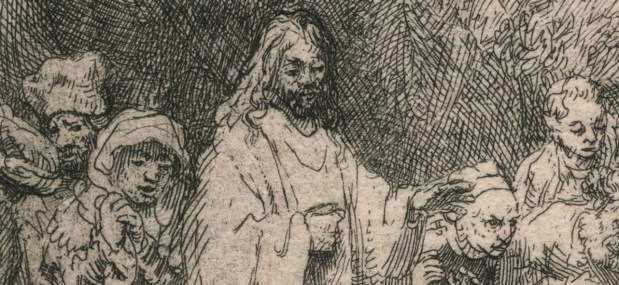
Digitization initiatives: The Vatican recently announced that it has partnered with a Japanese IT company to digitize all 82,000 manuscripts in its collection, in an effort to expand access to its holdings. The first phase, which includes a batch of 3,000 manuscripts, is slated for completion by 2018. On another note, the Morgan Library and Museum has just completed its digitization of its almost five hundred Rembrandt etchings, many of which depict biblical subjects. Check it out!

Rembrandt_Raising of Lazarus (detail)

Rembrandt van Rijn, The Raising of Lazarus: The Larger Plate (detail), ca. 1632. Etching, 36.7 x 25.8 cm.

Posted in Western Art | 1 Comment

Tee Time: You Mad, Bro?

Jesus defeats SatanFound at divinecotton.com.

Posted in T-shirts | Tagged , | Leave a comment

Andy Crouch on visual art

CIVA has posted a podcast interview with Andy Crouch, the author of Culture Making: Recovering Our Creative Calling. I loved his book, and this discussion with Brian Moss is equally interesting. I encourage you to follow the link to listen to it in full. It’s thirty-two minutes long.

1:56: What is the relationship between power and art?

Humans as image bearers — The cultural mandate and its tensions — Ancient cave paintings — Idolatry as an attempt to master reality, or the projection onto an image of the human quest for power — Dominion without control

8:04: How do you reconcile art making with the prohibition against graven images in Exodus 20?

The dangers of image making — Transcending time — The incarnation as a game changer (in Christ it was shown that matter can fully bear the presence of God)

11:28: It’s easy for families and congregations to know how to make music a part of their communal life of worship, but how can we participate together in the visual arts?

It’s not about drawing or painting together, but beholding together — Making your furniture match your art — Inviting contemplation rather than consumption

17:54: Visual art has the reputation of being elitist, mythical, so above us; what can we do in our churches to correct this attitude?

Beginner’s mind — Henry Ossawa Tanner’s The Banjo Lesson — Humility and patience

22:39: What do you think artists want the church to know?

Don’t mistake difficult work for unfaithfulness — Don’t think of us as prodigals — Accept our allergies

27:46: What does the church want artists to know?

“The church longs for artists to find a language we can share and help us name the deeper things that we can’t name without that language. . . . Sometimes the church feels like artists are speaking a very strange language that we can’t share or that we can’t understand, and we so long for artists to meet us halfway and give us ways of representing the world in all of its fullness and beauty and terror, in ways that we all can participate in and offer up as a sacrifice to God. And that requires a humbling of artists sometimes, because artists love to speak the most rich and complex languages, but sometimes that’s like speaking in tongues: when you bring it into the church without an interpretation, it can’t be heard. And maybe that’s another thing that the church is longing for: an interpretation. An interpretation of the artistic tongue.”


Posted in Western Art | Tagged , , , | Leave a comment

Tee Time: God Wants YouTu-be Saved

And for the final installment of the “Jesus on social media” T-shirt series . . . Jesus on YouTube


Found at zazzle.com.

Posted in T-shirts | Tagged , | Leave a comment

Stop making fun of “Kumbaya”

“Kumbaya” began as the sincere plea of a generation of African Americans for God’s intervention, but since entering popular culture in the 1950s it has become a metaphor of naive optimism or corny camaraderie and thus a term of derision, levied most often against peace activists and politicians. How did this happen? And why do we tolerate this disparagement of the black religious experience in America?

The precise origins of the song are unclear, but most ethnomusicologists believe it originated with the Gullah people (also called Geechee), the descendants of enslaved Africans who live on the Sea Islands and in the coastal regions of South Carolina and Georgia. (Perhaps you remember the kids’ TV show Gullah Gullah Island? I do! With much fondness.) The Gullah developed their own creole language, based on English but with strong influences of West African languages. The words “Kum ba yah” mean “Come by here” in Gullah. “Come by here, my Lord,” the Gullah people sang as they suffered under the Jim Crow regime. “Come by here.”  Continue reading

Posted in Music | Tagged , , , , , | 19 Comments

Tee Time: Jesus died for MySpace in heaven

Jesus on MySpaceFound at ebay.com.

Posted in T-shirts | Tagged , | Leave a comment

A 20th-century shift in the arts

“Unfortunately, the past century has systematically produced a culture of artists who believe their greatest responsibility is to be true to themselves, and not to a truth which exists outside of them. They are taught that to grow as artists they need to enter more and more into their own emotions and values, whereas the great artists of the past immersed themselves in universal values and spent a lifetime pursuing absolute truth. They strove to learn what their culture had to teach them, and then gave back this wisdom through their art.

“Today’s artists too are learning and giving back, but rather than being formed according to objective truth, they are being convinced that truth is relative. Their art reflects this relativism, which is especially harmful to the communication of morals and human values. This relativism creates stories that devalue human beings and provide the foundation for social ills.”

—Kenneth Noster, Director and President of Living Water College of the Arts,
Derwent, Alberta, Canada

Source: Transpositions.co.uk

Posted in Western Art | Leave a comment

Tee Time: Jesus on Twitter

Who do you follow?kerusso.com

Jesus had followers before Twitterspreadshirt.com

Follow J Creezy     bustedtees.com

Follow @Jesus (Twitter) ebay.com

Posted in T-shirts | Tagged , | Leave a comment

Tee Time: I Like Jesus

I like Jesus (Facebook)Found at kerusso.com.

Posted in T-shirts | Tagged , | Leave a comment