Book Review: The Art of Conversion: Christian Visual Culture in the Kingdom of Kongo by Cécile Fromont

From the accession of Afonso I to the Kongo throne in 1509 to its final dissolution in 1914, the Kongo in central Africa was a Christian kingdom whose status was recognized throughout the early modern Atlantic world. Remarkably, Christianity developed there at the demand and under the control of the Kongo crown itself, outside the context of colonization (but not apart from European contact). After adopting the new religion, the Kongo underwent a major redefinition of its visual culture: local and foreign forms were brought together to create a distinct expression of Kongo Christianity, one that helped ensure the Kongo’s place in the realm of Christendom. This process of visual inculturation is the topic of Cécile Fromont’s new book, The Art of Conversion: Christian Visual Culture in the Kingdom of Kongo (Chapel Hill: University of North Carolina Press, 2014).

The Art of Conversion (book cover)The book contains ninety-three halftones, thirty-seven of which are duplicated as color plates in a center insert. Disappointingly, the majority of these images are paintings by Europeans—mostly Italian missionaries from the Capuchin-Franciscan order, who arrived in the Kongo in 1645 and created didactic watercolors with glosses that describe their work there; scenes include missionaries performing wedding and funeral ceremonies, hearing confessions, blessing courtly performances, and leading processions. Other European images include oil paintings of Kongo ambassadors by a Dutch court artist (as pictured on the cover), observational drawings and prints by visitors from various countries, and imported devotional objects, such as statuettes of saints.

Indigenous objects pictured in the book include crucifixes, swords, staffs, pendants, carved tusks, mpu caps, textiles, and minkisi minkondi (nail figures). Fromont discusses how these objects functioned in Kongo society.  Continue reading

Posted in History, Non-Western Art, Politics | Tagged , , | 3 Comments

Walking with Jesus on Martin Luther King Jr. Day

Acoustic blues singer-songwriter Eric Bibb performs the traditional African American spiritual “I Want Jesus to Walk with Me.”

A pained prayer for divine support, the song was popular during the civil rights era: Lord, stand with us in our struggle; empower us; be for us. We need to feel your nearness, so come, God.

Fifty years later, the church offers up the same plea—that Jesus’s presence would be real and palpable to a world that’s hurting.

(Related post: “Stop making fun of ‘Kumbaya’”)

Posted in Music | Tagged , , , , | Leave a comment

Help wanted: Who’s the artist?

Over the years I’ve been collecting digital images of Christian artworks in hopes of making contact with the artists and exploring the feasibility (cost-wise and permissions-wise) of creating an online art gallery. I find these images mostly online, just from reading blog posts or utilizing search functions. Unfortunately there are many online content providers who post images without attribution, and so they are reposted, and reposted again, ad infinitum, without any information attached to them, and they circulate throughout the Web until it becomes nearly impossible to track down the image’s original source.  Continue reading

Posted in Western Art | 6 Comments

Tee Time: Jesus makes me a happy camper!

Jesus happy camperFound at kerusso.com.

Posted in T-shirts | Tagged , | Leave a comment

“Welcome, all wonders . . .”

Sir Edward Burne-Jones, Nativity, 1887. Oil on canvas.

“Welcome, all wonders in one sight!
Eternity shut in a span!
Summer in winter, day in night,
Heaven in earth, and God in man!
Great little One! whose all-embracing birth
Lifts earth to heaven, stoops heaven to earth.”

—Chorus from “In the Nativity of Our Lord God” by Robert Crashaw (1613-49)

Posted in Poetry, Western Art | Tagged , | Leave a comment

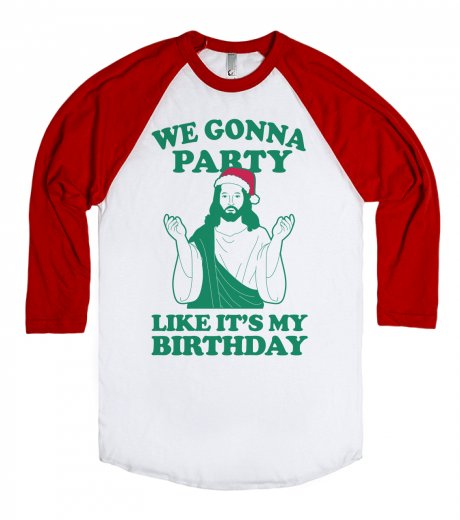
Tee Time: We gonna party like it’s my birthday

We gonna party like it's my birthdayFound at skreened.com.

Posted in T-shirts | Tagged , | Leave a comment

Christmas Roundup: The Polar Express, the Magi in art, the historical “Santa,” and more

“Jesus, Jacob, and The Polar Express by Greg Lucas: This dad reflects on his twenty-year-old autistic son’s emotional experience of Santa and wonders whether maybe the eager anticipation he feels waiting for Santa, and then the pure joy of finally seeing him (at the end of the movie, or the front of the line), indicates a deeper yearning, and is preparing him to experience a deeper joy—for and in Jesus.

“The Magi: Legend, Art, and Cult”: The Museum Schnütgen in Cologne is running an exhibition through January 25 that brings together ivories, sculptures, paintings, and manuscript illuminations from throughout Europe depicting the Three Wise Men. Learn the iconography associated with them, from their earliest appearance in art in the third century.

Left panel of a French diptych, ca. 1360. Tempera on wood, 50 x 31 cm. Museo Nazionale del Bargello, Florence.

Left panel of a French diptych, ca. 1360. Tempera on wood, 50 x 31 cm. Museo Nazionale del Bargello, Florence.

“Come, Thou Long-Expected Jesus” exegesis by W. David O. Taylor: Drawing on a sermon he gave as part of a series on the hymns of Advent and Christmas, Taylor analyzes the poetic structure and theological message of “Come, Thou Long Expected Jesus,” while also providing information about its author, Charles Wesley, and his place in the history of Christian hymnody.

Looking for a way to teach your kids about the real Saint Nicholas? Why not try the 2009 VeggieTales movie Saint Nicholas: A Story of Joyful Giving. (To acquaint yourself with his story beforehand, see my blog post from last year, “The Real Saint Nick.”)


Have you seen the video of this “O Holy Night” flash mob from last year? Vocalist Mark Joseph along with fifty or so of his fellow Berklee students performed inside Boston’s Museum of Fine Arts. I love living in a city with such musical talent!

Posted in History, Inspirational, Music, Roundup, Western Art | Tagged , , , , , | Leave a comment

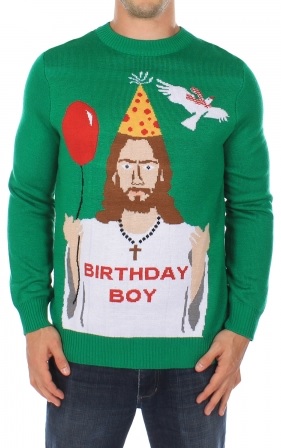
Tee Time: Birthday Boy

Jesus Christmas sweaterIn lieu of a T-shirt this week, here’s a sweater featuring Christmas’s #1 birthday boy. Sorry, it’s out of stock. Maybe tipsyelves.com will bring it back in time for next year’s ugly-sweater holiday parties.

Posted in T-shirts | Tagged , , | Leave a comment

The Christmas Truce of 1914

This December marks the centennial of the famous ceasefire along the Western Front during World War I. On Christmas Eve, 1914, along the four-hundred-mile frontline, enemy soldiers spontaneously emerged from their trenches, arms laid aside, to celebrate Christ’s birth together. They sang carols, exchanged gifts (jams and candies, cigarettes, newspapers), kicked around a soccer ball, and shared photos of loved ones. They also buried each other’s dead and prayed communally over the bodies, led by chaplains. Some even exchanged home addresses and promised to visit after the war.

One soldier described it in a letter home as “the Wonderful Day.” Another soldier, Pvt. Karl Muhlegg, wrote, “Never was I as keenly aware of the insanity of war.”

>> Read more firsthand accounts. <<

Though temporary truces are not unique in military history (they have been recorded since as far back as the Trojan War), never have they been carried out on such a large scale, and accompanied by such fraternization, as that of the Christmas Truce of 1914. Remarkably, this truce grew out of no single initiative but sprang up independently in many of the camps, against the orders of higher-ups. In most places it lasted from Christmas Eve through Boxing Day (December 26), though in some it lasted into January. It is estimated that some 100,000 men took part.

Inspired by this event, French filmmaker Christian Carion wrote and directed a dramatized film version of it, called Joyeux Nöel, which was nominated in 2006 for an Academy Award for Best Foreign Film. The film focuses on three different regiments—one Scottish, one French, and one German—and their interactions with one another during that first Christmas on the front.   Continue reading

Posted in Death / tragedy / suffering, Film, History, Inspirational, Poetry | Tagged , , , , | 3 Comments

Vintage Jesus, Part 11: Why Did Jesus’s Mom Need to Be a Virgin?

This twelve-part series outlines the “Vintage Jesus” sermons of Mark Driscoll. See part 1 here.

For a more succinct answer to this question, I refer you to the article “The Glory of His Virgin Birth” by David Mathis.


“I would like to ask him [Jesus] if he was indeed virgin-born. The answer to that question would define history for me.”—Larry King, in response to what one question he would ask Jesus

“The day will come when the mystical generation of Jesus by the Supreme Being as His father, in the womb of a virgin, will be classed with the fable of the generation of Minerva in the brain of Jupiter.”—Thomas Jefferson, in a letter to John Adams

0:55: Interview with Rabbi Mark Glickman

10:00: The virgin birth of Jesus is the second most controversial and debated miracle in all of human history.

12:09: What Scripture says

12:19: Genesis 3:15: The Lord God said to the serpent, “I will put enmity between you and the woman, and between your offspring and her offspring; he shall bruise your head, and you shall bruise his heel.”

This verse is known as the Protoevangelium (“first gospel”), because it is the first promise of redemption in the Bible. It alludes only vaguely to the virgin birth, in that it speaks of the woman’s offspring rather than the man’s, which is unusual in a patriarchal society, where genealogies are traced through the male line. Paul follows suit in Galatians 4:4, where he mentions that Jesus was “born of a woman” rather than giving the name of the father.

15:30: Isaiah 7:14: “Therefore the Lord himself will give you a sign. Behold, the virgin shall conceive and bear a son, and shall call his name Immanuel.”  Continue reading

Posted in Theology | Tagged , , , , , , | Leave a comment