Alive Because He Is

I am the resurrection and the life.  He who believes in me will live, even though he dies; and whoever lives and believes in me will never die. Do you believe this?”  -John 11:25-26

“Don’t you know that all of us who were baptized into Christ Jesus were baptized into his death?  We were therefore buried with him through baptism into death in order that, just as Christ was raised from the dead through the glory of the Father, we too may live a new life.”  -Romans 6:3-4

Jesus resurrection

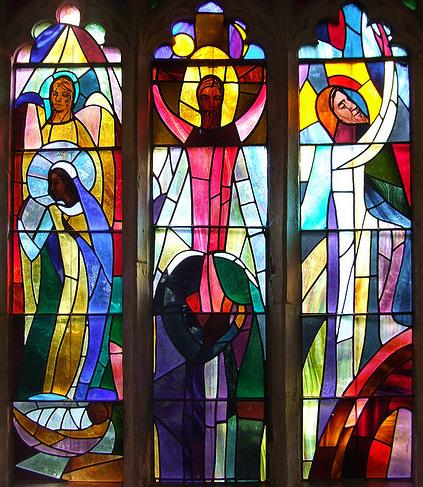
Rosemary Rutherford, "The Empty Tomb, Crucifixion, Resurrection," c. 1971, St. Mary's Church, Hinderclay, Suffolk, England

The death and resurrection of Jesus form the entire basis of Christianity, for it is through these two historical events that God reconciled mankind to himself—crushing the power of sin and death, which had held us separate, once and for all—and laid the foundation for the New Creation.  There are a lot of theological buzzwords associated with the Easter message—atonement, redemption, justification, imputation of righteousness, regeneration—but today I’d like to single in, just for a moment, on the liberating impact of Jesus’ death and resurrection.  Continue reading

Posted in Theology, Western Art | Tagged , , | Leave a comment

Gethsemane, Part 8: Indigenous Interpretations

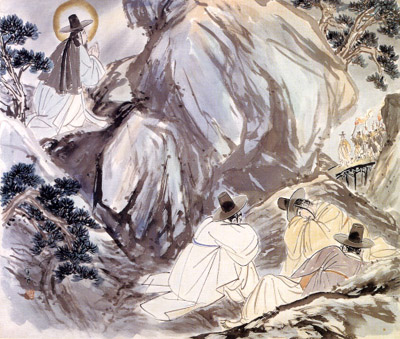
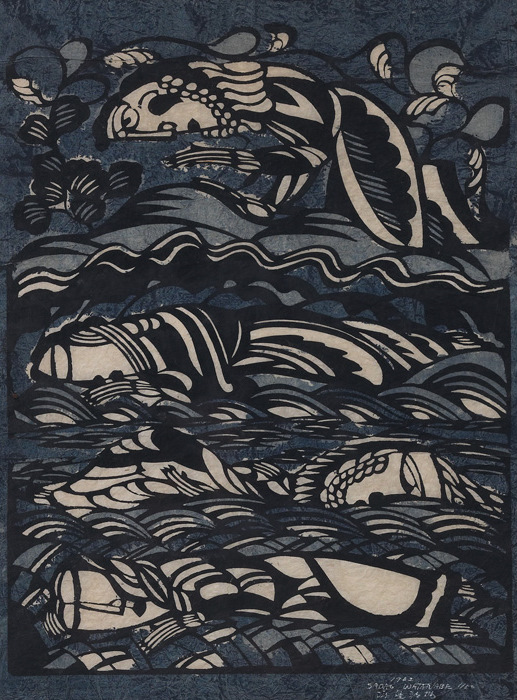
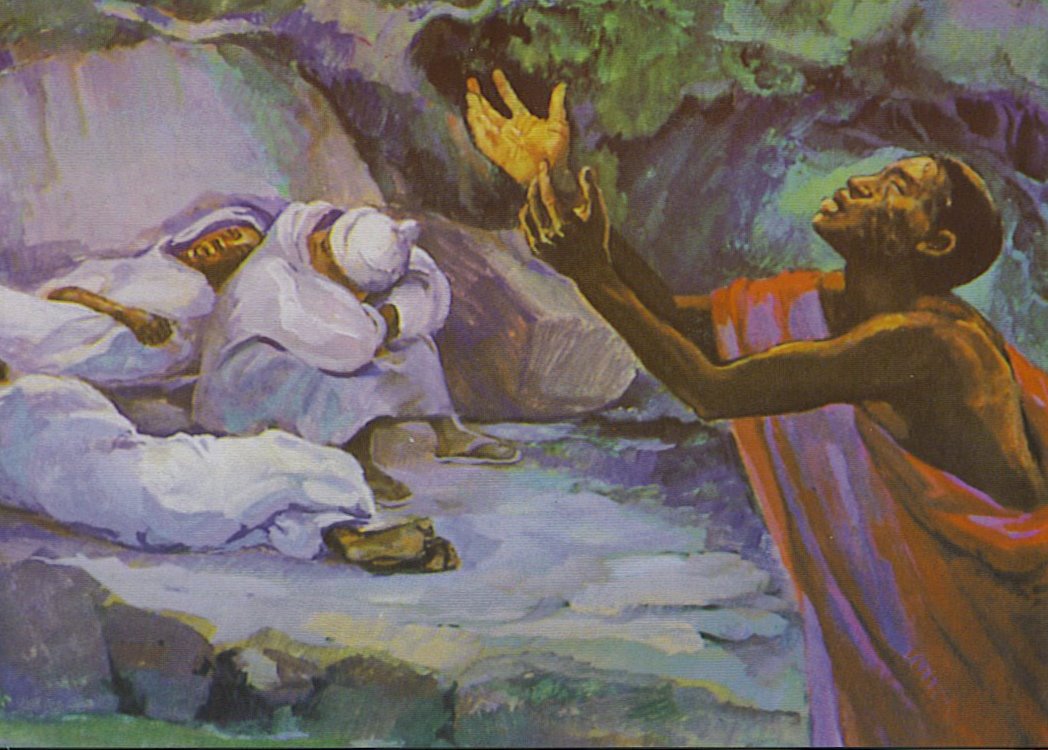
This is my last post on Gethsemane, and I’d like to devote it to the presentation of some indigenous interpretations of the event.  In the Christian art of other countries, Gethsemane is treated far less frequently than other events in the life of Christ, like the nativity and the last supper.  (Madonna and Child portraits, though, tend to be the most common.)  But I was able to find these few pieces of art on the topic (in addition to the two contemporary paintings I discussed in a previous post—from Indonesia and Uganda).  Note how each artist gives Jesus native features, clothes him in native dress, and places him in a native environment.
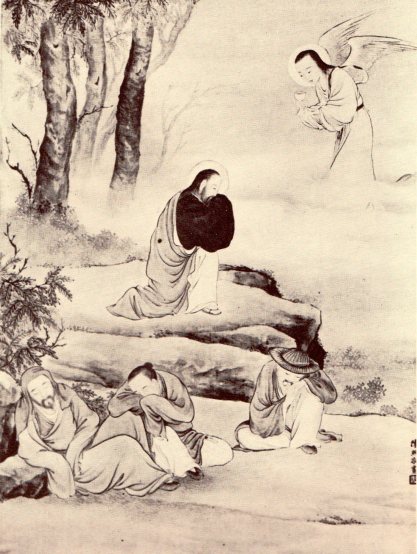
Christ in Gethsemane

Luke Ch’en, “Gethsemane,” 1928 (China). Source: Each With His Own Brush by Daniel Johnson Fleming
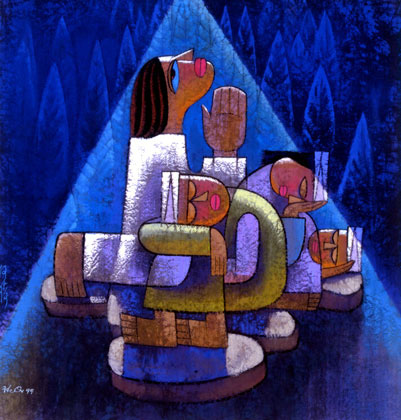
Christ in Gethsemane

He Qi, “Praying at Gethsemane,” 1999 (China). Source: HeQiGallery.com

Christ in Gethsemane

Ki-chang Woonbo Kim, “Christ in Gethsemane,” 1952-53 (Korea). Source: woonbokorea.co.kr

Christ in Gethsemane

Sadao Watanabe, “Garden of Gethsemane,” 1962 (Japan). Source: liveauctioneers.com

Christ in Gethsemane

Jyoti Sahi, “Gethsemane,” 1983 (India).  Source: jyotiartashram.blogspot.com

Christ in Gethsemane

“Gethsemane,” 1973 (Cameroon). Source: Jesusmafa.com
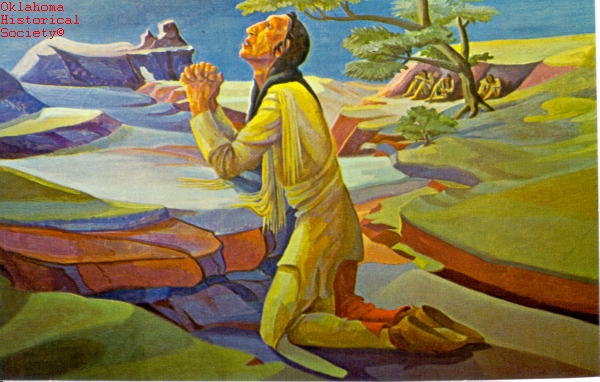
Christ in Gethsemane

Walter Richard West, “Gethsemane,” 1954 (American Indian, Cheyenne). Source: Oklahoma Historical Society’s Encyclopedia of Oklahoma History & Culture

You may find it odd that these artists have chosen to depict Christ as Chinese, Japanese, and so on, but they probably find it just as odd that Americans depict him as American—white-skinned, wavy-haired, and blue-eyed—or cling instead to the Italianate Jesuses of the Renaissance.  What makes the American or European version of Christ any more valid than another country’s or people’s?  The majority of Christians have fixed Jesus in their minds as a Westerner, forgetting (or ignoring) the fact that he was Middle Eastern—a Jew from Palestine.  So is it right to displace him from his racial and cultural context so that we might adapt him to our own, and make him look just like ourselves?

This question is a loaded one, and I’m posing it now so that you can think about it for a while, as it is one of the main questions I hope to answer over the course of this blog.  For now, I just want you to start thinking about your picture of Jesus, and how much it is shaped by the culture you live in.  (And by “picture” I mean a visual idea, yes, but I’m also talking about your picture of Jesus’ whole person—personality, goals, values, and all.)

Posted in Non-Western Art | Tagged , , , , , | 1 Comment

Gethsemane, Part 7: An Abstract Perspective

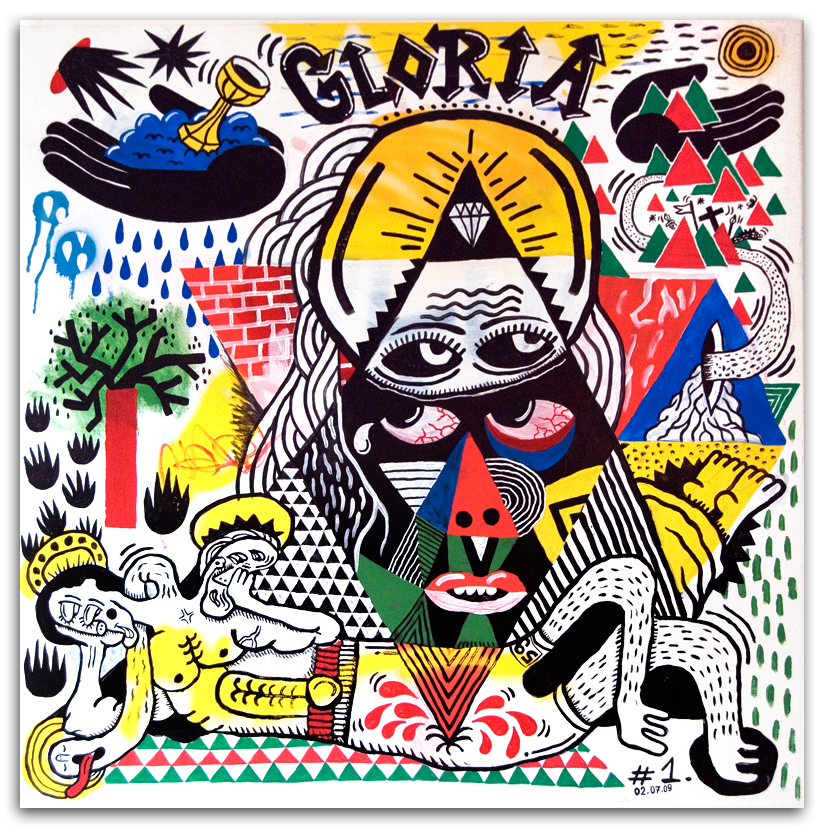
Christ in Gethsemane

3TTman, “First Station: Jesus in the Garden of Gethsemane,” 2010

This painting is part of a Stations of the Cross series by French street artist 3TTman.  He said he’s intrigued by religious symbology, the art of expression by symbols, which is why he chose to tell the story of Christ’s crucifixion wholly through them.

Although I can’t say definitively what the artist meant to represent with each of these symbols, the painting as a whole obviously represents the sorrow that was experienced, by Son and Father, in Gethsemane—but also the glory that accompanied it.  (And lest you think I’m a clever interpreter of abstract art—no, not really, the title just tipped me off.)  Continue reading

Posted in Western Art | Tagged , , , | 2 Comments

‘Sweet Jesus,’ it’s a PEEPshow!

Jesus made of peeps

Heather Hodge and Brad Conn, "Sweet Jesus," 2011

Here’s a timely Jesus, made up entirely of marshmallow Peeps!  Found by Marcus G.  (Thanks, Marcus!)

This Peep art was sponsored by the Carroll County Arts Council of Maryland.  Check out their flickr page for the other entries in last week’s fourth annual PEEPshow.

And take a minute to thank Jesus for being such a sweet Savior.  🙂

Posted in Jesus Kitsch | Tagged , , | 2 Comments

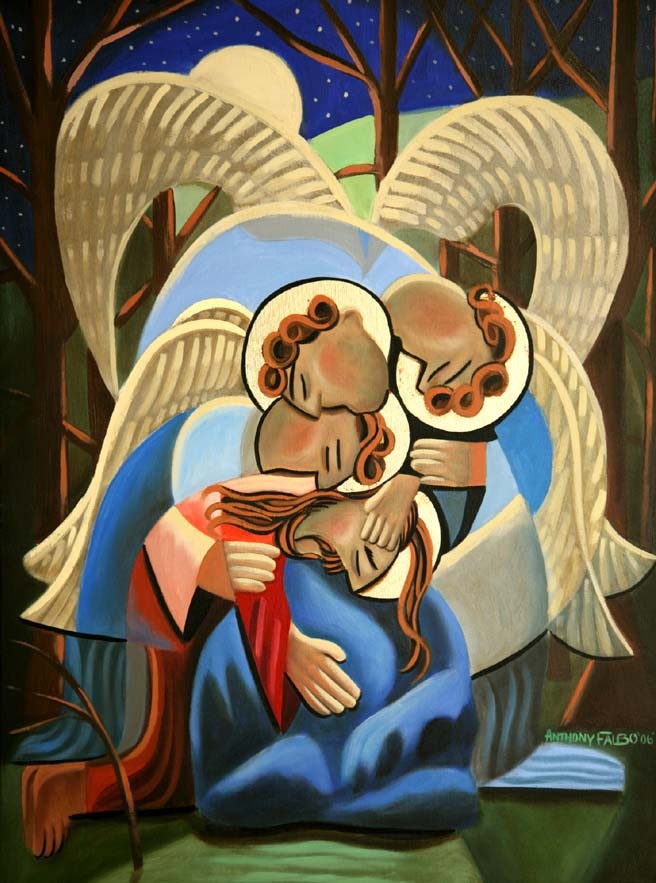
Gethsemane, Part 6: Covered by Angels

“Jesus went out as usual to the Mount of Olives, and . . . an angel from heaven appeared to him and strengthened him.” —Luke 22:39, 43

Christ in Gethsemane

Anthony Falbo, Gethsemane (The Hour is Near), 2006. Oil on canvas.

Luke is the only one of the Gospel writers to mention that in response to Jesus’s pained pleas in Gethsemane, an angel came down to strengthen him. American artist Anthony Falbo renders this moment of heavenly condescension in his painting Gethsemane (The Hour is Near). Unlike other artistic depictions of the same event, this one seems profoundly personal. The angels are not smiling on from a distance, enclosed in a giant orb of light, with arms outstretched but making no contact. To the contrary: the weight of these angels’  bodies falls firmly but gently on Christ as they enwrap him round about. They close their eyes, as if they’re trying to absorb his pain, to feel it along with him. They’re conduits of the Father’s comfort, for it is he who sent them down, to strengthen his Son in his moment of weakness. Continue reading

Posted in Western Art | Tagged , , | 2 Comments

Gethsemane, Part 5: Angry Jesus, Rockin’ It Out in the Garden

We’ve heard what the Gospel writers said about Jesus in Gethsemane. Now it’s time to examine a Hollywood perspective. In 1973, the rock opera Jesus Christ Superstar hit the big screen, with actor-singer Ted Neeley playing Jesus. One of the most tension-filled scenes in the movie is the scene in Gethsemane, during which Jesus expresses his bitterness, anger, and confusion toward God the Father. (The lyrics can be found here.) This movie is definitely worth watching, if for nothing else, then simply to consider the contemporary portrait it paints of Jesus.

Continue reading

Posted in Film | Tagged , , , | 2 Comments

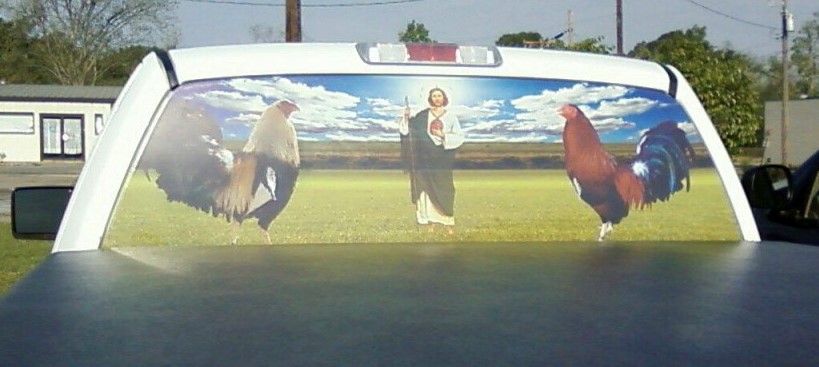
‘I Now Pronounce You Rooster and Hen’

A favorite daily amusement of mine is visiting the blog Jesus Needs New PR, maintained by Christian author Matthew Paul Turner. Among other things, Matthew posts photos of all the Jesus junk he encounters, many of which are submitted by his readers.

Here are just a few from this week:

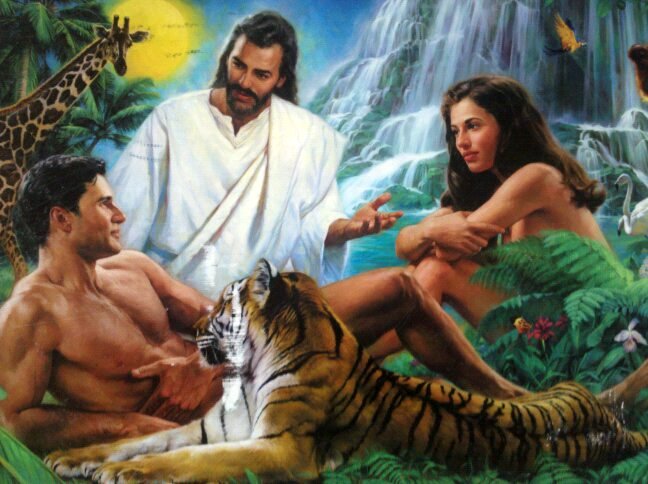
Jesus with Adam and Eve

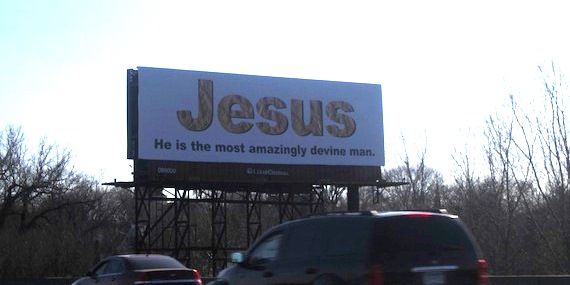
I . . . don’t even know how to respond to these. I’ll just let the comments on Matthew’s posts speak for me.

OK, one more:

Update, 10/23/13: I discovered that the second image is a painting by Nathan Greene called The Introduction. On another note, Jesus Needs New PR is now defunct; Turner now blogs at www.matthewpaulturner.com.

Posted in Jesus Kitsch | Tagged , , | Leave a comment

Gethsemane, Part 4: To Drink Or Not To Drink?

Jesus’ prayer in the Garden of Gethsemane has always been a question-raiser for me, mostly on the subject of wills.  I might have alternatively entitled this post “A Will Divided?”.

Before I go any further, let me first cite the three parallel Gospel accounts of Jesus’ prayer (which I take from the New International Version):

“My Father, if it is possible, may this cup be taken from me.  Yet not as I will, but as you will. … My Father, if it is not possible for this cup to be taken away unless I drink it, may your will be done.”  -Matthew 26:39, 42

“Abba, Father, everything is possible for you.  Take this cup from me.  Yet not what I will, but what you will.”  -Mark 14:36

“Father, if you are willing, take this cup from me; yet not my will, but yours be done.”  -Luke 22:42  Continue reading

Posted in Theology, Western Art | Tagged , , , , , , | Leave a comment

Gethsemane, Part 3: Through the Oil Press, or The Final Temptation

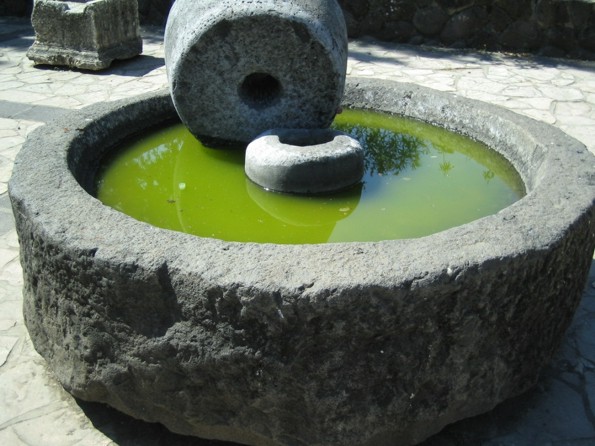
The Garden of Gethsemane is located at the foot of the Mount of Olives in Jerusalem (yes, it’s still there).  The name literally means “oil press.”

Oil Press

I’m going to fly away with a metaphor here, so bear with me, and reflect, if you will, on the image of Jesus as an olive, being pressed on all sides not only with thoughts of impending death and abandonment, but with the temptation to cease and desist from his mission.  We talk a lot about Jesus’ temptation in the wilderness, where he actually dialogued with Satan, but what about his temptation in the garden?  God’s plan for Jesus is just about to reach its climax, and it’s Jesus’ last chance to back down.  Satan knew that he would be particularly vulnerable at this time, so he attacks.  Here in the garden, Satan tries to crush the soul of the Lord—he runs a millstone over him, so to speak, putting pressure on him in an attempt to squeeze him dry.

What does a mind under such heavy pressure look like?  Well, probably something like this: Continue reading

Posted in Film, Non-Western Art, Theology | Tagged , , , , , | 2 Comments

Jesus Cottontail, Come to Save His Peeps

Posted in Uncategorized | Leave a comment