Tee Time: The Evolution of Jesus

Evolution of JesusFound at 8ball.co.uk.

Posted in Jesus Kitsch | Tagged , | 1 Comment

“On the Morning of Christ’s Nativity”: Stanzas 13-18

This is part 5 of a series on John Milton’s poem “On the Morning of Christ’s Nativity.” Read part 1 here. Read the complete poem here.

XIII.
Ring out, ye crystal spheres!1
Once bless our human ears,
If ye have power to touch our senses2 so;
And let your silver chime
Move in melodious time;
And let the bass of heaven’s deep organ blow;
And with your ninefold harmony3
Make up full consort of the angelic symphony.

XIV.
For, if such holy song
Enwrap our fancy long,
Time will run back and fetch the Age of Gold;4
And speckled Vanity
Will sicken soon and die,
And leprous Sin will melt from earthly mould;
And Hell itself will pass away,
And leave her dolorous mansions of the peering day.

XV.
Yes, Truth and Justice then
Will down return to men,
The enamelled arras of the rainbow wearing;
And Mercy set between,
Throned in celestial sheen,
With radiant feet the tissued clouds down steering;
And Heaven, as at some festival,
Will open wide the gates of her high palace-hall.  Continue reading

Posted in Poetry, Western Art | Tagged , , , , , | 2 Comments

Tee Time: Baby Jesus Is My Homeboy

Baby Jesus is my HomeboyFound at skreened.com.

Posted in Jesus Kitsch | Tagged , | Leave a comment

“On the Morning of Christ’s Nativity”: Stanzas 8-12

This is part 4 of a series on John Milton’s poem “On the Morning of Christ’s Nativity.” Read part 1 here. Read the complete poem here.

William Blake, "The Annunciation to the Shepherds," 1809. Watercolor on paper, 19.3 x 25.5 cm. Whitworth Art Gallery, Manchester, England.

William Blake, The Annunciation to the Shepherds (Thomas set), 1809. Watercolor on paper, 19.3 x 25.5 cm. Whitworth Art Gallery, Manchester, England.

VIII.
The Shepherds on the lawn,
Or ere the point of dawn,
Sat simply chatting in a rustic row;
Full little thought they than
That the mighty Pan1
Was kindly come to live with them below:
Perhaps their loves, or else their sheep,
Was all that did their silly thoughts so busy keep.

IX.
When such music sweet
Their hearts and ears did greet
As never was by mortal finger strook,
Divinely-warbled voice
Answering the stringèd noise,
As all their souls in blissful rapture took:
The air, such pleasure loth to lose,
With thousand echoes still prolongs each heavenly close.  Continue reading

Posted in Poetry, Western Art | Tagged | 4 Comments

“On the Morning of Christ’s Nativity”: Stanzas 1-7

This is part 3 of a series on John Milton’s poem “On the Morning of Christ’s Nativity.” Read part 1 here. Read the complete poem here.

THE HYMN

I.
It was the winter wild,
While the heaven-born child
All meanly wrapt in the rude manger lies;
Nature, in awe to him,
Had doffed her gaudy trim,
With her great Master so to sympathize:
It was no season then for her
To wanton with the Sun, her lusty Paramour.

II.
Only with speeches fair
She woos the gentle air
To hide her guilty front with innocent snow,
And on her naked shame,
Pollute with sinful blame,
The saintly veil of maiden white to throw;
Confounded, that her Maker’s eyes
Should look so near upon her foul deformities.

III.
But he, her fears to cease,
Sent down the meek-eyed Peace:
She, crowned with olive green, came softly sliding
Down through the turning sphere,
His ready Harbinger,
With turtle wing the amorous clouds dividing;
And, waving wide her myrtle wand,
She strikes a universal peace through sea and land.

IV.
No war, or battail’s sound,
Was heard the world around;
The idle spear and shield were high uphung;
The hookèd chariot stood,
Unstained with hostile blood;
The trumpet spake not to the armèd throng;
And Kings sat still with awful eye,
As if they surely knew their sovran Lord was by.

V.
But peaceful was the night
Wherein the Prince of Light
His reign of peace upon the earth began.
The winds, with wonder whist,
Smoothly the waters kissed,
Whispering new joys to the mild Ocean,
Who now hath quite forgot to rave,
While birds of calm sit brooding on the charmed wave.

VI.
The stars, with deep amaze,
Stand fixed in steadfast gaze,
Bending one way their precious influence,
And will not take their flight,
For all the morning light,
Or Lucifer that often warned them thence;
But in their glimmering orbs did glow,
Until their Lord himself bespake, and bid them go.

VII.
And, though the shady gloom
Had given day her room,
The Sun himself withheld his wonted speed,
And hid his head of shame,
As his inferior flame
The new-enlightened world no more should need:
He saw a greater Sun appear
Than his bright Throne or burning axletree could bear.
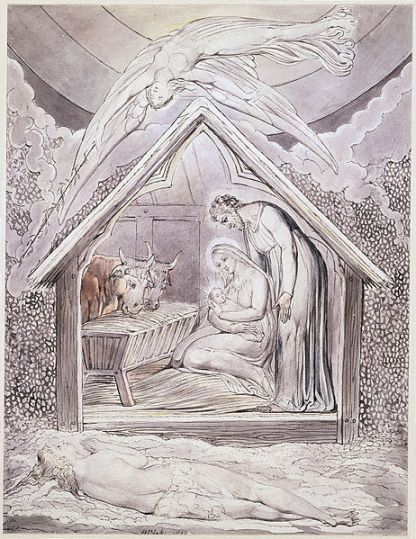
Blake nativity

William Blake, The Descent of Peace (Thomas set), 1809. Watercolor on paper, 19.4 x 25.5 cm. Whitworth Art Gallery, Manchester, England. Description: Peace breaks through the heavenly spheres, dispersing the clouds and waving her myrtle wand, while Nature (below) covers her nakedness with a snowy veil as she pays reverence to her Lord.

___________________

In these seven stanzas, Milton uses personification to color the context of Christ’s birth. Inanimate nature is imagined as a glamorous woman who, taking cue from her Lord, strips off her jewelry, makeup, and other finery, for these things would have been inappropriate for a stable birth. This stripping bare signifies winter. Nature prepares herself for Christ’s coming.  Continue reading

Posted in Poetry, Western Art | Tagged , | 2 Comments

“Where’s the line to see Jesus?”

This music video featuring the vocals of Becky Kelley became an instant YouTube sensation two years ago when it was first posted, having since garnered over 3.8 million views. Kelley says that the song was inspired by and titled after what her four-year-old nephew asked her while they were waiting in line at the mall to see Santa. The music and lyrics were written by her father, Steve Haupt.

What if there really were a line to see Jesus at the mall every Christmas? Kind of a funny thought . . .

Jesus at the mall

Advertisement put out by the United Church of Canada in 2006.


Posted in Music | Tagged , | Leave a comment

Tee Time: Taking Back Christmas

T-shirt_Taking Back ChristmasFound at T-shirt Hell.

Posted in Jesus Kitsch | Tagged , | Leave a comment

“On the Morning of Christ’s Nativity”: Preface

This is part 2 of a series on John Milton’s poem “On the Morning of Christ’s Nativity.” Read part 1 here. Read the complete poem here.

PREFACE

I.
This is the month, and this the happy morn,
Wherein the Son of Heaven’s eternal King,
Of wedded maid and Virgin Mother born,
Our great redemption from above did bring;
For so the holy sages once did sing,
That he our deadly forfeit should release,
And with his Father work us a perpetual peace.

II.
That glorious Form, that Light unsufferable,
And that far-beaming blaze of majesty,
Wherewith he wont at Heaven’s high council-table
To sit the midst of Trinal Unity,
He laid aside, and, here with us to be,
Forsook the Courts of everlasting Day,
And chose with us a darksome house of mortal clay.

III.
Say, Heavenly Muse, shall not thy sacred vein
Afford a present to the Infant God?
Hast thou no verse, no hymn, or solemn strain,
To welcome him to this his new abode,
Now while the heaven, by the Sun’s team untrod,
Hath took no print of the approaching light,
And all the spangled host keep watch in squadrons bright?

IV.
See how from far upon the Eastern road
The star-led Wisards haste with odours sweet!
Oh! run; prevent them with thy humble ode,
And lay it lowly at his blessèd feet;
Have thou the honour first thy Lord to greet,
And join thy voice unto the Angel Quire,
From out his secret altar touched with hallowed fire.  Continue reading

Posted in Poetry | Tagged , | 2 Comments

“On the Morning of Christ’s Nativity” by John Milton, with illustrations by William Blake

A few decades prior to writing his famous epic, Paradise Lost, John Milton composed this thirty-one-stanza ode—his first major work in English. Written in 1629 when he was just 21, the poem examines the cosmic significance of the incarnation, celebrating Christ’s triumph over the gods of paganism from the manger.

Regarding the poem’s composition, Milton wrote to his friend Charles Diodati,

I am singing the King of Heaven, bringer of peace, and the fortunate days promised by the holy book, the wanderings of God, and the stabling under a poor roof of Him who rules with his Father the realms above; the star that led the wizards, the hymning of angels in the air, and the gods flying to their endangered fanes. This poem I made as a birthday gift for Christ; the first light of Christmas dawn brought me the theme.1

Between 1803 and 1815, visionary poet and visual artist William Blake painted on commission two sets of watercolors to illustrate the poem—one for the Rev. Joseph Thomas (the “Thomas set”), and one for Thomas Butts (the “Butts set”). Each set contains six watercolors, and there is much resemblance between the two. The list of illustrations is as follows. (You’ll notice that not all the stanzas are illustrated.)

  1. The Descent of Peace (stanzas 1-3)
  2. The Annunciation to the Shepherds (stanzas 8-12)
  3. The Old Dragon (stanza 18)
  4. The Overthrow of Apollo and the Pagan Gods (stanzas 19-23)
  5. The Flight of Moloch (stanza 23)
  6. The Night of Peace (stanza 27)

As we move toward Christmas and Epiphany in the next few weeks, I will split up the poem into a series of bite-size posts, expositing the text along the way and contributing some of my own reflections. The illustrations I use will be from the Thomas set.

___________________

NOTES

1. ^ John Milton, “Elegia Sexta” (Elegy VI), a verse-letter written December 13, 1629, translated from the Latin by William Vaughn Moody in The Complete Poetical Works of John Milton (Cambridge Edition) (Boston and New York: Houghton, Mifflin, 1899), 339.

Read part 2.

Posted in Poetry | Tagged , | 6 Comments

Tee Time: Jesus Christ Is Coming to Town

T-shirt_Jesus Christ is coming to townFound at ellesplanet.wordans.us.

Posted in Jesus Kitsch | Tagged , | Leave a comment