A crucifix like no other

1914 German postcard

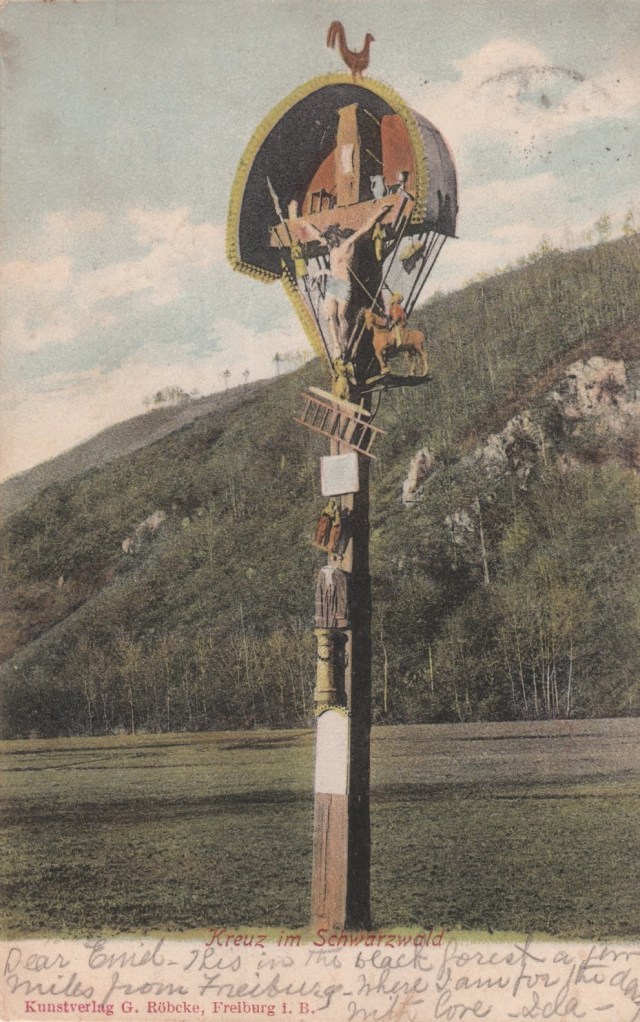
What’s going on here?

This is a 1914 German postcard from the collection of Jim Linderman. The caption reads Kreuz im Schwarzwald (“Cross in the Black Forest”), and the bottom line identifies G. Röbcke of Freiburg im Breisgau as the publisher.

I’m not sure whether this is/was an actual landmark or is just a fanciful hodgepodge of handcrafted wares; it could really be either.

At first glance the picture resembles a trash heap, but on closer inspection, one can see that the objects are not random at all but rather are carriers of symbolic meaning: from what I can make out, there’s a rooster weather vane (Peter’s denial), a lantern (Jesus is the light of the world), a water pitcher (Pilate’s hand-washing), a chalice (the Last Supper), a garment (for which lots were cast), a ladder (traditionally featured in paintings of the Deposition), and instruments of the passiona hammer (for the nails), a column (for the scourging), and at the bottom, a crown of thorns. And then, of course, there’s Longinus on horseback, and golden angels scattered about. All this under an awning that’s reminiscent of a barrel-vaulted cathedral niche.

Symbolism is a prominent feature in traditional Western crucifixion paintings, but the symbolic elements tend to be arranged more neatly, spread out evenly throughout the frame. Here they are all attached to the cross like magnets, creating imbalanced clutter.

This image is fun because it’s unconventional—a sort of upward-growing still life with devotional import. On a postcard. Interesting . . .

Posted in Jesus Kitsch, Western Art | Tagged , , , , | 3 Comments

Tee Time: Do you knead Jesus?

T-shirt_Do you knead JesusFound at zazzle.com.

Posted in Jesus Kitsch | Tagged , | Leave a comment

Be a thermostat, not a thermometer

As a fitting follow-up to yesterday’s post, here is a challenge to the church given by the Rev. Dr. Martin Luther King Jr. in his 1963 Letter from a Birmingham Jail. (If you have never read this letter in its entirety, do it.) After condemning the church for her failure to speak out boldly against injustice and thereby defend the principles of God’s Word, Dr. King begs her to become once again the “thermostat” that she was in her early days—regulating the moral climate of society, rather than merely projecting the temperature that society has already set.

“In deep disappointment I have wept over the laxity of the church. But be assured that my tears have been tears of love. There can be no deep disappointment where there is not deep love. Yes, I love the church. How could I do otherwise? I am in the rather unique position of being the son, the grandson and the great grandson of preachers. Yes, I see the church as the body of Christ. But, oh! How we have blemished and scarred that body through social neglect and through fear of being nonconformists.

“There was a time when the church was very powerful—in the time when the early Christians rejoiced at being deemed worthy to suffer for what they believed. In those days the church was not merely a thermometer that recorded the ideas and principles of popular opinion; it was a thermostat that transformed the mores of society. Wherever the early Christians entered a town the power structure got disturbed and immediately sought to convict them for being ‘disturbers of the peace’ and ‘outside agitators.’ But they went on with the conviction that they were ‘a colony of heaven’ and had to obey God rather than man. Small in number, they were big in commitment. They were too God-intoxicated to be ‘astronomically intimidated.’ By their effort and example they brought an end to such ancient evils as infanticide and gladiatorial contests. Things are different now. So often the contemporary church is a weak, ineffectual voice with an uncertain sound. So often it is an archdefender of the status quo. Far from being disturbed by the presence of the church, the power structure of the average community is consoled by the church’s silent—and often even vocal—sanction of things as they are.

“The judgment of God is upon the church as never before. If today’s church does not recapture the sacrificial spirit of the early church, it will lose its authenticity, forfeit the loyalty of millions, and be dismissed as an irrelevant social club with no meaning for the twentieth century.”

Posted in Politics | Tagged , , | 2 Comments

“The Rise of Christianity” by Rodney Stark

The Rise of ChristianityLast year I read the book The Rise of Christianity: How the Obscure, Marginal Jesus Movement Became the Dominant Religious Force in the Western World in a Few Centuries by Rodney Stark, published by HarperSanFrancisco in 1997. I was intrigued by the subtitle, as it’s a question I often wondered about. How did Christianity dislodge classical paganism and become the dominant faith of Western civilization? I had my own theories, of course, but it was fascinating to read a non-Christian sociologist’s analytical perspective on the matter. (At the time of publication, Stark identified as an agnostic, but in a 2007 interview with Massimo Introvigne, he said that he now identifies as an “independent Christian.”)

Stark’s research led him to the following conclusion:

Christianity did not grow because of miracle working in the marketplaces (although there may have been much of that going on), or because Constantine said it should, or even because the martyrs gave it such credibility. It grew because Christians constituted an intense community, able to generate the “invincible obstinacy” [against paganism] that so offended the younger Pliny but yielded immense religious rewards. And the primary means of its growth was through the united and motivated efforts of the growing numbers of Christian believers, who invited their friends, relatives, and neighbors to share the “good news.” . . .

Let me state my thesis: Central doctrines of Christianity prompted and sustained attractive, liberating, and effective social relations and organizations.

I believe that it was the religion’s particular doctrines that permitted Christianity to be among the most sweeping and successful revitalization movements in history. And it was the way these doctrines took on actual flesh, the way they directed organizational actions and individual behavior, that led to the rise of Christianity. (208, 211)

In his elaboration of this thesis, Stark proposes the following reasons for Christianity’s rapid growth in the first few centuries of the Common Era.  Continue reading

Posted in Books | Tagged , , , | 12 Comments

Tee Time: I Love Cheeses

I love cheesesFound at MrCloud.com.

Posted in Jesus Kitsch | Tagged , | Leave a comment

Jacob Wrestling the Angel: A Visual Meditation

I wrote ArtWay.eu’s visual meditation for today, on a painting by Jewish artist Arthur Sussman (1927-2008). Hop on over and check it out! http://www.artway.eu/content.php?id=1281&action=show&lang=en

The meditation is based on Genesis 32:22-32:

22 That night Jacob got up and took his two wives, his two female servants and his eleven sons and crossed the ford of the Jabbok. 23 After he had sent them across the stream, he sent over all his possessions. 24 So Jacob was left alone, and a man wrestled with him till daybreak. 25 When the man saw that he could not overpower him, he touched the socket of Jacob’s hip so that his hip was wrenched as he wrestled with the man. 26 Then the man said, “Let me go, for it is daybreak.”

But Jacob replied, “I will not let you go unless you bless me.”

27 The man asked him, “What is your name?”

“Jacob,” he answered.

28 Then the man said, “Your name will no longer be Jacob, but Israel, because you have struggled with God and with humans and have overcome.”  Continue reading

Posted in Western Art | Tagged , , , , | 1 Comment

Even witches love Jesus?

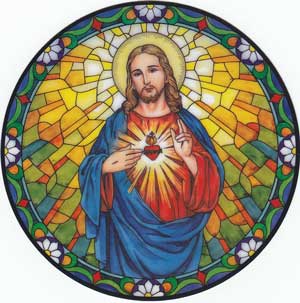
Sacred Heart of JesusI’ve mentioned before that I’m intrigued by how far Jesus’s reach is to people of other faiths. If a non-Christian religion does not officially recognize Jesus as a positive figure, then at the very least a large body of individuals belonging to that religion will have some kind of an affinity or respect for or even devotion to his person. Case in point: when researching the sacred heart of Jesus, I found that an online pagan, Wiccan, and witchcraft store sells a sticker with that image, describing it as a reminder of “the divine love of Christ.” The store also sells Jesus amulets and incense sticks.

It’s cool to me that so many people when they think of Christ think of his love. The association is automatic. Not so cool is how they tend to think of him as a flat figure possessing only that one attribute, and ignore or misunderstand those works which most proved his love. And being without the Spirit, they try to connect with him or channel his power in unbiblical ways (i.e., thinking that his protection comes from a silver charm).

The impulse to worship Christ is widespread. But in too many cases that translates into simply adding him to a pantheon of other gods, or reconfiguring him to suit your needs and tastes. Even Christians are sometimes guilty of this.

Jesus is love, and love is his greatest commandment. But he is also furious at sin, and he demands exclusive devotion.

Posted in Jesus Kitsch | Tagged , , , | 1 Comment

Tee Time: Let Jesus Occupy Your Heart

T-shirt_Jesus OccupyI’m several months late on this one, but I just couldn’t pass it up. Found at kerusso.com.

Posted in Jesus Kitsch | Tagged , | 1 Comment

“On the Morning of Christ’s Nativity”: Final Thoughts

This is the seventh and final part of a series on John Milton’s poem “On the Morning of Christ’s Nativity.” Read part 1 here. Read the complete poem here.

I hope you enjoyed delving into this poem of Milton’s. I love how it starts out as a typical Christmas poem—with soft, sweet language and pretty images—and then turns into a drama of epic proportions. The “But” of stanza 16 cuts through the tranquility of the first fifteen stanzas, exposing the spiritual warfare taking place beneath the surface of the event. To Milton, the first Christmas was not just a cuddly new baby and angels singing and presents and calm winds and soft snows, but mayhem, wailing, destruction, and mad flight, as the pagan gods were driven out from their seats of power.

Like many of his contemporaries (and some Christians today), Milton considered the gods of other religions to be demons—fallen angels with the power to perform miracles and embody different forms in their efforts to attract worship toward themselves and away from the one true God. This idea is developed more thoroughly in Paradise Lost. Milton believed, for example, that Apollo is the name of a demon who through deception inspired a cult following in ancient Greece. People erected statues of him and burned offerings to him and praised his mighty deeds. During his time of power, Apollo frequently resided in his shrine at Delphi and spoke to or possessed Pythia, the Oracle, inspiring false prophesies and perverse religious practices.

One theme running throughout the poem is the emptiness of pagan worship. The people engage in elaborate rituals to honor their local deities or to petition them to act on their behalf, but their gods are not even there anymore. And they never really were—only the illusion of them was. The “gods” are in reality nothing but resentful beings who have been cast out of heaven by God and are now bent on taking down as many people with them as they can.

In Blake’s illustrations, the gods are shown fleeing their images and shrines in terror of their enemy, Christ, who has just stepped onto the battlefield. The battle is swift—the light of Christ pushes the gods back to the darkness from whence they came. It’s a hasty retreat, directly into the prison that will become their grave.

The poem is about the destruction of one kingdom and the inauguration of another. The authoritarian rule of Satan and his demon viceroys is over—Christ’s birth severely limits their power, as he displaces them from their throne. That’s not to say, though, that Satan no longer exercises influence in this world. He may be bound, God’s prisoner-of-war, but there are still many who pay him their loyalty. His final defeat is still pending.

“On the Morning of Christ’s Nativity” is an ode—a praise song. It’s an ode to the birth of Christ and, by extension, his victory over all other gods, particularly those of Canaan, Babylon, Egypt, Greece, and Rome. How unusual for the genre: our martial hero is an infant! God’s first battle as Christ-on-Earth is fought from a manger-crib.

After this military interlude, the image of the bright and peaceful stable scene returns full circle. In Blake’s first painting, Peace descends, and in the last, Peace is here to stay. But let’s not forget that behind the scenes of this icon of Christmas, the cosmic forces of good and evil are confronting each other in a big way.

Posted in Poetry | Tagged | 6 Comments

“On the Morning of Christ’s Nativity”: Stanzas 19-27

This is part 6 of a series on John Milton’s poem “On the Morning of Christ’s Nativity.” Read part 1 here. Read the complete poem here.

The emphasis in stanza 25 is mine.

The Overthrow of Apollo by William Blake

William Blake, The Overthrow of Apollo and the Pagan Gods (Thomas set), 1809. Watercolor on paper, 19.3 x 25 cm. Whitworth Art Gallery, Manchester, England. Description: Pagan worshipers burn an offering to Apollo as his spirit flees its statue in fear. (The statue depicts Apollo’s defeat of the giant serpent Python, who had tormented his mother during her pregnancy.) To the right, a disheveled Nymph hides in a thicket to mourn, while above her, a train of refugee gods and goddesses fills the sky.

XIX.
The Oracles are dumb;
No voice or hideous hum
Runs through the archèd roof in words deceiving.
Apollo from his shrine
Can no more divine,
Will hollow shriek the steep of Delphos1 leaving.
No nightly trance, or breathèd spell,
Inspires the pale-eyed Priest from the prophetic cell.

XX.
The lonely mountains o’er,
And the resounding shore,
A voice of weeping heard and loud lament;
Edgèd with poplar pale,
From haunted spring, and dale
The parting Genius2 is with sighing sent;
With flower-inwoven tresses torn
The Nymphs in twilight shade of tangled thickets mourn.

XXI.
In consecrated earth,
And on the holy hearth,
The Lars3 and Lemures4 moan with midnight plaint;
In urns, and altars round,
A drear and dying sound
Affrights the Flamens5 at their service quaint;
And the chill marble seems to sweat,
While each peculiar power forgoes his wonted seat.  Continue reading

Posted in Poetry, Western Art | Tagged , , | 2 Comments