
This hymn, originally written in Greek, is ascribed to Anatolius of the seventh century. The following is an English translation by John Mason Neale from 1862.
Fierce was the wild billow, Dark was the night;
Oars labored heavily, Foam glimmered white;
Trembled the mariners, Peril was nigh:
Then said the God of God, “Peace! it is I.”
Ridge of the mountain wave, Lower thy crest!
Wail of Euroclydon,* Be thou at rest!
Sorrow can never be, Darkness must fly,
Where saith the Light of light, “Peace! it is I.”
Jesus, Deliverer, Come thou to me;
Soothe my voyaging Over life’s sea:
Thou, when the storm of death Roars, sweeping by,
Whisper, O Truth of Truth, “Peace! it is I.”
____________
* Euroclydon (Gr. Euros [east] + kludo [billow, surge]): the name given in ancient times to the stormy northeast wind that blows in the Adriatic Gulf (see Acts 27:14). Feared among sailors for its destructive power, it is known today as the “Gregale.”
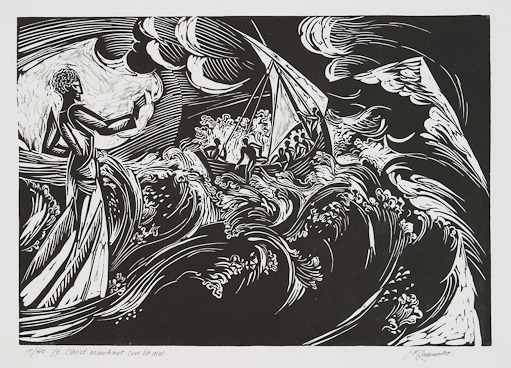
Jacques Richard Sassandra (1932- ), Christ Walking on the Water. Woodcut after Jacopo Tintoretto’s Christ at the Sea of Galilee.
____________________________
This poem is based on the New Testament episode of Christ’s walking on water (Matthew 14:22-33; Mark 6:45-52)—not to be confused with the similar account of Christ’s calming the storm from Matthew 8:23-27 (cf. Mark 4:35-41; Luke 8:22-25). Continue reading








 The Jesus Question