Gethsemane, Part 2: Hematidrotic Jesus

(If you’re not familiar with what happened in Gethsemane, the story is chronicled in three places:  Matthew 26:36-45, Mark 14:32-42, and Luke 22:39-46.  I will be referencing only bits and pieces at a time.)

“My soul is overwhelmed with sorrow to the point of death.”  -Matthew 26:38 / Mark 14:34 (NIV)  (Alternative translations: “My soul is swallowed up in sorrow,” “My soul is crushed with grief,” “My heart is oppressed with anguish”)

“And being in anguish, he prayed more earnestly, and his sweat was like drops of blood falling to the ground.”  -Luke 22:44

Physical torture is one thing; psychological torture is wholly another—the worser of the two, in my bold opinion.  The mental and emotional stress that Jesus underwent in the garden was so intense that his blood vessels ruptured, and he literally sweat blood.  This medical condition is known as hematidrosis.   (Fittingly, the physician Luke is the only Gospel writer who mentions this detail.)  Although rare, it has been noted on a handful of occasions, most frequently in the case of soldiers before battle, or men before their execution.  Continue reading

Posted in Popular Art, Theology | Tagged , , , | 3 Comments

Gethsemane, Part 1: Pain in a Tear

The Easter season is upon us, and I feel overwhelmed by all there is to address.  The resurrection of Jesus Christ is the centerpiece of Christianity.  It has tremendous implications for everyone, because if Jesus really did rise from the dead, then that proves that he really is the Son of God, and that all that he said was true, and we are obligated to respond accordingly; on the other hand, if he didn’t rise from the dead, then the Christian faith is entirely false and pointless.

So this month, instead of trying to address every minute narrative and theological detail of Christ’s Passion, I’m simply going to focus on a few small sections of the Passion accounts, as recorded in the canonical Gospels.  First, I’ll be reflecting on the episode of Jesus in the Garden of Gethsemane.  Continue reading

Posted in Western Art | Tagged , , | 1 Comment

‘Give Us This Day Our Daily Meds’

Then Jesus declared, “I am the med of life…”

Jesus pill box

Pill box found at philosophersguild.com.

Posted in Jesus Kitsch | Tagged , | Leave a comment

Jesus Invites Us to Touch, See, and Know

Doubting Thomas
One of my favorite narrative paintings of Jesus is Caravaggio’s St. Thomas Putting His Finger on Christ’s Wound (1603). I like it not just because of its display of technical skill but because of its theological message. To me this painting says that Jesus is a person who welcomes the questions of honest seekers.

Thomas has always gotten a negative rap in the church. “Don’t be such a Doubting Thomas,” we say disparagingly to those who dare to ask those “but how do we know . . .” sort of questions regarding the Christian faith.  Continue reading

Posted in Western Art | Tagged , , , | 6 Comments

Does Jesus Have Your Sole?

Jesus shoe

Jesus footwear… How trendy… Now not only can you walk in the footsteps of Jesus, you can wear him on your shoes, too.Jesus shoe

Jesus shoe


Found at zazzle.com.

Posted in Jesus Kitsch | Tagged | Leave a comment

Do Things Fall Apart When Jesus Meets an Indigenous Culture?

Traditional Igbo white-faced mask, twentieth century, eastern Nigeria. Its crest bears a depiction of a crucified Christ flanked by two angels.

I recently subscribed to Indigenous Jesus, a blog whose purpose is to celebrate the Christian art produced by nonwestern cultures. Its author, who has a background in anthropology and studio art, encourages his readers to learn from other cultures’ views and experiences of Jesus, rather than putting Jesus into a box, saying that he can only be experienced this way, or pictured that way. He warns Christians, and missionaries especially, to be careful not to conflate Christianity with Western culture. The two are completely separate; the one does not necessitate the other.

. . . when Jesus told his followers to ‘make disciples of every nation’ (Matthew 28:19), he wanted these disciples to follow him with all of their hearts, minds, souls and strength (Mark 12:30)—not a foreign culture. Therefore, the Gospel should be given to every nation (ethnos) so that they might follow Jesus in culturally relevant ways of their own choosing, in order to express their hearts’ praise to him.

Continue reading

Posted in Non-Western Art | Tagged , , , , , | 1 Comment

Sallman’s Pretty Jesus

Sallman's Head of Christ

Warner Sallman, Head of Christ, 1940. Oil on canvas. The Warner Sallman Collection, Anderson University, Indiana.

In 1940, commercial artist Warner Sallman created the oil painting Head of Christ. This image has since been reproduced hundreds of millions of times, on prints, plaques, bookmarks, greeting cards, funeral announcements, church bulletins, buttons, calendars, clocks, lamps, coffee mugs, stickers, billboards, and key chains. Stephen Prothero, author of American Jesus, says that the wide dissemination of Sallman’s Head of Christ transformed Jesus from a celebrity into a national icon, making him now instantly recognizable by Americans of all races and religions. And, more than that, Prothero says, the picture became the most common religious image in the world (out-popularizing Leonardo da Vinci’s Last Supper and dozens of other works of religious import). Even today, Warner Press receives requests for the use of Sallman’s work on a weekly basis from national media outlets, gift companies, publishers, ministries, and individuals.  Continue reading

Posted in Popular Art | Tagged , , , , | 18 Comments

Astronaut Jesus

Astronaut JesusAstronaut Jesus

Apparently during his lost years, Jesus went to outer space.  And I guess he needed a pressurized spacesuit to do it—you know, even though he’s God and all.


Astronaut Jesus

<< Oh, and he can’t forget his life support backpack, either.

DOMA, the argentine company that designed the toy, says that Astronaut Jesus is “an elite member of the astronaut gods that have come to our planet since the beginning of time to shape our civilization and the world as we know it.”  Really?

Posted in Jesus Kitsch | Tagged , , , | Leave a comment

Jesus as Logos, or Cosmic Christ (Part 2)

“In the beginning was the Logos,” the disciple John wrote in his Gospel, referring to Jesus Christ.  On Monday, we considered the possible influences the philosopher Philo’s multipart definition of “Logos” might have had on John.  Now I wish to center in on one of those definitions in particular, and that is the Logos as the Universal Bond, as this is the definition I find most intriguing when applied to Jesus.

Logos200

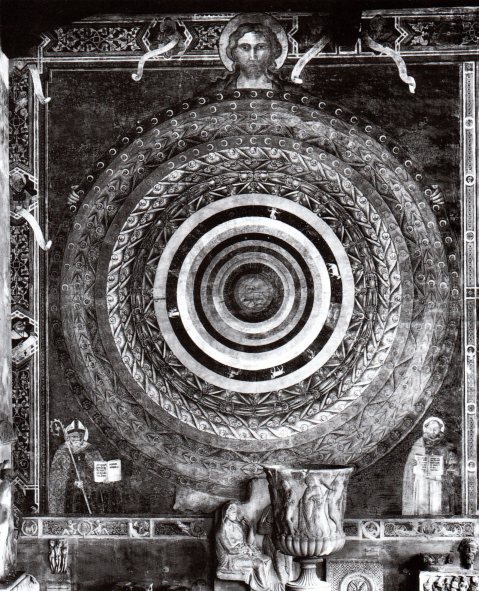
Pietro di Pucci da Orvieto, “Universe Supported by God with the Signs of the Planets,” Campo Santo, Pisa, Italy

“The Logos of the living God is the bond of everything,” Philo wrote, “holding all things together and binding all the parts, and prevents them from being dissolved and separated … the Logos, which connects together and fastens every thing, is peculiarly full itself of itself, having no need whatever of any thing beyond” (De Profugis; Quis Rerum Divinarum Heres Sit 188).

According to Philo, the Logos holds together all the parts of the world and all the parts of the body.  Not only that, he is entirely non-contingent and self-sufficient.  Continue reading

Posted in Theology | Tagged , , , , , , | Leave a comment

Jesus as Logos, or Cosmic Christ (Part 1)

“In the beginning was the Word, and the Word was with God, and the Word was God. … And the Word was made flesh, and dwelt among us, (and we beheld his glory, the glory as of the only begotten of the Father,) full of grace and truth.”  -John 1:1, 14

Jesus as Logos In the opening of his Gospel, John refers to Jesus using the Greek term “Logos.”  English Bible translators have rendered that loaded term as “Word”; unfortunately, as is true in any literary translation, much meaning is lost, as “Logos” carries with it many connotations—and indeed, an entire philosophical framework—that “Word” does not.  In the ancient world, the term “Logos” didn’t really have a fixed definition, since philosophers were continually reinterpreting it, readapting it, to give it renewed meaning (among them Heraclitus, Aristotle, the Stoics, Philo, and, in the third century A.D., Plotinus).  In most schools of Greek philosophy, though, the term was used to designate the underlying principle of the universe, one that was rational, intelligent, and vivifying.  Some loose synonyms for Logos might be Mind, Power, Cause, Act, Ground, Reason, or Structure, but no one word adequately sums up the fullness of the term.  Continue reading

Posted in Theology | Tagged , , , | 3 Comments