Jesus Is My Homeboy: A Photograph Series

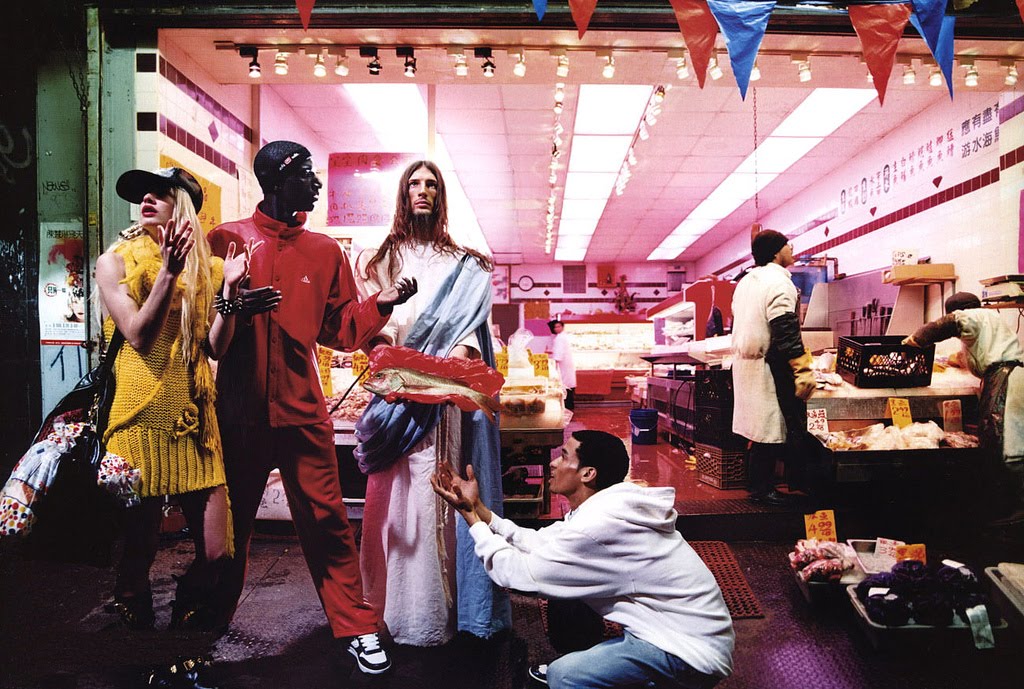
When fashion and fine arts photographer David LaChapelle saw someone wearing a “Jesus is my Homeboy” T-shirt in 2003, he was touched by the simplicity of the message.  It made him wonder who Jesus’ original homeboys (the twelve apostles) were—or rather, who they would have been had God chosen to incarnate himself in twenty-first-century America instead of in first-century Palestine.

“The apostles were not the aristocracy, they were not the well-to-do, they weren’t the popular people; they were sort of the dreamers and the misfits,” LaChapelle said in a 2008 interview for The Art Newspaper TV.  If Jesus were here today, he said, he would be hanging out with the street people and the marginalized:  the poor, the homeless, prostitutes, drug dealers, gangsters, and so on.  And more than that, these people would have been his closest and most faithful band of followers.

And so LaChapelle created this series of six photographs entitled Jesus Is My Homeboy, which was originally published in the British magazine i-D in 2003, then exhibited later in 2008 in London and St. Moritz, Switzerland.

David LaChapelle's "Loves and Fishes"

David LaChapelle, "Loaves and Fishes," 2003

Continue reading

Posted in Controversial Art, Western Art | Tagged | 6 Comments

Jesus Is My Homeboy: The Story That Started It All

Jesus is my homeboyThe “Jesus is my Homeboy” T-shirt is a fashion trend that peaked in the mid-2000s, when celebrities like Jessica Simpson, Pamela Anderson, Ben Affleck, Ashton Kutcher, and Brad Pitt could be spotted wearing it. I remember seeing classmates in high school, Christian and non-Christian, wearing the tee. I never got on that bandwagon, though, because I never quite understood what the shirt was trying to communicate. I feel comfortable calling Jesus my Savior, my Lord, my Friend, even. But my “homeboy”? What does that even mean?

It wasn’t until recently that I found out this shirt has a back story. That the familiar image that so many people don (or dismiss) without a thought was actually born of a moment of trauma and grace.  Continue reading

Posted in Popular Art | Tagged , , | 13 Comments

Upcoming Topics

Lately I’ve been reading a lot but writing little.  I apologize for failing to keep up with my three-posts-a-week rule.  But to protect myself from accusations of complete negligence, I’d like to show you what I’ve been working on.  I’ve added a new tab to my blog called “Upcoming Topics” so that at any given time, you can see the long-term research projects I’m involved in and can give me suggestions on where to look for information (who to talk to, what to read) and what specific questions to address.  Also, I would love to hear any Jesus-related topic suggestions you might have.  What are you most interested in learning about, or what do you know that you think other people would benefit from knowing?

Posted in Uncategorized | 1 Comment

Yue Minjun and the Maniacally Grinning Christ

Contemporary Chinese artist Yue Minjun recently completed a series of six paintings depicting key events from the life of Christ, which are on display at The Pace Gallery in Beijing through July 16.  These paintings demonstrate a confluence of Christian iconography of the Renaissance with Yue’s own distinctive, parodic style—a style marked most often by iterations of the artist’s self-portrait, pink-skinned and sporting an uncomfortably large grin.

The Crowning with Thorns

Yue Minjun, "The Crowning with Thorns," 2009

Art critics tend to refer to Yue as a “Cynical Realist,” linking him to China’s post-Tiananmen generation of disillusioned artists.  Yue said that the Tiananmen Square Massacre of 1989, in which hundreds of protesters were gunned down by Communist officers, shattered his patriotism and made him feel cheated.  Having just graduated from art school, he decided to develop a visual language to express his feelings of lostness and hurt.  He settled on a toothy cackle, a reference to the Laughing Buddha of Chinese folklore (who taught men to laugh at reality) as well as to the posters of happy, smiling citizens created during China’s Cultural Revolution.  The smiles are a trick, he said, to conceal the pain that lies beneath them.  Continue reading

Posted in Non-Western Art | Tagged , , , | 6 Comments

Take a Seat in the Savior’s Lap

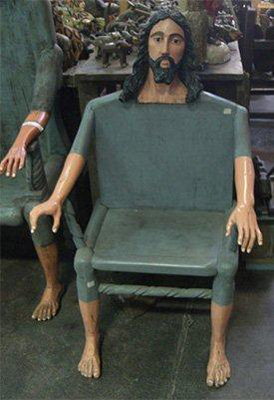
Jesus chair“Come unto me, all you who labor and are heavy laden…”

This wooden oddity was spotted by an Irish tourist in a Guatemalan arts and crafts shop in 2007.  It was retailing at 5,300 quetzal, or about $700.

I must say, as a living room furnishing, it would be quite the conversation piece.

Posted in Jesus Kitsch | Tagged | Leave a comment

Gospel Illumination for the 21st Century

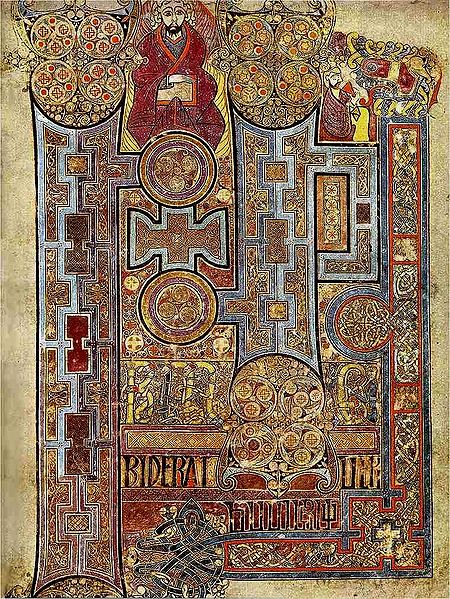
You’re probably at least somewhat familiar with the medieval practice of manuscript illumination: the elaborate decoration of a handwritten text with illustrations, borders, and drop caps, all pressed or dusted with gold leaf.

Book of Kells

Book of Kells, fol. 292r, Ireland, ca. 800. Incipit to John: “In principio erat verbum” (“In the beginning was the Word”)

Book of Hours

Book of Hours, fols. 7v-8r, Bruges, Flanders, 1425

The term “illumination” refers to the literal “lighting up” of the book pages with bright flecks of silver and gold.  But the word has a more spiritual meaning, too, which is to interpret the given text, to elucidate it, to celebrate it; to shine a light on beauty and help to bring it out more strongly. In the Middle Ages, texts were illuminated using representational art—art that depicts recognizable forms. So an illumination of Luke 2, for example, would likely show the baby Jesus in a manger.

When the printing press was invented in the fifteenth century, though, it pretty much put a kabosh on manuscript illumination. Books could be made much faster and more cheaply now, so they ceased being an art form and became a commodity instead.

The Four Holy GospelsKudos to Crossway for reviving the long-forsaken process of manuscript illumination, for bringing art back into direct conversation with the Gospel texts through its Four Holy Gospels project.

In 2009, Crossway President Lane Dennis commissioned New York artist Makoto Fujimura to illuminate the four canonical Gospels in commemoration of the four hundredth anniversary of the King James Bible. Over the course of just nine months, Mako created five major paintings, eighty-nine chapter-heading letters, and 140-plus pages of embellishments for the project. The Four Holy Gospels, as the finished volume is called, is the first illuminated manuscript to feature abstract contemporary art in lieu of traditional representational illustrations. It truly is the only one of its kind, but I hope there will be more to follow from other artists in the future.  Continue reading

Posted in Non-Western Art, Theology, Western Art | Tagged , , , , | 1 Comment

Catnappin’ with Jesus

Kitten hugging Jesus

Found at DreamingofKittens.com.

Posted in Jesus Kitsch | Tagged | Leave a comment

What Makes Jesus Happy?, Part 5: Redeeming Us Through His Death

In my search for smiling Jesuses, I came across this drawing by five-year-old Abi Davis, which her father, Jimmy, shared on his blog:
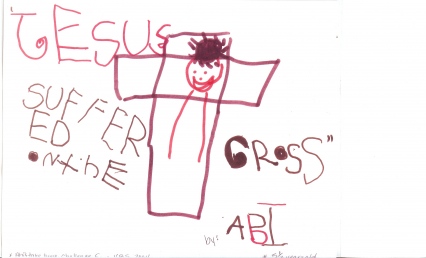
Smiling JesusAs you can see, it shows Jesus smiling on the cross—a very odd concept, I must say, especially when set next to big red letters that read “JESUS SUFFERED.”  Now, I know that whenever kids draw people, smiley faces are their default, so I’m not necessarily attributing profound insight to little Abi.  But in light of Hebrews 12:2—“For the joy set before him he endured the cross, scorning its shame, and sat down at the right hand of the throne of God”—the depiction is very apt.  Whether he actually smiled or not doesn’t matter as much as the fact that he had a deep-seated joy in glorifying the Father, so in a way, he was glad to die, since it meant saving mankind from sin and death and bringing them into perfect and everlasting fellowship with God.  As odd as it sounds, Jesus was happy to bear our sins to Calvary, to absorb the wrath of God, and to suffer and die in our place.  He loves us that much.  And it makes him even happier when we acknowledge his sacrifice and claim the gifts it wrought—salvation, life, forgiveness, freedom, power, etc.—as our own, through him.

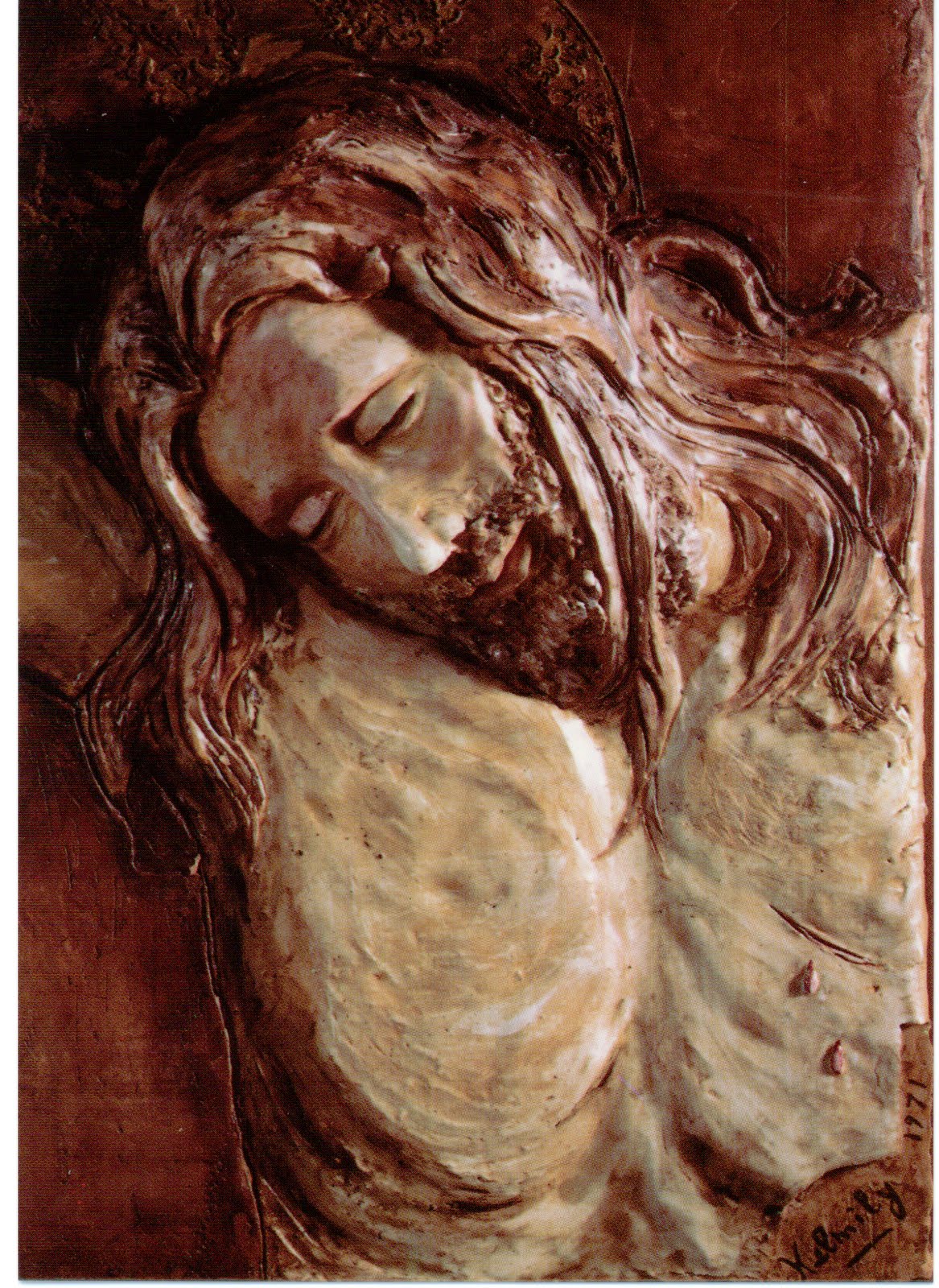
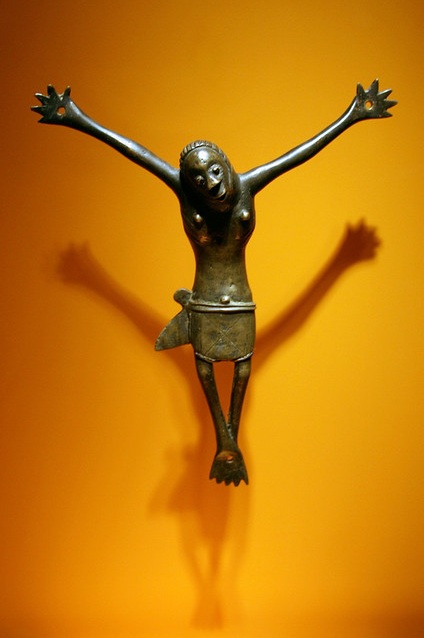
This child’s drawing made me wonder whether there are any precedents of a smiling crucifix in art history.  I could find only this one.
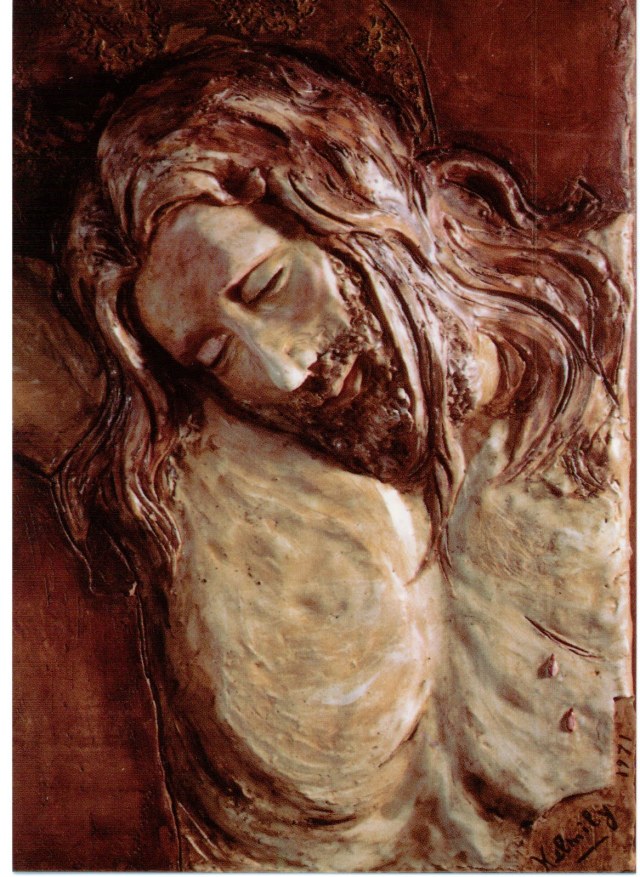
Smiling Jesus I found it on the blog of Bishop William Giaquinta (who did not respond to an e-mail I sent, so I cannot identify the who and where of this work, but I can make out a “1971” on the inscription), posted along with a poem he wrote called “The Smiling Christ.”  Here’s a brief excerpt, taken from the conclusion:

“To be able to smile always,
in joy and in pain,
to friends and to foes,
to the indifferent,
is the grace that we ask of you,
Smiling Lord of Calvary.”

Jesus experienced unimaginable horrors on the cross.  Do you think he could have smiled while he was up there?  And if so, what is it that made him smile, exactly?

Have you ever seen any serious artistic depictions of Jesus smiling on the cross?

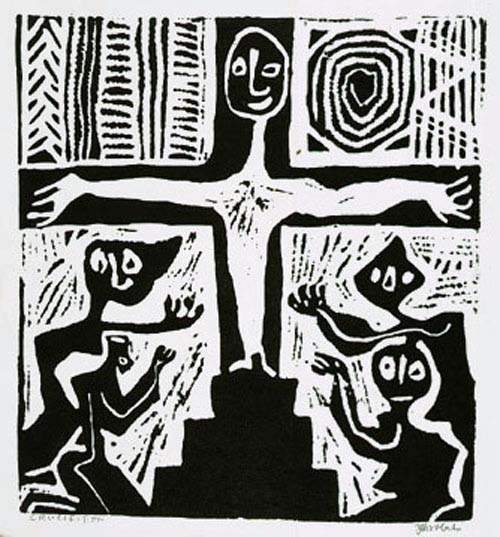
Update (9/23/11):  I’ve found a few more examples of smiling crucifixes.  Here they are:
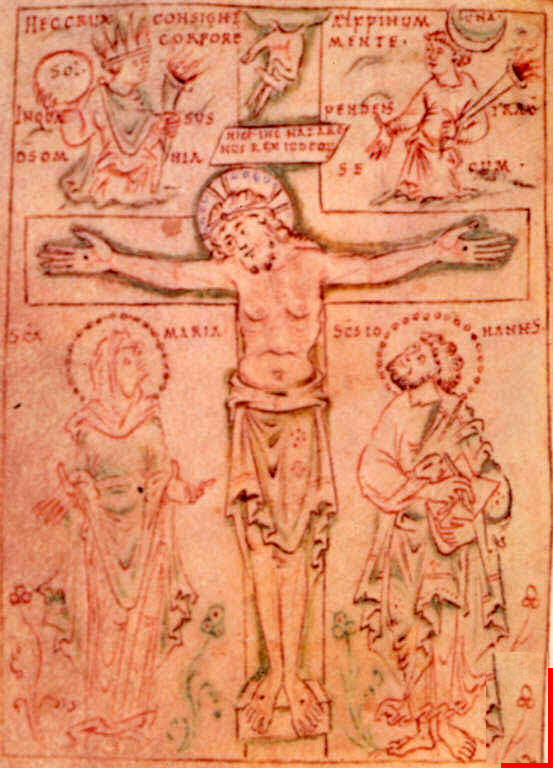
"Christ alive on the Cross, with the Virgin, and St. John writing his testament," from the Prayerbook of Aelfwine, c. 1023-35. Source: British Library.
Smiling crucifix

"Crucifix," 17th c. Copper alloy. Congo. On display at the National Museum of African Art, Washington, D.C.

Smiling crucifix

Jacob Afolabi, "The Ecstatic Crucifixion," 1990s. Linocut on paper. Oshogbo, Nigeria.

Posted in Theology | Tagged | Leave a comment

What Makes Jesus Happy?, Part 4: Fellowshipping with Us

“Fellowship” is one of those Christian buzzwords that is tossed around loosely in prayers and sermons and church bulletins and such.  One might speak of a “Fellowship Luncheon,” or thank God for “this time of fellowship”—the reference is to spending time with Christian friends.

But “fellowship” means so much more than merely socializing and enjoying the company of others.  The Greek word is koinonia, and it means communion by intimate participation.  In contemporary Greek, it refers to, among other things, marriage partnerships.  Synonyms vary by context but include “commonality,” “contribution,” “sharing,” and “participation.”  The noun is active and suggests the idea of not just being together, but doing together.  Doing the work of Christ, bound together by his love, our common ground.

The word is used 20 times in the Bible, sometimes referring to the union of Christians with each other and sometimes to the union of Christians with their God.  For example, “koinonia” is the word Paul uses in 1 Corinthians 10:16 to refer to the sacrament of Communion; he speaks of us “participating” in the body and blood of Christ through our partaking of the bread and wine.  Having fellowship with us—communing with us intimately, seeing us participate with him in the work of the Father—makes Jesus immeasurably happy.  Continue reading

Posted in Non-Western Art, Theology | Tagged , , , | Leave a comment

What Makes Jesus Happy?, Part 3: Unity

Fan Pu Jesus

Fan Pu, "Happy Jesus -- One in Christ," 2007 (China)

This papercut by Chinese artist Fan Pu makes me smile:  Jesus strolling along cheerfully, wrapped in a cloak made up of Christian faithfuls of all colors.  The artist said that when she created it, she had in mind the joyful uniting of the church with Christ when he returns:  “When is Jesus full of joy?  I believe it is only through the completing of the Church on Earth, when we become the bride of Christ, and Christ the joyous groom comes to receive the bride.”  Isaiah 62:5 says, “As a bridegroom rejoices over his bride, so will your God rejoice over you.”  To me, this artwork doesn’t so much conjure up the image of Christ as bridegroom as it does the image of Christ as head of the church body.  What makes Jesus happy?  The unity of all people under his headship.

Paul says that the ultimate will, pleasure, and purpose of God is “to bring all things in heaven and on earth together under one head, even Christ” (Ephesians 1:10).  Jesus echoes this same desire in John 17:20-23, when he prays “for those who will believe in me through their [the disciples’] message, that all of them may be one, Father, just as you are in me and I am in you. … I have given them the glory that you gave me, that they may be one as we are one—I in them and you in me—so that they may be brought to complete unity.”  The gospel message isn’t meant to tear apart; it is meant to bring together.  Jesus died on the cross so that we could all be made one with God and with each other.  So then why is Christian history filled with so much divisiveness?  Why is it defined mostly by its schisms and breaks (called either “heresies” or “reforms,” depending on which side of the line you’re standing)?  Continue reading

Posted in Non-Western Art, Theology | Tagged , , , , | 6 Comments