It Is Finished by Anthony Falbo

Anthony Falbo’s sense of humor is one of the qualities that endears me to his art. He frequently paints religious subjects but not with the stilted piety of much of today’s (what passes as) Christian art—instead, he approaches his subjects with a spirit of play.
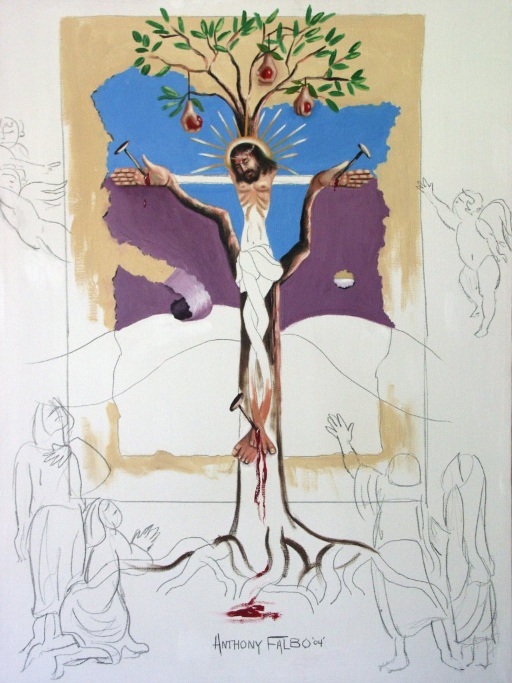
Crucifixion by Anthony Falbo

Anthony Falbo (American, 1953-), It Is Finished, 2004. Oil and charcoal on paper, 24 x 18 in.

In his painting It Is Finished, Falbo employs a pun in the title: “it is finished” refers to one of the Seven Last Words of Christ but is also an affirmation that yes, despite appearances, this artwork is complete as is.

I showed this image as part of a presentation before a small group of friends on the Crucifixion in contemporary art, and when they saw the title—before I even said anything—a few chuckled out loud. (It was the only one of the images that invited such a reaction.)

But what I love about Falbo is that his humor is not gimmicky; his paintings may elicit a smile or a laugh, but they do far more than that—they actually provide substance to sink into. Let’s look at this one, for example.   Continue reading
Posted in Theology, Western Art | Tagged , , , | 3 Comments

A Prayer for Migrants

The Rev. Dr. Sam Wells, vicar of St. Martin-in-the-Fields in the heart of London, issued a statement yesterday on the migrant crisis, concluding with the following prayer:

Wilderness God, your Son was a displaced person in Bethlehem, a refugee in Egypt, and had nowhere to lay his head in Galilee. Bless all who have nowhere to lay their head today, who find themselves strangers on earth, pilgrims to they know not where, facing rejection, closed doors, suspicion, and fear. Give them companions in their distress, hope in their wandering, and safe lodging at their journey’s end. And make us a people of grace, wisdom, and hospitality, who know that our true identity is to be lost, until we find our eternal home in you. Through Christ our rejected yet risen Lord. Amen.

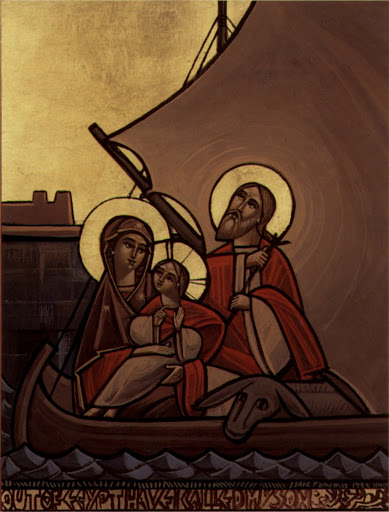
Neo-Coptic icon

Isaac Fanous (Egyptian, 1919-2007), Flight to Egypt.

Posted in Current Events, Non-Western Art | Tagged , , | Leave a comment

Jesus as the New David

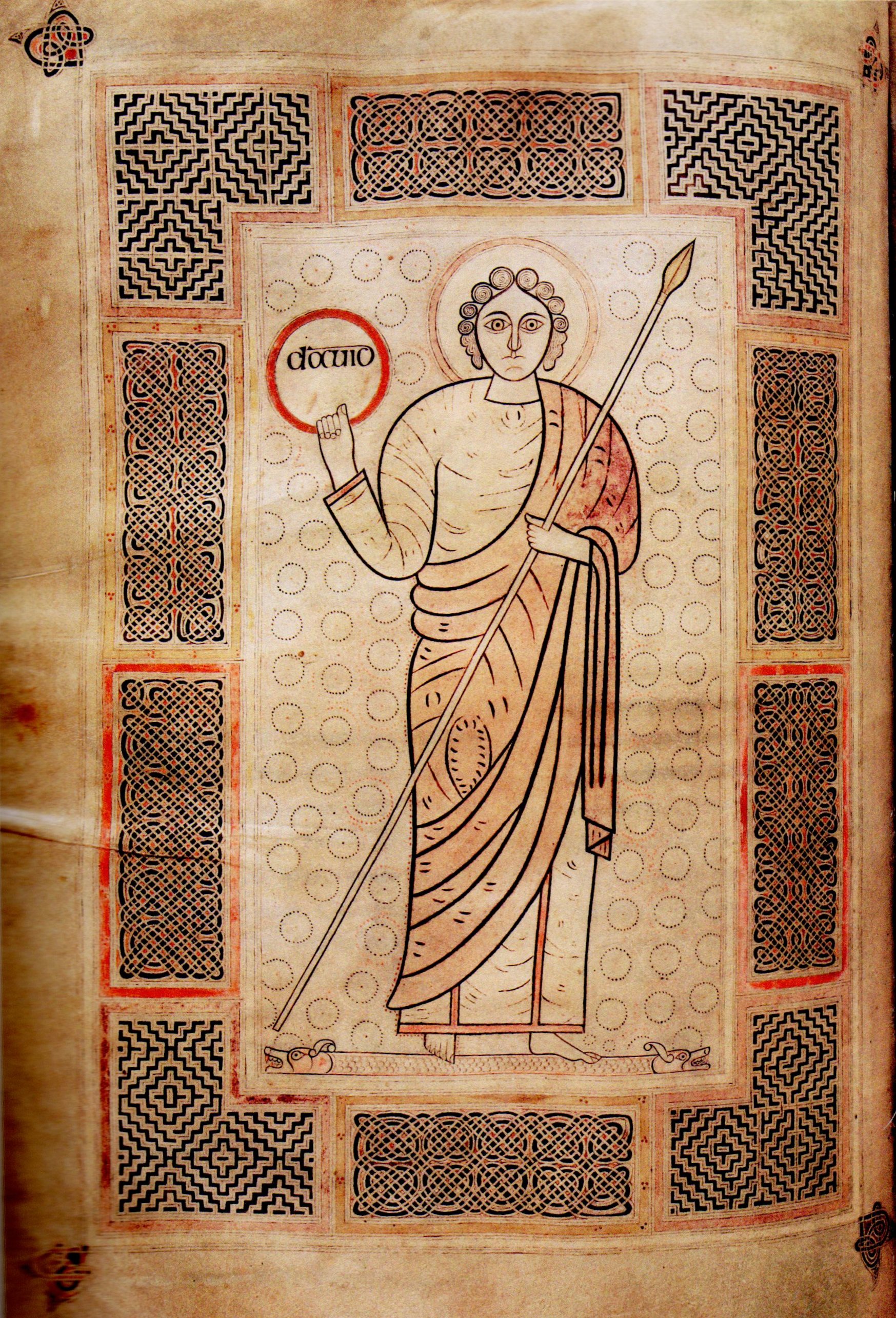
Cassiodorus's "Commentary on the Psalms": Christ/David, second quarter of the 8th century. 42 x 29.5 cm (Durham Cathedral Library, MS B.ii.30, fol. 172v).

Christ/David, from Cassiodorus’s Commentary on the Psalms (Durham Cathedral Library, MS B.ii.30, fol. 172v), second quarter of the 8th century. Image size: 42 x 29.5 cm.

This illumination is from an eighth-century copy of Cassiodorus’s sixth-century Commentary on the Psalms. (The manuscript is sometimes referred to as the Durham Cassiodorus because of the cathedral library that houses it.) Created in the Anglian kingdom of Northumbria, it shows a haloed, cloaked figure holding a spear in one hand and in the other an orange disc (halo?) that encircles the name David. The figure stands on a snarling two-headed beast, a reference to Psalm 91:13: “You will tread on the lion and the adder; the young lion and the serpent you will trample underfoot.”

Although this figure is labeled as David, he is also meant to be read—as Cassiodorus tells us in his commentary—as Jesus Christ. His pose and attributes evoke the then-widespread iconography of the Resurrection, which showed Jesus trampling the twin beasts of sin and death—a motif sometimes referred to in art historical literature as the super aspidem motif.

Here Christ is presented as the New David, the warrior-king from whom he descended.

In the book Anglo-Saxon Art, Leslie Webster writes that the dual nature of the Christ/David image spoke both to the Anglo-Saxon taste for riddles, verbal and visual, and to the Anglo-Saxon cult of the heroic Christian warrior-king.

For more on the typological parallels between King David and Jesus, see Jonathan Edwards’s “Types of the Messiah,” II.259.

Posted in Theology, Western Art | Tagged , , | 2 Comments

Niño Jesus

Jesus as a child

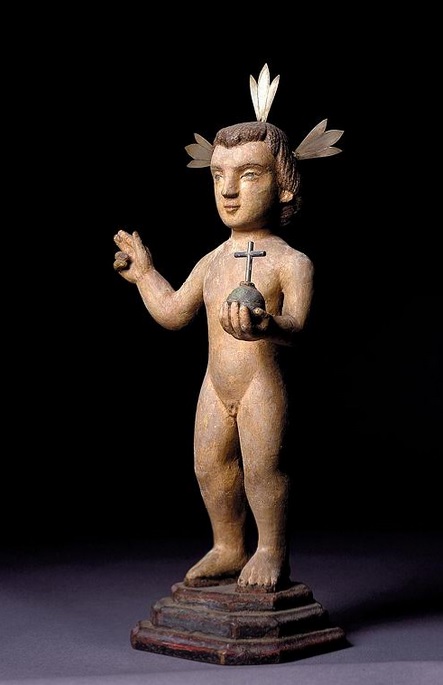
Niño Jesus, 18th century. Unidentified artist. Carved and painted wood and metal, 34 x 14 x 11.2 cm. Smithsonian American Art Museum, Washington, DC.

From the Smithsonian’s website:

“Devotional figures of the infant Jesus became popular in Puerto Rico during the seventeenth and eighteenth centuries. . . . An unknown craftsman carved this small figure in the act of benediction, or blessing, with an orb in his left hand to symbolize God’s dominion over the Earth. The three flame-like shapes around the child’s head represent the three parts of the soul [as delineated by Saint Augustine]: memory, understanding, and will.”

The other, more obvious allusion of the three rays is to the Trinity of Father, Son, and Spirit.

Posted in Non-Western Art | Tagged , , , , | Leave a comment

Johnny Cash’s “Gospel Road”

Despite all Johnny Cash’s chart-topping hits—“I Walk the Line,” “Folsom Prison Blues,” “Ring of Fire,” etc.—his lesser-known movie The Gospel Road is supposedly his proudest work. [1]

This 1973 feature film was a labor of love: he and his wife produced it themselves. Shot on location in the Holy Land, it features a black-clad Cash narrating the story of Jesus’s life in speech and song as mute reenactments take place on-screen. Additional vocalists include The Carter Family, The Statler Brothers, June Carter Cash (as Mary Magdalene), Kris Kristofferson, and Rita Coolidge.

The full soundtrack—songs and spoken narration—was released as a double album the same year by Columbia Records.   Continue reading

Posted in Film, Music | Tagged , , , , , , | 1 Comment

Rowan Williams talks Jesus art

In 2004 Dr. Rowan Williams, then archbishop of Canterbury, wrote an introduction to the exhibition catalog for “Presence: Images of Christ for the Third Millennium,” reflecting on the challenges inherent to the task of representing Jesus in art and how different artists through the years have coped with those challenges. The Guardian published an excerpt, and it is that excerpt that I want to engage here.

Eschewing obviousness in favor of irony

The primary challenge for the artist attempting to depict Christ is how to convey his dual nature: fully man yet fully God. It’s one of the greatest paradoxes of Christianity, and it presents a problem for both theologians and artists. For artists, that problem is formal: How can a figure be rendered as thisworldly and otherworldly at the same time? What does divinity clothed in humanity look like?

Some artists throw their hands up in surrender, saying that it can’t be done. Others attempt to solve the issue by representing a human being engulfed in light, an indication that here is someone special. Such was the recourse of most artists from the seventeenth through early twentieth centuries, whose work Williams considers to be, for the most part, spiritually flat. The Baroque, German Nazarene, Pre-Raphaelite, and naturalist movements failed in their attempts to create meaningful religious art because, says Williams, the works lacked irony; they simply deferred to the familiar:

The style renders visible the obviousness of religious sentiment of a certain kind, and so makes practically unthinkable any perception other than that already familiar. That is not to say it cannot operate as religious art of a kind, as what you might call casual reinforcement of shared piety; but it fails, once again, as a depiction of difference or distinctiveness, and so as a depiction of the divine importance, the reference-changing character, of Jesus.

Continue reading

Posted in Non-Western Art, Western Art | Tagged , , , | Leave a comment

Jesus did tonglen

I worked for four years at a Buddhist publishing house, and “tonglen” was a topic I came across many times. It’s a Buddhist contemplative practice in which the practitioner breathes in the pain and suffering of others and breathes out relief for them.

In the second volume of The Profound Treasury of the Ocean of Dharma, meditation master Chögyam Trungpa describes the practice and its importance:

Exchanging oneself for others is one of the leading mahayana disciplines, and a very important one indeed. It is central to the mahayana outlook on reality. Without it, you cannot understand Buddhism at all. . . .

In the practice of exchange, you take on the pain and misery of others, and you give away your own pleasure and luxury. In Tibetan this practice is known as tonglen: tong means “let go” and len means “take on,” so tonglen means “sending and taking.” . . .

With tonglen, when our breath goes out, we let go of any goodness, positivity, or achievement that we have accomplished and give it to others; and as we breathe in, we breathe in the pain, suffering, and misery of others. (304-5)

In essence, this is what Jesus did on the cross. He “took on” the sin (suffering) of the world, bearing it in his body, and in what is known in Christian theology as the “Great Exchange,” he “let go” of his privilege, his merit, imputing it to us. In-breath: “My God, my God, why have you forsaken me?” Out-breath: “It is finished.”  Continue reading

Posted in Non-Western Art, Theology | Tagged , , , , | 3 Comments

Two unlikely characters sharing the same space

I have tremendous admiration for Ben Quash for the contributions he’s made to the field of Christianity and the arts. As a professor at King’s College in London, his primary research interest is the way in which the arts can stimulate renewed theological engagement with the Bible. (Same as mine!)

His latest book, Found Theology: History, Imagination and the Holy Spirit, examines what happens when people in new contexts engage with old material, be it biblical narratives or texts, doctrinal formulas, or works of art or literature.

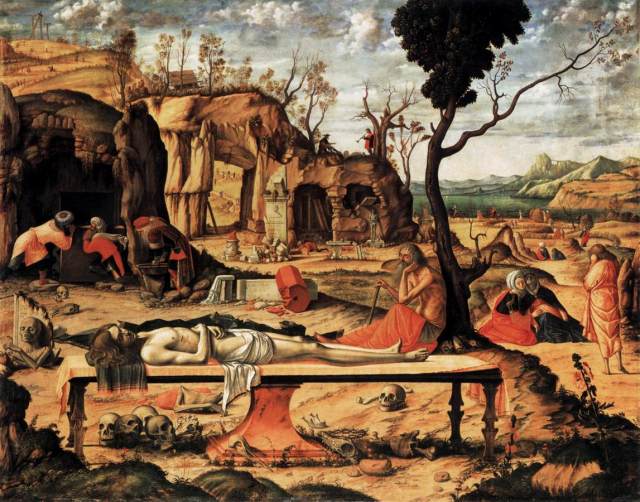
Most interesting to me was chapter 4, “In my flesh I shall see God,” an extended analysis of the Renaissance painting Contemplation of the Dead Christ by Vittore Carpaccio. Quash discusses the painting as a meditation on time, prophecy, death, and redemption.

Carpaccio's Dead Christ

Vittore Carpaccio, Contemplation of the Dead Christ, ca. 1505. Oil on canvas, 145 x 180.5 cm. Staatliche Museen, Berlin.

The dead Christ is of course the focal point of the image, but second to him is the hermit figure sitting under the tree in the middle ground—identifiable as Job through cross-reference to The Meditation on the Passion, another of Carpaccio’s paintings in which a very similar-looking figure sits on a marble slab with the Hebrew inscription “My redeemer lives 19,” a reference to Job 19:25Continue reading

Posted in Theology, Western Art | Tagged , , , , , , | 2 Comments

From my private collection: Wailing Wall: Song for Quin by Steve Prince

Two weeks ago my husband and I moved 400 miles down the East Coast from just outside Boston to just outside Baltimore. In our last few months as New Englanders whenever people asked us, “Where to?” our reply was oftentimes followed by a pitying “Oh . . .” or “Yikes, be careful!” They had the April race riots in mind.

But our assistant pastor at Citylife Presbyterian, David Cho, had a different reaction. He was genuinely excited for us, expressed a love for the city, and said something like, “What a great opportunity to practice justice and reconciliation—there are obviously a lot of hurting people in Baltimore, and they need more people to hear their stories and to advocate for them.”

David sees everything through a gospel lens, which is one of many reasons I was so blessed to be under his leadership and teaching for the last five years. When Michael Brown was shot in Ferguson, Missouri, last August, David led our church in corporate lament—for the death of a young man and all the pain that occasions, for the vandalism and looting that followed, for racial injustices that still persist in America, and for people who deny there’s even a problem, including our own complicity. As a church we stood together and proclaimed that none of this is right. We were given time to grieve individually and to petition God for understanding, grace, and healing. We prayed for the families on both sides and for improved race relations in our nation.  Continue reading

Posted in Western Art | Tagged , , , , , | 3 Comments

Karel Teissig’s Black Jesus

At the end of the TV miniseries Killing Jesus that premiered this March, several contemporary Jesus artworks scan the screen. I recognized many of them, but one that was new to me and that I really like is a crucifixion painting by the Czech graphic artist Karel Teissig (1925-2000). Here’s a screen capture:

Black crucifixionIt appears that Teissig created this image as a film poster illustration for Lotr po pravici, the Czech release of the 1968 Italian film Seduto alla sua destra (released in the US as Black Jesus). Directed by Valerio Zurlini, the film is a thinly disguised biography of the Congolese independence leader Patrice Lumumba, here called Maurice Lalubi. Lalubi is a Christ figure who passively resists the dictatorial regime that had sprung up in his country and as a result is imprisoned and tortured.

Black Jesus movie poster

1970 Czech poster for the film Lotr po pravici (Black Jesus), designed by Karel Teissig

Posted in Film, Non-Western Art | Tagged , , | Leave a comment