“I should be sorry if I only entertained them. I wish to make them better.”—George Frederick Handel, responding to a compliment on the fine entertainment Messiah had provided its audience
“And without Controversy, great is the Mystery of Godliness: God was manifested in the Flesh, justified by the Spirit, seen of Angels, preached among the Gentiles, believed on in the World, received up in Glory.”—Preface to Messiah, printed on the original libretto
I saw this work performed yesterday at Boston’s Symphony Hall by the Handel and Haydn Society, who has been performing it annually since 1854. It was for me both an entertaining and devotional experience. I had studied the work in college (I was a music minor), but never had I heard it performed live, and never from start to finish all in one sitting. The difference between listening to music as a series of MP3 files through laptop speakers and listening to it in a concert hall is enormous. One compresses the sound, the other delivers it directly in all its acoustical fullness. One lacks visuals (singers’ expressions, musicians’ handwork), the other puts them up on stage. One is a private experience, the other public, communal. All these latter factors add dimensionality to the work and helped me to experience it more fully as Handel intended.
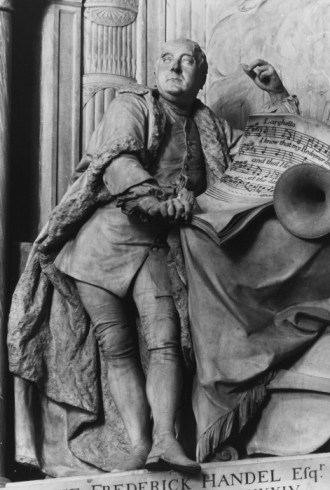
The monument above Handel’s grave in Westminster Abbey, London, England. Artist: Louis François Roubillac. Year: 1759-1762. Photo © Courtauld Institute of Art. Handel is shown holding the musical score of the aria “I know that my Redeemer liveth” from Messiah.
Messiah debuted on April 13, 1742, at the Great Music Hall in Dublin to an oversold room of 700. (Women were asked to come without their hoop skirts, and men without their swords, to make room.) All proceeds were donated to local charities. The work was very well received and was performed numerous times in England and Ireland until Handel’s death in 1759. He frequently revised the music to suit the performers he was working with.
The genre is oratorio—a dramatic work, fully sung, based on a sacred subject taken from the Bible. Oratorios are very similar to operas in style and structure; however, unlike operas, they are not meant to be staged and thus do not usually include acting, costumes, and stage props. Also, in addition to soloists and an orchestra, oratorios heavily feature a choir. Continue reading →


 Found at





 The Jesus Question