Tee Time: Dirt Bike Jesus

Dirt bike JesusFound at cafepress.com.

Posted in Jesus Kitsch | Tagged , | Leave a comment

“Good Friday” by Christina Rossetti (1896)

“Am I a stone, and not a sheep,
That I can stand, O Christ, beneath Thy cross,
To number drop by drop Thy blood’s slow loss,
And yet not weep?

Not so those women loved
Who with exceeding grief lamented Thee;
Not so fallen Peter weeping bitterly;
Not so the thief was moved;

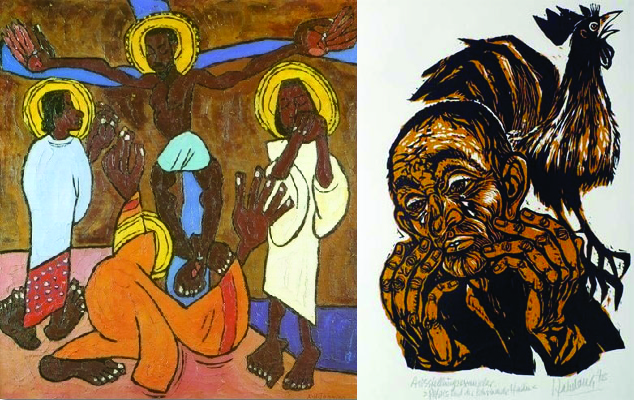
Left: William H. Johnson, Jesus and the Three Marys, 1935. (Source) Right: Walter Habdank, Peter and the Crowing Rooster, 1979. (Source)

Not so the Sun and Moon
Which hid their faces in a starless sky,
A horror of great darkness at broad noon—
I, only I.

Yet give not o’er,
But seek Thy sheep, true Shepherd of the flock;
Greater than Moses, turn and look once more
And smite a rock.”

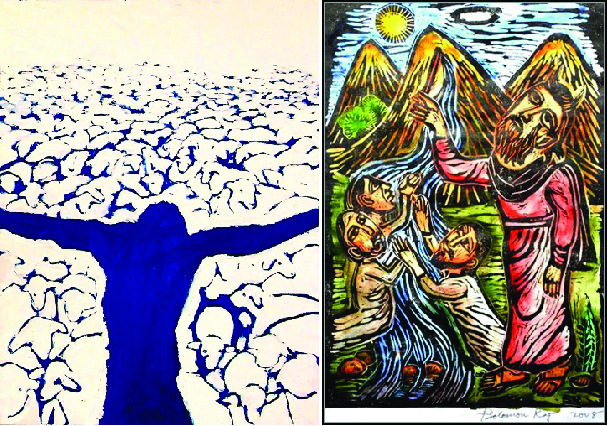
Left: Daniel Bonnell, The Good Shepherd. (Source) Right: Woodcut by P. Solomon Raj, 2008. (Source)

________________

In this poem Rossetti addresses Jesus as the New Moses, asking him to strike her heart of stone to make it pour out tears for him. (See Numbers 20:1-13.) She’s ashamed of her inability to generate emotion over Christ’s death. Positioning herself as a disengaged spectator at the foot of the cross, she contrasts her coldness with the deep grief of the three Marys and the penitence of Peter and the thief on the cross. Even the sun and moon, she says, have retreated from their posts to mourn.

Just like the desert-wandering Israelites of the Old Testament, Rossetti calls out from her personal desert to ask for an emotional breakthrough, for refreshment and release.

Maybe you’re in the same boat as Rossetti: you desperately want to forge a connection with Christ, to observe this Lenten season with all sincerity, but you’re having trouble. I encourage you to pray that Christ would strike your heart and make it gush; that he would, as the greater Moses, lead you into God’s promises but also into a deeper, more grateful awareness of the cost at which those promises were secured.


Posted in Non-Western Art, Poetry, Western Art | Tagged , , , , | Leave a comment

Tee Time: Got Jesus? It’s hell without him.

Got Jesus? It's hell without him.Found at choiceshirts.com.

Posted in Jesus Kitsch | Tagged , | Leave a comment

“Hallelujah to Jesus, who died on the tree, to raise up this ladder of mercy for me”: Jacob’s vision as a prefigurement of Christ

I love this song from Dave Eggar’s 2010 album Kingston Morning. Featuring the vocals of Dr. Ralph Stanley and with Eggar on cello, “Jacob’s Vision” is a hymn that praises Jesus for his mediation between God and humanity. It interprets Christ’s death in light of Jacob’s dream about the angel-trodden ladder (Genesis 28:10-22), the cross being seen as that which was raised up to connect earth to heaven, so that humanity could, by trust in its strength and stability, climb up to God. This narrative link is rooted in John 1:51, in which Jesus prophesies to Nathanael, “Very truly I tell you, you will see heaven open, and the angels of God ascending and descending on the Son of Man.”  Continue reading

Posted in Music, Theology | Tagged , , , , | 3 Comments

Tee Time: Let me turn my Jesus on

Let me turn my Jesus onFound at virtuousplanet.com.

Posted in Jesus Kitsch | Tagged , | Leave a comment

A prayer for Losar, and a Tibetan Christian thangka

For those of you who don’t know, I work for a Tibetan Buddhist publisher. That means that tomorrow I have off of work for Losar (the Tibetan New Year—Happy Year of the Water Snake!). The president of the company encouraged us to spend the day reflecting on the spirit of this blessing, written by a Tibetan master for a recent Losar, and to consider how we might welcome in the coming year:

May a rich timely rain of the nectar of auspicious blessings shower upon you hundreds of times,

Enlivening the leaves and petals of your longevity, merit, glory, and wealth, which sprout from the seeds of virtuous acts, source of happiness and excellence.

May magnificent fruit—spiritual experience and realization—ripen as a spontaneously appearing crop that fulfills your and others’ well-being.

As a Christian, this blessing makes me feel gratitude for the “longevity, merit, glory, and [spiritual] wealth” Christ has already bestowed on me. He is the virtuous seed who fell into the earth so that he might produce abundant life (John 12:24). The benefits of lines 1 and 2, therefore, I can already claim with confidence. I have been made alive by Christ! Continue reading

Posted in Non-Western Art | Tagged , , , | 7 Comments

J. I. Packer on putting God in a box

In this excerpt from his 1987 essay “Theism for Our Time,” J. I. Packer urges Christians to acknowledge God’s ultimate incomprehensibility on this side of eternity and the limitations of human language to describe him. As valuable as theology is, we must not elevate our concepts and definitions of God to the level of full reality. This can be said even of those that come from Scripture, for the authors were but toddlers, just as we are, to whom the all-knowing Father accommodated his speech and before whom he censored his thoughts so that our small minds could know all that we need to know of him—most simply, that he loves us and wants the best for us, and to that end he laid down his life for us.

Packer warns against the “theological triumphalism” that Christians commonly wield, oftentimes with pure intentions, against the noncommittal subjectivism of today and calls instead for an open-ended theology that is humble in its claims and willing to expand.

“Just as the two-year-old son of a man with a brain like Einstein could not understand all that was going on in his father’s mind if his father told him, so (we may be sure) it would be beyond us under any circumstances to understand all that goes on in the omniscient, all-wise, and not in any way time-bound, mind of God. But, just as the genius who loves his boy will take care that in talking to him he speaks in such a way that all he says can be understood, even though that means reducing it all nearly to baby-talk, and leaving much of his own thinking unvoiced, so God does when he opens his mind and heart in the written Scriptures. . . .

      “The child, though in general terms aware that his father knows far more than his present words express, may yet learn—indeed, is intended to learn—from these words all that as a child he needs to know for as full and happy a relationship with his father as a two-year-old is capable of; and similarly, we may learn from ‘God’s Word written’ (Anglican Article 20)—from Scripture, that is, viewed as torah, God’s fatherly law, proceeding as Calvin put it from God’s own holy mouth—all that we need to know for faith and godliness. But we must never forget that we are always in the little boy’s position in my parable. At no point dare we imagine, therefore, that the thoughts about God that Scripture teaches us take the full measure of his reality. The fact that God condescends and accommodates himself to us in his revelation certainly makes possible clarity and certainty of understanding, so far as our understanding goes; equally certainly, however, it involves limitation in the revelation itself. The fact that through Scripture we know everything we need to know for living with God in faith, hope, love, and joy, does not mean that through Scripture we know everything about God that he knows about himself.  Continue reading

Posted in Theology | Tagged | Leave a comment

Tee Time: Don’t croak without Jesus

Don't croak without JesusFound at ainttheycute.com.

Posted in Jesus Kitsch | Tagged , | Leave a comment

“These Things Did Thomas Count as Real” by Thomas H. Troeger (1983)

“These things did Thomas count as real:
The warmth of blood, the chill of steel,
The grain of wood, the heft of stone,
The last frail twitch of flesh and bone.

The vision of his skeptic mind
Was keen enough to make him blind
To any unexpected act
Too large for his small world of fact.

His reasoned certainties denied
That one could live when one had died,
Until his fingers read like Braille
The marking of the spear and nail.

May we, O God, by grace believe
And thus the risen Christ receive,
Whose raw, imprinted palms reached out
And beckoned Thomas from his doubt.”

J. Kirk Richards, "Thomas Who Doubted." Oil on panel.

J. Kirk Richards, “Thomas Who Doubted,” 2008. Oil on panel, 26 x 12.25 in.

This hymn appears in the Psalter Hymnal of the Christian Reformed Church (Oxford University Press, 1984), with music by Carol Doran. For more information visit www.hymnary.org.

For more on “Doubting Thomas,” see these two older posts: “Jesus Invites Us to Touch, See, and Know” and “What Makes Jesus Happy?, Part 1: Revealing Himself to Us.” I also recommend this recent blog post by Pastor J. D. Greear of The Summit Church in Durham, North Carolina: “Feeling Christ’s Wounds Changes Us Forever.”

Posted in Music, Poetry | Tagged , , | 4 Comments

Tee Time: Jesus is a Cracker

T-shirt_Jesus is a crackerFound here.

Posted in Jesus Kitsch | Tagged | Leave a comment