Luke 2:1-5: The Journey to Bethlehem

In those days a decree went out from Caesar Augustus that all the world should be registered. This was the first registration when Quirinius was governor of Syria. And all went to be registered, each to his own town. And Joseph also went up from Galilee, from the town of Nazareth, to Judea, to the city of David, which is called Bethlehem, because he was of the house and lineage of David, to be registered with Mary, his betrothed, who was with child.

P. Solomon Raj, The Journey to Bethlehem. Batik.

Posted in Non-Western Art | Tagged | Leave a comment

Luke 1:46-55: The Magnificat

 And Mary said,

“My soul magnifies the Lord,
and my spirit rejoices in God my Savior,
for he has looked on the humble estate of his servant.
For behold, from now on all generations will call me blessed;
for he who is mighty has done great things for me,
and holy is his name.
And his mercy is for those who fear him
from generation to generation.
He has shown strength with his arm;
he has scattered the proud in the thoughts of their hearts;
he has brought down the mighty from their thrones
and exalted those of humble estate;
he has filled the hungry with good things,
and the rich he has sent away empty.
He has helped his servant Israel,
in remembrance of his mercy,
as he spoke to our fathers,
to Abraham and to his offspring forever.”

Sister Mary Grace Thul, Magnificat. Woodblock print, 14 x 17 in.

Sister Mary Grace Thul, Magnificat. Woodblock print, 14 x 17 in.

Posted in Western Art | Tagged , | Leave a comment

Luke 1:39-45: The Visitation

In those days Mary arose and went with haste into the hill country, to a town in Judah, and she entered the house of Zechariah and greeted Elizabeth. And when Elizabeth heard the greeting of Mary, the baby leaped in her womb. And Elizabeth was filled with the Holy Spirit, and she exclaimed with a loud cry, “Blessed are you among women, and blessed is the fruit of your womb! And why is this granted to me that the mother of my Lord should come to me? For behold, when the sound of your greeting came to my ears, the baby in my womb leaped for joy. And blessed is she who believed that there would be a fulfillment of what was spoken to her from the Lord.”

James B. Janknegt, The Visitation, 2008. Oil on canvas, 36 x 24 in.

James B. Janknegt, The Visitation, 2008. Oil on canvas, 24 x 36 in.

Posted in Western Art | Tagged , , | 2 Comments

Luke 1:26-38: The Annunciation

In the sixth month the angel Gabriel was sent from God to a city of Galilee named Nazareth, to a virgin betrothed to a man whose name was Joseph, of the house of David. And the virgin’s name was Mary. And he came to her and said, “Greetings, O favored one, the Lord is with you!”

But she was greatly troubled at the saying, and tried to discern what sort of greeting this might be.

And the angel said to her, “Do not be afraid, Mary, for you have found favor with God. And behold, you will conceive in your womb and bear a son, and you shall call his name Jesus. He will be great and will be called the Son of the Most High. And the Lord God will give to him the throne of his father David, and he will reign over the house of Jacob forever, and of his kingdom there will be no end.”

And Mary said to the angel, “How will this be, since I am a virgin?”

And the angel answered her, “The Holy Spirit will come upon you, and the power of the Most High will overshadow you; therefore the child to be born will be called holy—the Son of God. And behold, your relative Elizabeth in her old age has also conceived a son, and this is the sixth month with her who was called barren. For nothing will be impossible with God.”

And Mary said, “Behold, I am the servant of the Lord; let it be to me according to your word.”

And the angel departed from her.

Sawai Chinnawong, Annunciation to Mary (The Dove), 2008. Acrylic on canvas.

Sawai Chinnawong, Annunciation to Mary (The Dove), 2008. Acrylic on canvas.

Posted in Non-Western Art | Tagged , , | Leave a comment

The Christmas Story in Text and Image

Starting tomorrow and going through the 26th, I’m going to post daily selections from Luke’s Gospel account of Jesus’s conception and birth, along with a piece of modern religious art for each passage. My hope is that as you read the story in small portions, you will take time to meditate on the sweetness, the awesomeness, of each detail, and that seeing the story unfold in color and form will stimulate your heart and mind as you commune with God this Christmas and lead you more deeply into the truth of the incarnation.

The reading plan is as follows:

December 19: Luke 1:26-31: The Annunciation
December 20: Luke 1:39-45: The Visitation
December 21: Luke 1:46-56: The Magnificat
December 22: Luke 2:1-5: The Journey to Bethlehem
December 23: Luke 2:6-7: The Nativity
December 24: Luke 2:8-14: The Annunciation to the Shepherds
December 25: Luke 2:15-18: The Adoration of the Shepherds
December 26: Luke 2:19: After the Shepherds’ Visit . . .

The passages will be taken from the English Standard Version (ESV) of scripture.

Posted in Non-Western Art, Western Art | Tagged | Leave a comment

Tee Time: Holding Baby Jesus

Baby Jesus Christmas shirtLook at that trompe-l’oeil effect!

Found at themountain.com.

Posted in T-shirts | Tagged , | Leave a comment

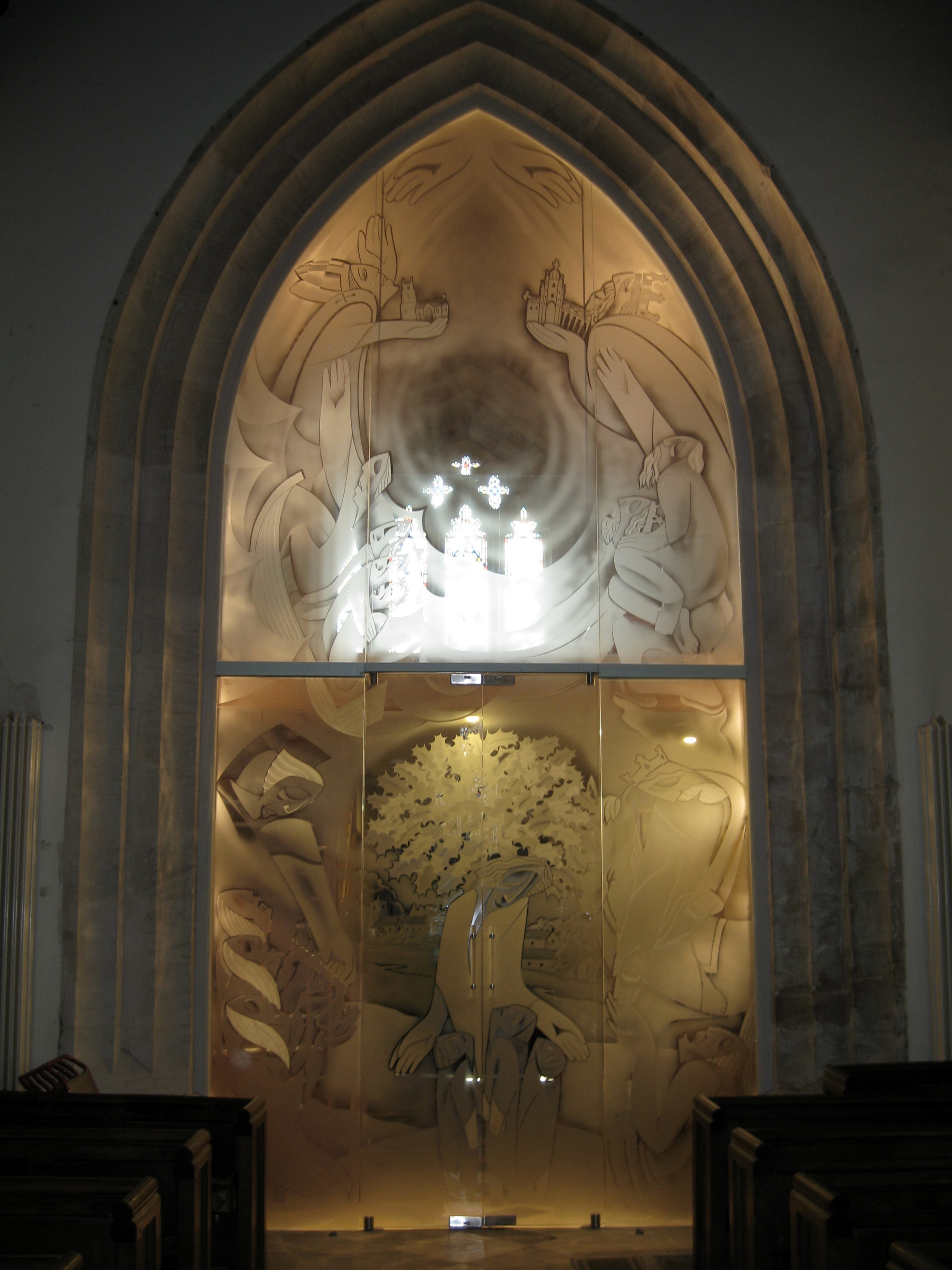
Glass Screen at the Church of St. Nicholas, Islip

While visiting Oxford in April, I had the pleasure of meeting artist Nicholas Mynheer and, what’s more, of having him talk me through some of his works on location. One of my favorites was the glass screen he designed for Saint Nicholas’s Church in nearby Islip, installed in 2011.

St. Nicholas Screen

Sandblasted glass screen at the west end of the Church of St. Nicholas, Islip, Oxfordshire, England. Designed by Nicholas Mynheer and made by Davia Walmsley of Daedalian Glass, 2011.

The screen depicts scenes from the life of St. Nicholas, a fourth-century bishop from Asia Minor and the prototype for Santa Claus, and the life of St. Edward the Confessor, who was born in Islip and reigned as King of England from 1042 to 1066. Though separated by seven centuries and a continent, the lives of these two men mirror each other in several ways—because they both mirror Christ. Key episodes unfold in parallel up each side of the screen, with the blessing hands of God the Father at the top, and the blessing hands of Christ at the base, behind whom lies the village of Islip.  Continue reading

Posted in Western Art | Tagged , , , , , | 3 Comments

Tee Time: Defend Christmas

Defend ChristmasSeller’s description: Features “Santa and Jesus holding back the rising tide of pointy-toothed, Christmas-eating atheists and their liberal overlords in Americatown, USA.”

It’s nice to see Jesus and Santa on the same team!

Found at ebay.com.

Posted in T-shirts | Tagged , | Leave a comment

The Real Saint Nick

Saint Nicholas altarpiece

Gentile da Fabriano, St. Nicholas of Bari, 1425. Panel from the Quaratesi Polyptych. Tempera on wood, 200 × 60 cm. Uffizi Gallery, Florence, Italy. In his right hand, St. Nicholas holds three golden balls, alluding to the episode of the three destitute maidens. His vestment is decorated with scenes from the life of Christ.

Santa Claus: fact, or fiction?

The answer is, a little bit of both. The Santa Claus of American lore is based on the real-life Nicholas of Myra, a Greek Christian living in Asia Minor during the third and fourth centuries. (Myra is modern-day Demre, Turkey.) Little is known for sure about St. Nicholas, but tradition tells us that he was born the only child of a wealthy, pious couple in a town called Patara. His parents died in an epidemic when he was young, after which he went to live with his uncle in a monastery. There he continued to grow in his knowledge of and love for Christ, and after some time, he was elected Bishop of Myra. He is most known for his acts of generosity, including anonymous gift giving, which gave rise to all the various December gift-giving traditions that are carried out throughout the world today.

The Provision of the Three Dowries

The most famous story associated with St. Nicholas is the story of his saving three impoverished sisters from a life of prostitution. Their father could not afford dowries for them, which made them unmarriageable, and it had come to the point where he could no longer support them. Out of desperation, he decided that the only thing left to do was to have them prostitute themselves, so then at least they could earn enough money to keep themselves clothed and fed. But Nicholas would not stand for this. Having heard of the family’s misfortune, he stole away under shade of night to their home and tossed a bag of gold through the girls’ bedroom window—which landed in the eldest daughter’s stocking (or some versions say shoe). The next morning, the family discovered the gift and rejoiced, for now the eldest daughter was able to get married. Another night soon thereafter, Nicholas visited the house again and threw another bag of gold through the window, which enabled the middle daughter to likewise marry. Wanting to figure out the source of these mysterious gifts, the father stayed up all night, night after night, until Nicholas returned again with a third bag of gold. This time, the father caught him after the act and thanked him profusely. Nicholas told him to direct his thanks to God instead, for it is God who provides, and not to tell anyone who the gifts had come from.  Continue reading

Posted in History, Pop Culture | Tagged , , , , , | 3 Comments

Tee Time: Loved Actually by Jesus

Loved actually by JesusFound at religioustshirts.co.uk.

Posted in T-shirts | Tagged , | Leave a comment