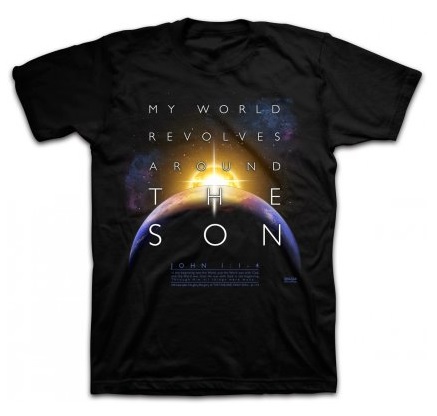
Tee Time: My world revolves around the Son

My world revolves around the SonFound at kerusso.com.

Posted in T-shirts | Tagged , | 2 Comments

Roundup: MOBIA closing, spirituality in African & African American art, Christian bookstores, a mom’s legacy, “River of Life”

The Museum of Biblical Art in New York City will be closing permanently on June 14 due to lack of funding. I really am saddened by this news. The (secular) art news blog Hyperallergic covered this story, writing that MOBIA “showcased smartly curated exhibitions that looked academically and artistically at the biblical influence on art. . . . Its examinations of religion’s impact on art history and the openness of its programming will be missed.”

This year the Smithsonian National Museum of African Art is running an exhibition called “Conversations: African and African American Works in Dialogue.” One of the themes the exhibition explores is spirituality. See works by Henry Ossawa Tanner, Aaron Douglas, William Henry Johnson, and more.

“10 Things We Miss about ’90s Christian Bookstores”: Gotta say, I was a regular patron of my local Christian bookstore in the nineties. They carried some of the tackiest stock around.

“One Thing I Want My Kids to Remember about Me” by Melissa Edgington: Hear what this mommy blogger has to say.

George Black of Elm City Vineyard Church in New Haven, Connecticut, sings the children’s church classic “River of Life”:

Posted in Roundup | Leave a comment

A tribute to Joan Hartz, my grandma

My grandma is a truly amazing woman of faith, whose life bears witness to the grace and goodness of God. She gave herself to Christ at a young age and has been serving him ever since in central New Jersey—in her home, her church, and her community. She has been one of the most influential people in my spiritual formation, a constant encouragement and a shining example of Christlikeness. Selfless and joyful in all that she does, she lives in constant praise of the One who has saved her.
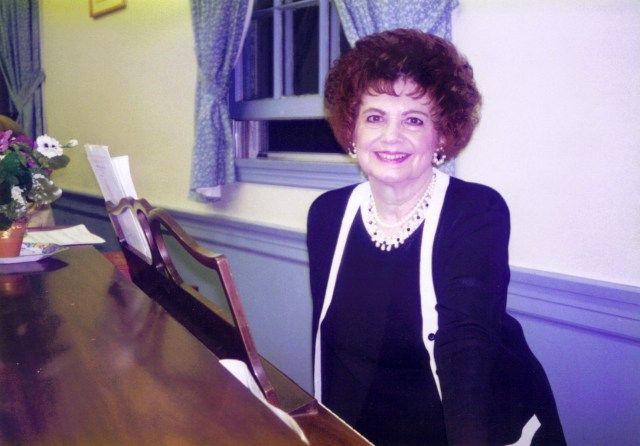
Joan Hartz at the piano

Not only does Mom-Mom model Christ to me, she is also the most talented pianist I know. As with her other gifts, she uses it to serve God; she’s been playing the piano and/or organ for her church for the last sixty-five years, and she gives regular concerts at a local nursing home. Though I too play the piano, I know I will never attain the level of expertise that she’s been able to—but it’s fun to try to work toward! We sometimes tinker around together in duet. But I can really only play the notation in front of me; Mom-Mom, on the other hand, has this amazing ability to embellish a basic melody with all kinds of creative flourish. Her arrangements have an arc that builds to a climax and then winds back down again.

Some of my fondest memories of visiting Mom-Mom and Pop-Pop’s have to do with sitting in the living room with the rest of my family, listening to her make those keys sing. We cuddle up in blankets with dessert in hand and shout out hymn requests, which she strings together into seamless medleys full of spiritual vitality.

When Mom-Mom visits my parents in North Carolina, she’s usually invited to play special music at their church. During one such practice session last November, my mom arranged to have her recorded. So with no advance notice, nothing special prepared, Mom-Mom sat down and created these impromptu arrangements, which have all the character of her living room performances.

So I am pleased to publish online for the first time nine of Joan Hartz’s original piano arrangements. I’ve called the set Hymn Improvisations. Listen below, or jump over to SoundCloud, where the playlist is hosted.

Unfortunately, some modification of the original recording was necessary. In seeking permission for the few songs still under copyright, I found that the two controlled by Music Services, Inc.—“My Hope Is in the Lord” and “’Til the Storm Passes By”—are too expensive to license for online streaming, so I’ve omitted those from the playlist. Other than that, I’ve preserved intact the order and content of that November recording session.

I’d like to draw your attention to track 5, which features Mom-Mom’s favorite hymn, “My Jesus, I Love Thee.” The first verse goes,

My Jesus, I love Thee, I know Thou art mine;
For Thee all the follies of sin I resign.
My gracious Redeemer, my Savior art Thou;
If ever I loved Thee, my Jesus, ’tis now.

Track 4, “In the Garden,” also holds special significance for Mom-Mom, it being her mother Florence Rothamel’s favorite hymn.

I hope you enjoy my grandma’s online debut!

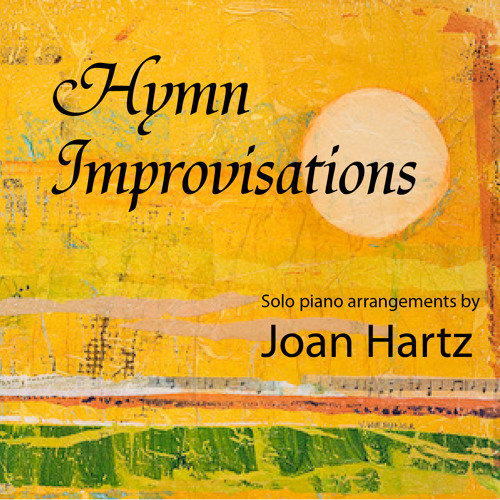
A special thanks to Virginia Wieringa, who graciously allowed me to use one of her collages for the album cover art. Inspired by Psalm 5, the image expresses so well my grandma’s exuberant spirit, which I think you will agree comes across in her music.

Posted in Music | Tagged , | 4 Comments

Tee Time: When Jesus makes tea . . .

Tea Jesus

. . . Hebrews.

Found at shopgoodie.com.

Posted in T-shirts | Tagged , | Leave a comment

The Laureation of Christ

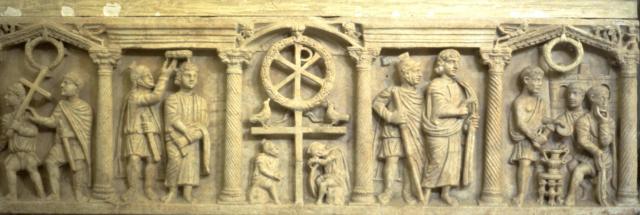
I wrote an Easter meditation for ArtWay, on the marble relief carvings of an early Christian sarcophagus. Check it out!

Sarcophagus with Scenes of the Passion (probably from the Catacomb of Domitilla), Rome, mid-fourth century. Marble, 23ʺ x 80ʺ. Museo Pio Christiano, Vatican, Rome.

“In the late third century, wealthy Christians started commissioning the carving of marble sarcophagi for use in the catacombs, their network of underground burial chambers. More than decorative niceties, these relief carvings on the fronts were articulations of Christian theology—a visual expression of what the new religionists believed about death. Along with wall paintings in the catacombs, they served as confessions of faith and symbols of hope for the community after the passing of one of its own. Funerals, it turns out, provided the context for the creation of the earliest Christian art.

“The fourth-century sarcophagus pictured above highlights three distinct scenes from Jesus’s Passion narrative—Christ before Pilate (in the two rightmost registers), the crowning of Christ, and Simon of Cyrene helping Jesus carry his cross—plus a central scene suggestive of the Resurrection. In all of these Jesus is depicted as calm, dignified, and pretty much untouched; the physical agony that came to characterize him in the art of the Middle Ages is absent. Young and beardless, he’s your typical Roman hero, and like a philosopher, he holds a scroll.

“Most notable, however, are the various emblems of imperial power, which here assign victory and supreme authority to Jesus. The laurel wreath, the eagle, and the sun and moon, associated in contemporaneous Roman art with the emperor, are employed by the craftsmen of this sarcophagus—in consultation with their client—in the service of Christian doctrine. All three come together in the central register, which is the focal point of the piece, the climax of the narrative, and the main container of commentary. This register shows the chi-rho monogram mounted triumphantly on a cross and encircled by a laurel wreath, which two doves peck at from below.”

Read more.

Posted in Western Art | Tagged , , , , , , , , | Leave a comment

Holiday ritual in the boyhood home of Jesus

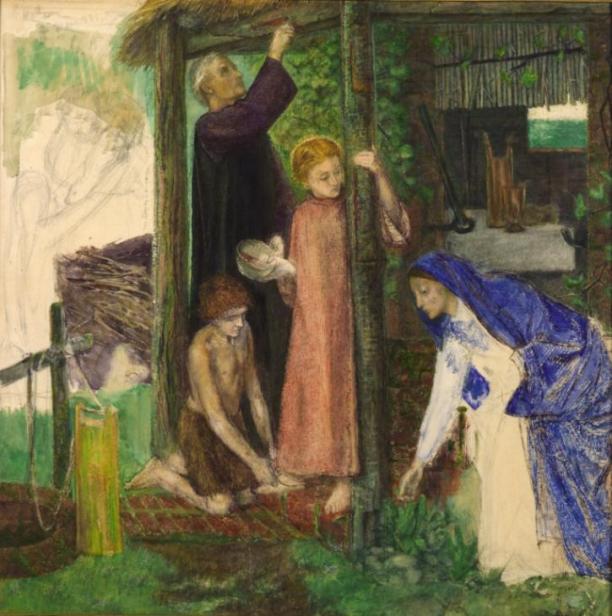
Jesus celebrating Passover

Dante Gabriel Rossetti (English, 1828-1882), The Passover in the Holy Family, 1855-56. Unfinished watercolor on paper, 40.6 × 43.2 cm. Tate Britain, London.

Here meet together the prefiguring day
And day prefigured. ‘Eating, thou shalt stand,
Feet shod, loins girt, thy road-staff in thine hand,
With blood-stained door and lintel,’ — did God say
By Moses’ mouth in ages passed away.
And now, where this poor household doth comprise
At Paschal-Feast two kindred families, —
Lo! the slain lamb confronts the Lamb to slay.

The pyre is piled. What agony’s crown attained,
What shadow of death the Boy’s fair brow subdues
Who holds that blood wherewith the porch is stained
By Zachary the priest? John binds the shoes
He deemed himself not worthy to unloose;
And Mary culls the bitter herbs ordained.  Continue reading

Posted in Poetry, Western Art | Tagged , , , , , , | Leave a comment

In Song and Picture: Christus Victor

Listen: “Death Has Lost Its Sting.” Words by Isaac Watts (based on Psalm 3), 1707; adapted by Rebecca Dennison, 2011. Music by Mike Cosper, 2011. Performed by Sojourn (featuring Megan Shaffer), 2011.


Look:

____________

For their album The Water and the Blood, the talented musicians at Sojourn Community Church in Louisville, Kentucky, revamped twelve hymns by the father of English hymnody, Isaac Watts, among them “Death Has Lost Its Sting.” Based on Psalm 3, the song expresses a stumbling in the dark toward the hope that is in Christ, who secured for us victory over death and sin by way of his resurrection. The song took on a special personal resonance for vocalist Megan Shaffer, whose father died a few days before the group recorded it.

Turning from lament to praise, the chorus calls on God to arise once more and demonstrate in our lives that selfsame power that brought down Satan all those years ago:

Arise, O Lord, fulfill thy grace,
While I thy glory sing;
My God has broke the serpent’s teeth,
And death has lost his sting.

Whether physical death or just a feeling of being buried alive by emotional pressures or circumstances, the resurrection of Christ speaks to both, has the power to “break the teeth” of our worst fears and most violent oppressors.

In today’s gallery you will find first an image of desperation, of overwhelm—a common experience in the life of faith and in the human journey in general, one that’s attested to by the psalmists of scripture and by Watts, who adapted their words.

What follows are images (some subtle, some not so subtle) of the triumphant Christ. Linocut artist Kreg Yingst shows a corpse-like figure being lifted out of grave, his burial clothes unwinding, within purview of the All-Seeing Eye. On a much larger scale, Bruce Herman presents the crucified Christ as the Second Adam come to undo the curse brought about by the first; totally dependent on this grace, Adam grasps at the vine that grows out from the cross, and Eve lies prostrate, as Mary stands on either side in contemplation—the wedding at Cana and its jars of wine a prefigurement of the abundant provision of blood at the cross. In the Anglo-Saxon ivory carving, you see the very literal trampling of evil (embodied by a lion, dragon, asp, and basilisk) by the resurrected Christ, who holds high the crux invicta (cross of victory). Ding Fang, in a related motif influenced by Eastern Orthodox iconography, shows Christ standing atop the busted-down gates of hell, calling the saints of ages past unto himself. Lastly, Yvonne Valenza uses phoenix imagery—a mythological bird who after it dies is reborn from its own ashes—to evoke the theme of resurrection. Through Christ we too can rise from death.

Posted in Music, Non-Western Art, Western Art | Tagged , , , , , | Leave a comment

Early-bird registration almost up for CIVA’s biennial conference

There are just four days left to register for this year’s CIVA (Christians in the Visual Arts) conference, “Between Two Worlds: Contemporary Art and the Church,” at the early-bird rate of $235. Consisting of keynote presentations, panel discussions, exhibitions, workshops, and cultural outings, it’s taking place June 11-14 at Calvin College in Grand Rapids, Michigan. I’ll be attending and would love to see you there!

For more information, visit http://civa.org/events/conference/.

Posted in Western Art | Tagged , | Leave a comment

Who was Saint Patrick?

St. Patrick’s feast day is tomorrow, March 17. Here’s a short clip from the video curriculum Christian History Made Easy that explains why the church commemorates him every year.

For more on St. Patrick’s outreach to the Irish, read the article “The Mission of Saint Patrick” by David Mathis.

Posted in History, Pop Culture | Tagged , | Leave a comment

In Song and Picture: Lightness of Being

Listen: “I Lay My Sins on Jesus.” Words by Horatius Bonar, 1843. Music by Justin Ruddy, 2010. Performed by Castle Island Hymns (featuring Kevin Burtram), 2010.


Look:

____________

The hymn “I Lay My Sins on Jesus” by Horatius Bonar draws together several different metaphors and roles of Jesus: Jesus as sin bearer, scapegoat; Jesus as Paschal lamb; Jesus as cleansing agent; Jesus as healer, redeemer, liberator, co-sufferer. Underlying them all is the notion of transfer, cost—we bring our burden to Jesus, and to free us from it, he takes it upon himself. Whatever it is that’s weighing us down—sin, guilt, yearnings, sickness, grief, anxiety—we are invited to pass it on to him who alone can bear it perfectly.

Though the text is a bit sprawling (Bonar later apologized for it, admitting it to be “not good poetry”), I appreciate what the musicians at Citylife Presbyterian Church in Boston, known collectively as Castle Island Hymns, saw in it. Justin Ruddy’s retuning of this Victorian hymn, and especially the instrumentation, evokes a sense of lightness, of liftedness. Spirited guitar plucking sets the tone that is sustained throughout, which the piano, at first trudging, is lifted up into by the strings.

For visual complements to this piece, I chose first Jyoti Sahi’s Lamb and the Tree, which shows a lamb cut open, letting loose a stream of blood, and at the base of this blood flow a green shoot is sprouting up—life rising out of death. Second, I chose Brad Lucas’s bronze sculpture of Christ falling on the way to Calvary, the cross breaking him down and twisting him up. (Click here to view the sculpture from other angles and to read the artist’s commentary.)

Lastly, a painting by Michael D. O’Brien, who describes the image like this:

The ascending birds represent souls being rescued from destroying flames. The rescuer exposes his arms to the fire in order to hold it back while he guides the birds upward toward the horizon, toward light. The human figure is a “type” or symbolic metaphor of Christ.

Jesus is the hero in all three artistic works: he causes us to flourish and to fly. To enter into this growth, this freedom, we need only lay our sins on him.

Lightness of being—that’s what Jesus achieved for us. But as these artists remind us in their respective images, he first had to be torn open, crushed, burned.

Posted in Music, Theology, Western Art | Tagged , , , , , , , | Leave a comment