Jesus as Logos, or Cosmic Christ (Part 2)

“In the beginning was the Logos,” the disciple John wrote in his Gospel, referring to Jesus Christ.  On Monday, we considered the possible influences the philosopher Philo’s multipart definition of “Logos” might have had on John.  Now I wish to center in on one of those definitions in particular, and that is the Logos as the Universal Bond, as this is the definition I find most intriguing when applied to Jesus.

Logos200

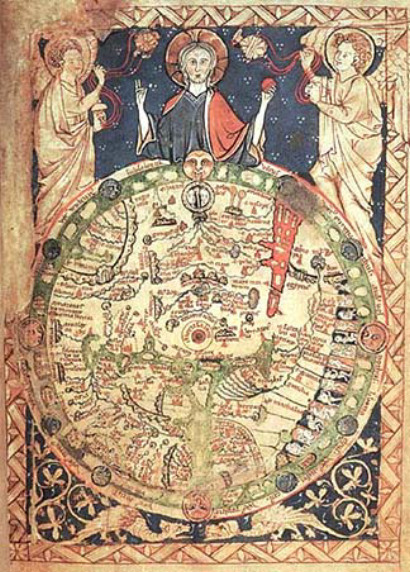
Pietro di Pucci da Orvieto, “Universe Supported by God with the Signs of the Planets,” Campo Santo, Pisa, Italy

“The Logos of the living God is the bond of everything,” Philo wrote, “holding all things together and binding all the parts, and prevents them from being dissolved and separated … the Logos, which connects together and fastens every thing, is peculiarly full itself of itself, having no need whatever of any thing beyond” (De Profugis; Quis Rerum Divinarum Heres Sit 188).

According to Philo, the Logos holds together all the parts of the world and all the parts of the body.  Not only that, he is entirely non-contingent and self-sufficient.  Continue reading
Posted in Theology | Tagged , , , , , , | Leave a comment

Jesus as Logos, or Cosmic Christ (Part 1)

“In the beginning was the Word, and the Word was with God, and the Word was God. … And the Word was made flesh, and dwelt among us, (and we beheld his glory, the glory as of the only begotten of the Father,) full of grace and truth.”  -John 1:1, 14

Jesus as Logos In the opening of his Gospel, John refers to Jesus using the Greek term “Logos.”  English Bible translators have rendered that loaded term as “Word”; unfortunately, as is true in any literary translation, much meaning is lost, as “Logos” carries with it many connotations—and indeed, an entire philosophical framework—that “Word” does not.  In the ancient world, the term “Logos” didn’t really have a fixed definition, since philosophers were continually reinterpreting it, readapting it, to give it renewed meaning (among them Heraclitus, Aristotle, the Stoics, Philo, and, in the third century A.D., Plotinus).  In most schools of Greek philosophy, though, the term was used to designate the underlying principle of the universe, one that was rational, intelligent, and vivifying.  Some loose synonyms for Logos might be Mind, Power, Cause, Act, Ground, Reason, or Structure, but no one word adequately sums up the fullness of the term.  Continue reading

Posted in Theology | Tagged , , , | 3 Comments

Jesus on a Cracker (on Your Neck)

I’m sure you’ve seen many a pretty gold or silver cross pendant before, but here’s some Jesus jewelry I bet you haven’t seen.

Jesus cracker necklace

Granted, these items are sold from an online shop that markets itself as “the one stop shop for all your tacky crap needs.”

Posted in Jesus Kitsch | Tagged , , | Leave a comment

Jiminy Jesus

Jesus iconsInterVarsity Christian Fellowship, an evangelical campus mission, was handing out these cards at a recruitment event at MIT last fall.  What a great discussion starter!

Jiminy CricketEven among Christians, there is no consensus on exactly who Jesus is, or on what cultural / political / religious icons he most closely resembles.  I guess growing up, I tended to see Jesus as a Jiminy Cricket sort of fellow.  You know, as a conscience to whom I could “give a little whistle” when I got in trouble or faced temptation.  As a buddy who looks out for me and helps me out of scrapes.

As a teenager, I tended to associate Jesus more with George Bush:  a political conservative and promoter of American values.  In my mind, Jesus was a Republican, which to me meant anti-abortion, anti-same-sex marriage, and pro-capital punishment.

The more I grew in my faith, though, the more I saw Jesus as a Mother Teresa, one who ministered to the poor, sick, orphaned, and all the other outcasts of society.  One who radically and sacrificially gave.  I tend to cling to this image still today.

Which of these icons were you taught that Jesus most resembles?  Have your views of Jesus changed since you were a kid?  What do you think is the most prevailing image that comes to mind when people think “Jesus” today?

Posted in Who is Jesus? | Tagged , , , | 2 Comments

‘Who do men say that I am? . . . Who do you say that I am?’

Now Jesus and His disciples went out to the towns of Caesarea Philippi; and on the road He asked His disciples, saying to them, “Who do men say that I am?” So they answered, “John the Baptist; but some say, Elijah; and others, one of the prophets.”  He said to them, “But who do you say that I am?

—Mark 8:27-29a (NKJV, emphasis added)

This latter question is one of the most piercing and resonant questions in all of Scripture, and one that still begs an answer today. Some, like the apostle Peter, respond to the question with immediate affirmation of Jesus’s supremacy and Godhood. Others respond with respect or intrigue. And others still, with skepticism or indifference. Nonetheless, what makes the question such a compelling one is its multiple layers, the bottom layer being the implicit plea, “Know me. Find out for yourself who I really am.”

Continue reading

Posted in Who is Jesus? | Tagged , , , | 3 Comments