


I found this shirt at evolvefish.com.
It’s a reference to a scene from the movie My Best Friend’s Girl, starring Dane Cook. (Content advisory: This clip contains a piece of crude sexual humor at 0:56.)
I found this shirt at evolvefish.com.
It’s a reference to a scene from the movie My Best Friend’s Girl, starring Dane Cook. (Content advisory: This clip contains a piece of crude sexual humor at 0:56.)
“He loves Thee too little who loves anything together with Thee, which he loves not for Thy sake.”
—St. Augustine, Confessions
“Nor Thou nor Thy religion dost control,
The amorousness of an harmonious Soul,
But thou would’st have that love Thyself: as Thou
Art jealous, Lord, so I am jealous now,
Thou lov’st not, till from loving more, Thou free
My soul: who ever gives, takes liberty:
O, if Thou car’st not whom I love
Alas, Thou lov’st not me.
Seal then this bill of my Divorce to All,
On whom those fainter beams of love did fall;
Marry those loves, which in youth scattered be
On Fame, Wit, Hopes (false mistresses) to Thee.”
—John Donne, “A Hymn to Christ”
I recently watched the movie Cool Hand Luke (1967), so this song has been stuck in my head:
“I don’t care if it rains or freezes
Long as I got my plastic Jesus
Sittin’ on the dashboard of my car.
Comes in colors, pink and pleasant,
Glows in the dark ’cause it’s iridescent,
Take it with you when you travel far.
Get yourself a sweet Madonna,
Dressed in rhinestones, sittin’ on a
Pedestal of abalone shell.
Goin’ ninety, I ain’t scary [sic: “wary”],
’Cause I’ve got the Virgin Mary
Assurin’ me that I won’t go to hell.”
In this scene, Luke just found out that his mother died, so the tone of his performance is tender, soulful, sad—completely unlike the obnoxious and irreverent premiere performance in 1962, which was intended as a parody. Singer-songwriters Ed Rush and George Cromarty wrote the song in reaction to a Christian radio station in Del Rio, Texas, which they said ran ads whose copy read like the lyrics of this song. They recorded “Plastic Jesus” as part of a fake Christian radio broadcast, under the fake band name “The Goldcoast Singers” (click here to read the script, or here to listen to the audio on YouTube). Ernie Marrs adapted the lyrics and tune in 1965. The song was adapted even further for Cool Hand Luke,and has since been covered by a few dozen artists, the most famous of which is probably Billy Idol.
To see some of the lyric variations that have developed in the last four decades, click here.
I put together a (nonexhaustive) Spotify playlist of different versions of the song. The only one I can stand to listen to is Rocky Votolato’s from 2007, which I rather like. (Still doesn’t beat Paul Newman’s, though.)
Click here to listen to the “Plastic Jesus” playlist. (You will need to sign up for Spotify if you are not already a member.)

Photo by Joseph Novak
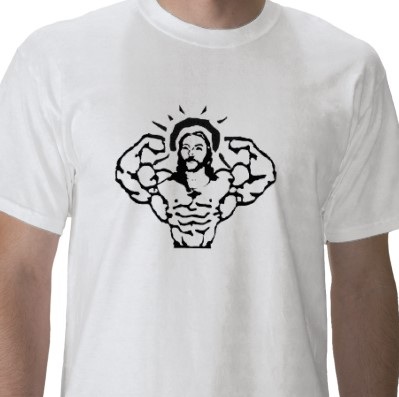 Found at zazzle.com.
(I can’t figure out how to replicate the poem’s indentations in WordPress. You can read the poem in its original formatting here.)
“Rise heart; thy Lord is risen. Sing his praise
Without delayes,
Who takes thee by the hand, that thou likewise
With him mayst rise:
That, as his death calcined thee to dust,
His life may make thee gold, and much more, just.
Awake, my lute, and struggle for thy part
With all thy art.
The crosse taught all wood to resound his name,
Who bore the same.
His stretched sinews taught all strings, what key
Is best to celebrate this most high day.
Consort both heart and lute, and twist a song
Pleasant and long;
Or since all musick is but three parts vied
And multiplied;
O let thy blessed Spirit bear a part,
And make up our defects with his sweet art.
I got me flowers to strew thy way;
I got me boughs off many a tree:
But thou wast up by break of day,
And brought’st thy sweets along with thee.
The Sunne arising in the East,
Though he give light, and th’ East perfume;
If they should offer to contest
With thy arising, they presume.
Can there be any day but this,
Though many sunnes to shine endeavour?
We count three hundred, but we misse:
There is but one, and that one ever.”
Disturbing as it is, I love the musical imagery in the third stanza: our heartstrings, the stretched tendons of Jesus on the cross, and the song of the Spirit form a trio of voices, one lovely chord. This picture reminds me of the line in “Come Thou Fount,” where the speaker petitions God, “Tune my heart to sing Thy grace”—bring my pitch into harmony with You. In Herbert’s poem, Jesus’ sacrificial death establishes the key in which we are are to play; he is the tonic, the base on which we build our song.
In the last two stanzas, Herbert plays on the homonyms “sun” and “Son”—a common device in medieval and Renaissance poetry. No sunrise has ever been or will be as glorious, Herbert writes, as the resurrection Sonrise on that first Easter Sunday.
For a musical setting of Herbert’s poem, see songs one and two of Ralph Vaughan Williams’s Five Mystical Songs. If you have Spotify, you can listen to them here.
In the Greek Orthodox Church, it is a Maundy Thursday tradition to hard-boil some eggs and dye them red. The red symbolizes the blood of Christ, shed on the cross on our behalf. Families arrange the eggs in a basket or into some other decorative display and put them up in their home, where they serve as a reminder of Christ’s death and entombment.
On Easter Sunday, Christians ceremonially crack open the eggs, symbolizing how Jesus cracked open the shell of his tomb and emerged with new life. As friends and families have fun hitting the eggs against each other, they are reminded not only of Christ’s resurrection to new life, but of their own as well. The shell thus represents not only the physical rock that sealed Jesus off for three days, but also the sin that encases us before we “hatch,” so to speak. The message of Easter is that Jesus Christ broke through the shell of death and sin so that we can be born anew in the Spirit.
In cultures all over the globe, stretching back before Jesus’ time, the egg has always symbolized fertility and life—but to (Greek Orthodox) Christians, it has this added personal meaning. The birth and life and growth that we speak of is of a spiritual nature and is wholly grace-based.
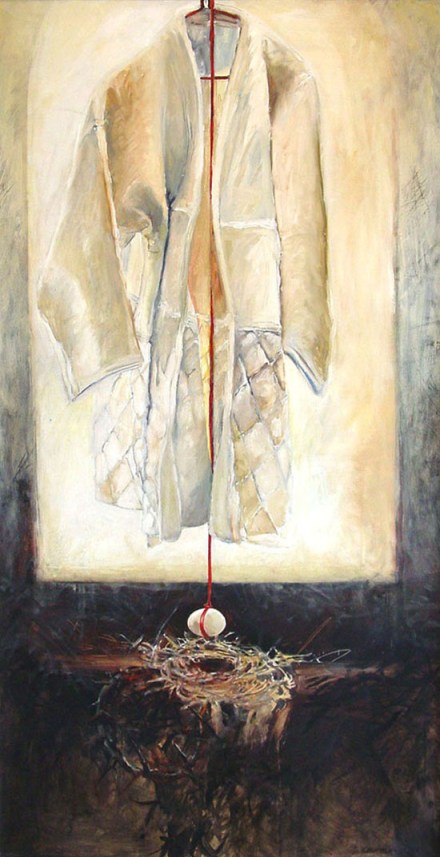
Grace Carol Bomer, "Heaven/Earth." Oil on paper on panel, 60 x 32 in.
North Carolina artist Grace Carol Bomer invokes the symbolism of the egg in her painting Heaven/Earth.
The painting is about how Jesus connects both realms with the ribbon of his blood, Bomer says on her website; in one word, it’s about atonement (literally “at-one-ment”). Earth, which occupies the bottom third of the painting, is represented by a thorny nest. (Thorns were the curse of Adam after the Fall [Genesis 3:17-19], and also a tool of torture that Christ endured prior to his execution [Matthew 27:29; cf. Mark 15:17, John 19:2].) But from these thorns emerges an egg, which is being lifted up by a red ribbon dangling from a white robe. The robe represents the righteousness of God and the heavenly realm wherein it dwells in all fullness.
Christ’s death is the fabric that connects man to God, heaven to Earth. It lifts us up to new life; it ties together; it at-ones. What a beautiful Easter image.
“With all wisdom and understanding, he made known to us the mystery of his will according to his good pleasure, which he purposed in Christ, to be put into effect when the times reach their fulfillment—to bring unity to all things in heaven and on earth under Christ” (Ephesians 1:8-10).
 A triple feature. These T-shirts are from, in order of appearance, Café Press, humerusonline.com, and championsof hell.com.


Here’s a recap of the series:
In part 1, we looked at three different musical interpretations of “Lord of the Dance” by Sydney Carter. “Dance . . . and I’ll lead you,” says the Jesus of these lyrics. Carter said that the life and words of Jesus give us all a dancing pattern that we would do well to follow.
In part 2, we looked at the art of Indian Christian artist Jyoti Sahi, which contains visual references to Shiva as Nataraja (“Lord of the Dance”). Sahi draws on traditional Hindu iconography to portray Jesus as the Christian’s Nataraja—Creator, Preserver, Destroyer, and Liberator, who dances on the burning-ground of men’s hearts with a fire that both kills and kindles.
In part 3, we looked at the medieval carol “Tomorrow Shall Be My Dancing Day,” in which Jesus, as speaker, tells his love story, about what he did to woo humanity.
In part 4, we looked at two paintings by an American artist who enjoys exploring indigenous symbols, styles, and themes in his work. One of his paintings shows a Mayan Jesus dancing up out of the jaws of death, flanked by stalks of maize, an allusion to resurrection. Continue reading
 Found at GuitarCenter.com.
Balinese artist Nyoman Darsane was born in 1939 and raised as a Hindu. At age seventeen, he became a Christian and as a result was ostracized by his family and village community. But because he so persistently strove, through his art, to give Christianity a Balinese shape, they eventually decided to accept him back in. They saw that he still loved and respected the culture; he was still “one of them,” even though his religious beliefs took a different turn. Does he feel that, as a Balinese Christian, his identity is divided, that he cannot fully embrace both at once? Not at all. “Bali is my body; Christ is my life,” he says. In other words, Jesus Christ is his all, but can he not pray to and worship and express his love for Jesus Christ in a Balinese fashion? And can he not picture Jesus as a fellow Balinese, incarnate in the skin tone and dress and dance poses of his people?
This is one way that Darsane gives Christianity a Balinese “body”: by giving Jesus a Balinese body, a dancing Balinese body. Dance is an integral part of Balinese culture, and it is intricately tied to religion.
Approximately 95 percent of the people in Bali practice what is known as “Balinese Hinduism” (or “Bali Hindu Dharma”), a unique blend of Hinduism, Buddhism, and ancient indigenous beliefs including animism and ancestor veneration. The Balinese insist that they are monotheistic: they believe in one supreme God (whom they call “Ida Sanghyang Widi Wasa,” or “Sanghyang Widi” for short), but this God has multiple manifestations. They also believe in a spirit realm that exists between the realm of the gods and the realm of human beings. Their rituals, which are frequent and many, are for the purpose of preserving the cosmic balance that exists between the forces of good and evil—which is why they make offerings to both gods and demons.
… But back to dance. The Balinese use dance to worship, petition, channel, and/or entertain the gods, and also to tell stories. Darsane plays upon these functions in his paintings. I’ll focus on just four, each of which casts Jesus in a different role: Creator, Servant, Teacher, Warrior. In all these roles, Jesus can be seen preeminently as Savior: He created the world to be at one with the Godhead, free and at peace and in joy. When that oneness was broken, he descended into the world to restore it. During his earthly ministry, he taught others about God’s will for them, and about how he was the fulfillment of the law and the prophets. Then he fought sin and death head-on, crushing both and making salvation possible for all. Continue reading
 The Jesus Question