Tee Time: Elvis Jesus

T-shirt_Elvis Jesus Amigos

Elvis Jesus

Elvis Jesus

The designer wear company Elvis Jesus was founded in 1997. According to their website, “Somewhere between the gutter and the stars lies Elvis Jesus, juxtaposing heroes with anti-heroes, rock with religion and fashion with politics. Using inky black humour, renegade design and painstaking hand applied couture detailing, Elvis Jesus portrays a twisted tale of sex and drugs and sweet salvation.”

Posted in T-shirts | Tagged , , | Leave a comment

Roundup: Yeezianity, the Young Messiah, false Jesus theories, abandoned churches, religion treasures at Yale

“The Church of Yeezianity” by Matt Wilstein: This new religion reveres Kanye West as Yeezus, “a divine being who has been sent by God to usher in a New Age of humanity,” according to the religion’s official website. In an interview with Noisey, the anonymous founder of Yeezianity—who insists that no, this is not a joke—said, “Jesus has all this baggage and all these connotations, and Yeezus is this new thing. . . . Yeezus is when Kanye elevates to that God-level, which I feel like we all have the potential to do.” He also says that Kanye has the highest moral standards of anyone today. Oy vey.

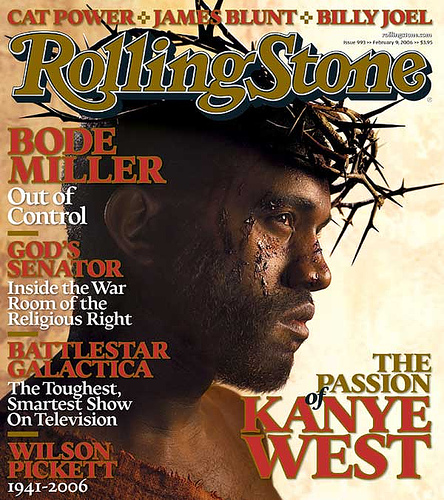
Kanye West on Rolling Stone

Kanye West made Rolling Stone‘s February 9, 2006, cover story. His song “Jesus Walks” has been hailed as one of the greatest hip-hop songs of all time.

The Young Messiah: This new movie set to release next March follows Jesus at age seven as he returns home to Galilee and starts growing into his religious identity. Based on the Anne Rice novel Christ the Lord: Out of Egypt.

“Refuting 5 False Theories about Jesus” by Kyle Dillon: Jesus the Pagan Myth. Jesus the Failed Prophet. Jesus the Moral Philosopher. Jesus the Violent Revolutionary. Jesus the Ahistorical Existentialist.

“Photos of European Churches Left in Holy Ruin” by Anika Burgess: Photographer Hans van Vrouwerf has a fascination with lost faith and forgotten places of worship and has visually documented about twenty abandoned churches around Europe.

“15 Religion Treasures at Yale” by Tom Krattenmaker: Yale University houses artistic and literary treasures relating to various religious faiths, and the fifteen that Krattenmaker highlights are all available for public viewing. Those from the Christian tradition include a Gutenberg Bible, a wall painting extracted from a third-century house church in present-day Syria (which features one of the earliest depictions of Jesus! see image below), and the original handwritten text of the sermon “Sinners in the Hands of an Angry God” by Yale alum Jonathan Edwards.

Christ at Dura Europos

Christ Healing the Paralytic, third century. Wall painting extracted from the baptistery at Dura-Europos, now housed at Yale University Art Gallery, New Haven, Connecticut.

Posted in Film, Pop Culture, Roundup | Leave a comment

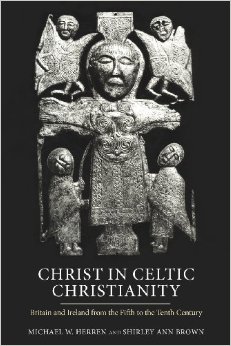
Book Review: Christ in Celtic Christianity, by Michael W. Herren and Shirley Ann Brown

Christ in Celtic ChristianityCeltic has become a buzzword in today’s age, evoking romantic notions of a peaceful, inclusive, nature-loving Christianity practiced in the British Isles of the Early Middle Ages. Classicist Michael W. Herren and medieval art historian Shirley Ann Brown, however, do not indulge these popular misconceptions in their book Christ in Celtic Christianity: Britain and Ireland from the Fifth to the Tenth Century (Woodbridge, Suffolk, UK: Boydell Press, 2002, 2012). On the contrary, by examining textual and artistic evidence they reveal that the Christianity that was first embraced by Celtic-speaking peoples was very much ascetic and oriented around the avoidance of hell, with salvation being conceived as the end of a life of self-effort rather than an act of God’s grace. Christ the Perfect Monk and Christ the Judge were the most common images of Christ during this period—literary images, that is, for the early British and Irish churches rejected the making of physical images. Only later in the mid-seventh century, when the Roman Church began to infiltrate the Isles, did Celtic Christology start to take on a more orthodox form, with a greater emphasis on Christ as divine, redeeming, and miracle working. This is when stone sculpture and incision, metalwork, and illuminated manuscripts of a distinctly Celtic Christian nature started appearing.

The book contains 16 halftones and 10 line-drawn figures. Because the paperback is being printed by an on-demand service, the quality of the halftones is compromised—however, most of these images can be found online, and in fact I wouldn’t recommend viewing the manuscript illuminations in any other way than in color.

A collaborative effort between two scholars of different specializations, the book is for the most part conjunctive, its voice consistent. Chapters 1–4, written by Herren, present a history of Christianity in Britain and Ireland up to the tenth century, with special emphasis on Pelagian doctrine and the relationship between the Celtic Church and Rome. Chapter 5, also by Herren, describes the four most common images of Christ found in the religious writings produced in or imported to Britain and Ireland: Christ the Perfect Monk, Christ the Judge, the Heroic Christ (Harrower of Hell), and Christ the Wonder Worker. Chapters 6–7, written by Brown, survey the various visual representations of Christ in Celtic art, including symbolic representations like the cross and the sacred monogram. I would have preferred that the literary themes were integrated with the visual rather than treated in separate chapters, as this would have eliminated some redundancy and made for better flow, in my opinion, but this is a minor criticism.   Continue reading

Posted in Theology, Western Art | Tagged , , , , , , , | 2 Comments

Get dusty!

An ancient Jewish blessing supposedly goes, “May you be covered in the dust of your rabbi.” The idea is that a rabbi’s disciples—those who took on his yoke, his set of interpretations of scripture—were to follow so closely behind him when they walked that they would become caked in the dust he kicked up with his feet. The blessing had a literal meaning but was primarily metaphoric, and the common Christian saying “following in the footsteps of Jesus” conveys the same idea (albeit less poetically!).

This blessing for religious learners is expounded on in the short film Dust by Rob Bell, embedded below, which is part of the NOOMA series. Its content evolved into what became chapter 5 of the book Velvet Elvis.

(I am aware that since making this video Bell has veered far off-center of orthodox Christianity and has thus lost the esteem of evangelical leaders, but that doesn’t mean we need to reject all his teachings. Dust was my first introduction to Bell—almost ten years ago!—and while I am disappointed with the direction he has taken, I appreciate his desire to ask questions and to seek fresh ways to articulate the truths of scripture.)

In this video Bell explains what it meant to be a rabbi’s disciple in Jesus’s day, which can give us a better understanding of what compelled Peter and Andrew to drop their nets when Rabbi Jesus called them, and what it means for us to be chosen by Jesus today.

If you are interested in learning more about this traditional blessing, I commend to you the blog post “Covered in the Dust of Your Rabbi: An Urban Legend?” by Lois Tverberg. In response to a writer’s allegation that the “dust” blessing is commonly misinterpreted by Christians, Tverberg examines its primary source, the Mishnah, as well as Jewish commentaries.

Posted in History | Tagged , , , , , , | 1 Comment

Sewing seeds of hope in South Africa

This article was originally published in a shorter form on ArtWay.eu. All photos are courtesy of the Keiskamma Trust; click to enlarge.

Created by about 130 Xhosa—mainly women—living along the Keiskamma River in South Africa’s Eastern Cape [1], the monumental Keiskamma Altarpiece is a memorial to community members who died of AIDS and an homage to the strength and agency of the women left behind. Consisting of embroidery, beadwork, wire sculpture, and photography, the altarpiece mourns loss, but more important, it prophesies hope and redemption for the village of Hamburg, providing a vision for residents to live into.

The project was spearheaded by Carol Hofmeyr, a medical doctor and fine artist who moved from Johannesburg to Hamburg in 2000. Struck by the area’s high unemployment rate and lack of adequate healthcare, she established the Keiskamma Trust, an organization that sponsors dozens of community-upliftment initiatives. Wanting to improve the quality of life for her new neighbors, many of whom were infected with HIV, Hofmeyr knew that medicine, though imperative, was not all that would be needed; people must also be given a reason to live. That’s why along with running an AIDS hospice and treatment center, the Trust commissions locals to create art. This holistic approach to AIDS treatment honors both the body and the soul. The planning and making of the Keiskamma Altarpiece, for example, was an act of communal therapy; it provided an opportunity for Hamburg’s women to talk openly about AIDS and to work through their grief and confusion over the loss of loved ones or personal diagnoses as well as to ponder the role their faith plays in suffering—all while learning new skills [2], earning an income, and producing a thing of beauty for the world to behold.

Keiskamma Altarpiece

South African health-care worker Eunice Mangwane presents the Keiskamma Altarpiece at the Cathedral Church of St. James in Toronto, the first stop on its North American tour in 2006. Mangwane is commemorated in the central panel of the altarpiece’s fully open view, pictured above.

At the height of the AIDS epidemic in Hamburg in late 2004, Hofmeyr conceived the idea of creating an altarpiece modeled on the famous Isenheim Altarpiece by Matthais Grünewald, itself a response to a horrifying epidemic in sixteenth-century France known then as St. Anthony’s Fire (and today as ergotism). This disease caused arterial constriction, sores, and gangrene and killed its victims slowly and agonizingly. Grünewald was commissioned by St. Anthony’s Monastery in Isenheim, France—which functioned as a hospital specializing in treatment of the disease—to create a piece for its chapel’s high altar, an image that would provide hope and comfort to patients. He responded with a complex, multipaneled altarpiece that features biblical and extrabiblical saints known for their fortitude in the face of suffering, most prominent of which is Christ, shown as a victim of St. Anthony’s Fire.

Isenheim Altarpiece

Matthais Grünewald, Isenheim Altarpiece (closed view), 1515. Oil on wood.

The Keiskamma Altarpiece draws on the Isenheim’s imagery of suffering, death, and resurrection but adapts it to the local context of Hamburg and its experience of the modern AIDS epidemic. In making this work the artists sought to draw a parallel between AIDS and other diseases that once seemed hopeless but that are now no longer a threat.   Continue reading

Posted in Non-Western Art | Tagged , , , , , | 1 Comment

Why Jesus’s most incredible claim gained widespread acceptance

No major religion has a founder who claimed to be God, though some small short-lived cults have had them. While there have been self-deceived people in history who have made divine claims, they never were able to make their assertions believable except to a tiny group. Why not? It is impossible to convince people you are God if you have any of the normal flaws of human character—selfishness, impatience, uncontrolled anger, pride, dishonesty, and cruelty. And there are invariably people who live closely enough to the divine claimant to see all those flaws and who are thus able to see through the illusion. And if you add to this the deep cultural and theological skepticism of Judaism, you see that it would be impossible to convince a critical mass of Jews that you were God—unless that were really the most sensible explanation of the facts.

Historical scholarship shows us that, after his death, a fast-growing body of people, insisting they were faithful to Jewish monotheism, nonetheless began to worship Jesus as the one True God. What kind of life must Jesus have led to accomplish what no other person in history has ever done—convince more than a tiny percentage of unbalanced people that he is the Creator and Judge of the universe? What kind of person must Jesus have been to overcome the profound resistance of Jews to such preposterous claims? The answer is, he would have to have been like the incomparably beautiful human being depicted throughout the New Testament.

—Tim Keller, Encounters with Jesus, pp. 48-49

Posted in Apologetics, History, Theology | Tagged , | Leave a comment

A seasonally appropriate metaphor for Jesus

Bread of Life. Living Water. Light of the World. Good Shepherd. The Vine. The Lamb. These are several well-known biblical metaphors for Jesus.

Here’s one you may be less familiar with: Jesus Christ the apple tree. It comes from Song of Solomon, a compilation of erotic love poetry traditionally read by Christian exegetes as an allegory of the love between Christ and his church: “As an apple tree among the trees of the forest, so is my beloved among the young men. With great delight I sat in his shadow, and his fruit was sweet to my taste” (2:3).

In 1761 an anonymous poet teased out this apple tree metaphor and submitted the outcome to London’s Spiritual Magazine under the initials R.H. By 1784 the poem had been picked up by New England Baptist minister Joshua Smith and published in his popular compilation Divine Hymns, or Spiritual Songs. Since then several composers have set it to music: Elizabeth Poston’s 1967 setting is the most commonly performed today, but I prefer the more recent setting by Stanford Scriven (video below). Scriven, who was only twenty-one when his version premiered in 2009, said,

In my mind, the poet [who wrote “Jesus Christ the Apple Tree”] is a simple, honest individual attempting to depict the wonder of the Son of God in a way that is understandable by all. Thus, I sought the same in composing this piece. I wanted to create a sense of peace and assurance in the music that could speak to everyone, even those who know nothing about music technically, because this is how I see the text.

It being the first day of fall—time for strolling those ripe apple orchards—“Jesus Christ the Apple Tree” is a fitting subject for meditation. The text by “R.H.” is as follows:   Continue reading

Posted in Music, Theology | Tagged , , , | Leave a comment

Roundup: Liquor-store Jesus, Leviticus-inspired art, Hollywood actor talks grace, and more

What would Jesus do if he saw a stray shopping cart in a parking lot? Watch the video below to find out. Be like Jesus!


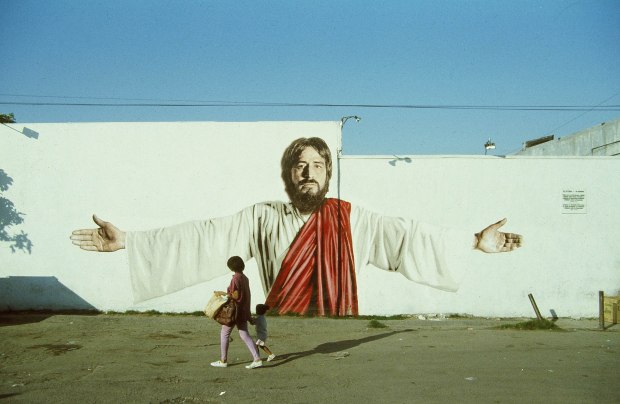
“111th Street Jesus” by Jim Hinch: This Image journal article from last year profiles muralist Kent Twitchell, who has executed several large-scale murals of Jesus, perhaps most famously his 111th Street Jesus, which was painted in 1984 on the exterior of a liquor store—punched through with bullet holes—in a gang-ridden section of Los Angeles (unfortunately, it was recently whitewashed by a new property owner). Hinch reports that a local Catholic priest, Father Dennis Berry, had recruited Twitchell to help beautify the neighborhood with the help of two former gang members who wanted to learn how to paint. As his model Twitchell used a young Hispanic man who had played Jesus in a local Passion play.

Jesus mural

Kent Twitchell (American, 1942-), 111th Street Jesus, 1984. Acrylic mural at Vermont Avenue and 111th Street, South Central Los Angeles, 14 x 50 feet. (No longer extant) Photo: François Duhamel.

“Q&A with ‘Captive’ star: ‘For me, Jesus is my denomination’” by Adelle M. Banks: Christian actor David Oyelowo, who played the Rev. Martin Luther King Jr. in Selma, plays a very different character in his latest film, Captive: Atlanta murderer and kidnapper Brian Nichols. In this interview he talks about grace, worship, and the book The Purpose Driven Life—which features heavily in the movie, now in theaters. (See the trailer below.)


“Contemporary Takes on the Self in a Manhattan Church” by Allison Meier: Through October 22, the Church of St. Paul the Apostle in New York City is hosting an exhibition titled “On the Inner and Outer Self.” Many of the twenty-eight artists taking part have created site-specific works for it.

Leviticus art exhibition: Through December 6, the Hudson Valley Center for Contemporary Art in Peekskill, New York, is showing a series of terragraphs by Hermann Nitsch inspired by Leviticus, a book of the Bible that lays out the rituals and ceremonies practiced by the ancient people of Israel. Christians value the book, among other reasons, for its explanation and picturing of atonement, a state of reconciliation between God and man that we consider as having been accomplished once and for all by Jesus Christ’s sacrificial death on the cross. (For more on Leviticus, see the excellent video overview put out by The Bible Project. 4:23 starts the bit on Yom Kippur, which Jews will be celebrating this Tuesday and Wednesday.)

Leviticus by Hermann Nitsch

Hermann Nitsch (Austrian, 1938-), Leviticus, 2010. Book of terragraph prints opened to Leviticus 7:2-10, which describes the proper priestly distribution of the guilt offering.

Posted in Pop Culture, Western Art | Tagged , , , , , , , , , | Leave a comment

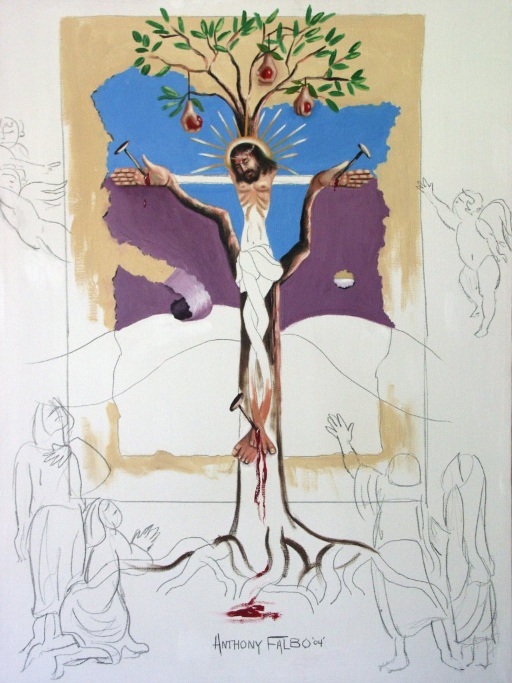
It Is Finished by Anthony Falbo

Anthony Falbo’s sense of humor is one of the qualities that endears me to his art. He frequently paints religious subjects but not with the stilted piety of much of today’s (what passes as) Christian art—instead, he approaches his subjects with a spirit of play.

Crucifixion by Anthony Falbo

Anthony Falbo (American, 1953-), It Is Finished, 2004. Oil and charcoal on paper, 24 x 18 in.

In his painting It Is Finished, Falbo employs a pun in the title: “it is finished” refers to one of the Seven Last Words of Christ but is also an affirmation that yes, despite appearances, this artwork is complete as is.

I showed this image as part of a presentation before a small group of friends on the Crucifixion in contemporary art, and when they saw the title—before I even said anything—a few chuckled out loud. (It was the only one of the images that invited such a reaction.)

But what I love about Falbo is that his humor is not gimmicky; his paintings may elicit a smile or a laugh, but they do far more than that—they actually provide substance to sink into. Let’s look at this one, for example.   Continue reading

Posted in Theology, Western Art | Tagged , , , | 3 Comments

A Prayer for Migrants

The Rev. Dr. Sam Wells, vicar of St. Martin-in-the-Fields in the heart of London, issued a statement yesterday on the migrant crisis, concluding with the following prayer:

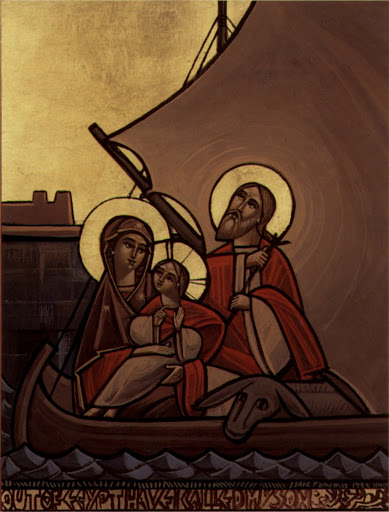
Wilderness God, your Son was a displaced person in Bethlehem, a refugee in Egypt, and had nowhere to lay his head in Galilee. Bless all who have nowhere to lay their head today, who find themselves strangers on earth, pilgrims to they know not where, facing rejection, closed doors, suspicion, and fear. Give them companions in their distress, hope in their wandering, and safe lodging at their journey’s end. And make us a people of grace, wisdom, and hospitality, who know that our true identity is to be lost, until we find our eternal home in you. Through Christ our rejected yet risen Lord. Amen.

Neo-Coptic icon

Isaac Fanous (Egyptian, 1919-2007), Flight to Egypt.

Posted in Current Events, Non-Western Art | Tagged , , | Leave a comment