Roundup: The Bible, Secular Beatitudes, Short-Term Missions, OT vs. NT law, Les Mis

Here are a few posts by others that went up this week that I enjoyed reading.

“God Did Not Write the Bible…” by Kathy Vestal:  I’ll have to wrestle with this one some more.  It raises some provocative questions, like is “divinely inspired” really the same thing as “divinely authored”?  (Can we really say that God wrote the Bible?)  And if we hold to the view that the Bible was not dictated by God or handed down to us from heaven, but is the work of human individuals recording their unique experiences of God within the limitations of human language, then why do we insist that it must be without error, especially when the Bible makes no such claim of itself?  Vestal says that some Christians make the Bible their god and worship it, instead of worshiping the one true God, which is why those Christians get so offended when people point out alleged errors in the Bible (they interpret that to mean that God has made a mistake).  I don’t agree with everything in this article, but it did prompt me to consider what I mean when I use the terms “divine inspiration” and “inerrant.”

“The Secular Beatitudes” by Josh Harris:  Cultural values often run counter to the values of Jesus.  If today’s were to be formatted into a beatitudinal list (“Blessed are…”), it might read something like this:  “1. Blessed are the self-confident because they rule the world.  2. Blessed are positive-thinkers because they don’t need anybody’s comfort.”  And so on.  (Read Harris’s eight in parallel with Matthew’s.)

“Should Churches Abandon Travel-Intensive Short-Term Missions in Favor of Local Projects?” by Brian M. Howell, David Livermore, and Robert J. Priest:  This question has been on my mind for a while, as to me, the answer should be an obvious yes.  I don’t deny the necessity of foreign missions, but I do question the value of some short-term mission trips, when the assigned work could easily and gladly be done by locals, and all the money spent on airfare could be put toward something more worthwhile.  This article offers three thoughtful perspectives, though, which have helped me to round out my thinking on the topic.

“Making Sense of Scripture’s ‘Inconsistency’” by Tim Keller:  “I find it frustrating when I read or hear columnists, pundits, or journalists dismiss Christians as inconsistent because ‘they pick and choose which of the rules in the Bible to obey.’  Most often I hear, ‘Christians ignore lots of Old Testament texts—about not eating raw meat or pork or shellfish, not executing people for breaking the Sabbath, not wearing garments woven with two kinds of material and so on.  Then they condemn homosexuality.  Aren’t you just picking and choosing what you want to believe from the Bible?’”

And now, just for fun, the trailer for the upcoming movie musical Les Misérables, starring Anne Hathaway and Hugh Grant.  Set in nineteenth-century France, the story is chock-full of spiritual themes, among them redemption, sacrifice, and justice versus mercy.  I can’t wait!

Posted in Pop Culture, Theology | Leave a comment

Site suspension error

If you tried visiting this website in the last 24 hours, you encountered this message:  “This blog has been archived or suspended for a violation of our Terms of Service.”  This is untrue; the suspension notice was due to a glitch in WordPress’s automated spam detection system, for which they have apologized.  TheJesusQuestion.org is not in violation of any terms and will continue running as usual.

Posted in Uncategorized | 1 Comment

Tee Time: I Found Jesus!

I found JesusFound at adoremusbooks.com.

Posted in Jesus Kitsch | Tagged , | 1 Comment

“The Battle Hymn of the Republic”: Its Origin and Meaning

Julia Ward HoweOne of the most popular patriotic anthems of all time, this song is often performed at the funerals of American soldiers and statesmen, presidential nominating conventions and inaugurations (both Republican and Democrat), and at Independence Day church services and festivities.  It was played during the Boston fireworks show on Wednesday, only a mile or so away from where its lyricist, Julia Ward Howe, is buried.

“The Battle Hymn of the Republic” originated during the Civil War.  On November 17, 1861, Howe traveled with her husband, Samuel, then director of the Army’s Sanitary Commission, to inspect a Union camp outside Washington, DC.  While there, she took notice of a particularly catchy marching song that the troops were fond of singing, called “John Brown’s Body (Lies A-Mouldering in the Grave).”  The song memorializes John Brown, the radical abolitionist who was executed in 1859 after leading an unsuccessful raid on the federal armory in Harpers Ferry, Virginia (now West Virginia), that killed fourteen men.  Brown became a Union hero, praised by the pens of famous writers like Ralph Waldo Emerson and Henry David Thoreau, and even the French novelist Victor Hugo, whose open letter requesting a pardon for Brown was published by newspapers in both the U.S. and Europe.  “His soul’s marching on!” the Union soldiers sung in refrain—until Howe rewrote the lyrics, that is.

John Brown treason poster

She did so at the urging of a friend, the Reverend James Freeman Clarke, who was part of the traveling party that winter.  “Why do you not write some good words for that stirring tune?” he suggested—something higher-minded, something grander and more poetic, not so coarse.

Howe’s solution was “The Battle Hymn of the Republic.”  It carries the same rah-rah sentiment as the old song, with the added weight of biblical references to Christ’s judgment of the wicked.  She penned the new lyrics overnight, and they were published two and a half months later, on the front page of the February 1862 edition of the Atlantic Monthly.  Notice the conflation of Christian apocalyptic imagery with the Union military campaign of the 1860s.  Continue reading

Posted in Music, Politics | Tagged , , , , | 36 Comments

Tee Time: Use Christ Truthpaste

Brushing up on the WordFound at christianshirts.net.

Posted in Jesus Kitsch | Tagged , | Leave a comment

‘Disturb us, Lord’

“Disturb us, Lord, when we are too well pleased with ourselves, when our dreams have come true because we dreamed too little; when we arrive safely because we sailed too close to the shore.

Disturb us, Lord, when with the abundance of things we possess, we have lost our thirst for the waters of life; having fallen in love with life, we have ceased to dream of eternity, and in our efforts to build a new earth, we have allowed our vision of the new heaven to dim.

Disturb us, Lord, to dare more boldly, to venture on wider seas, where storms will show your mastery; where losing sight of land, we shall find the stars.  We ask you to push back the horizons of our hopes, and to guide us into the future in strength, courage, hope and love.”

—Attributed to Sir Francis Drake (1540-96) (qtd. in The Art of Worship: Paintings, Prayers, and Readings for Meditation, p. 88)

Posted in Poetry | Tagged , | 1 Comment

Tee Time: Sonkissed

SonkissedFound at shopgreatproducts.com.

Posted in Jesus Kitsch | Tagged , | Leave a comment

Happy Anniversary to My Honey

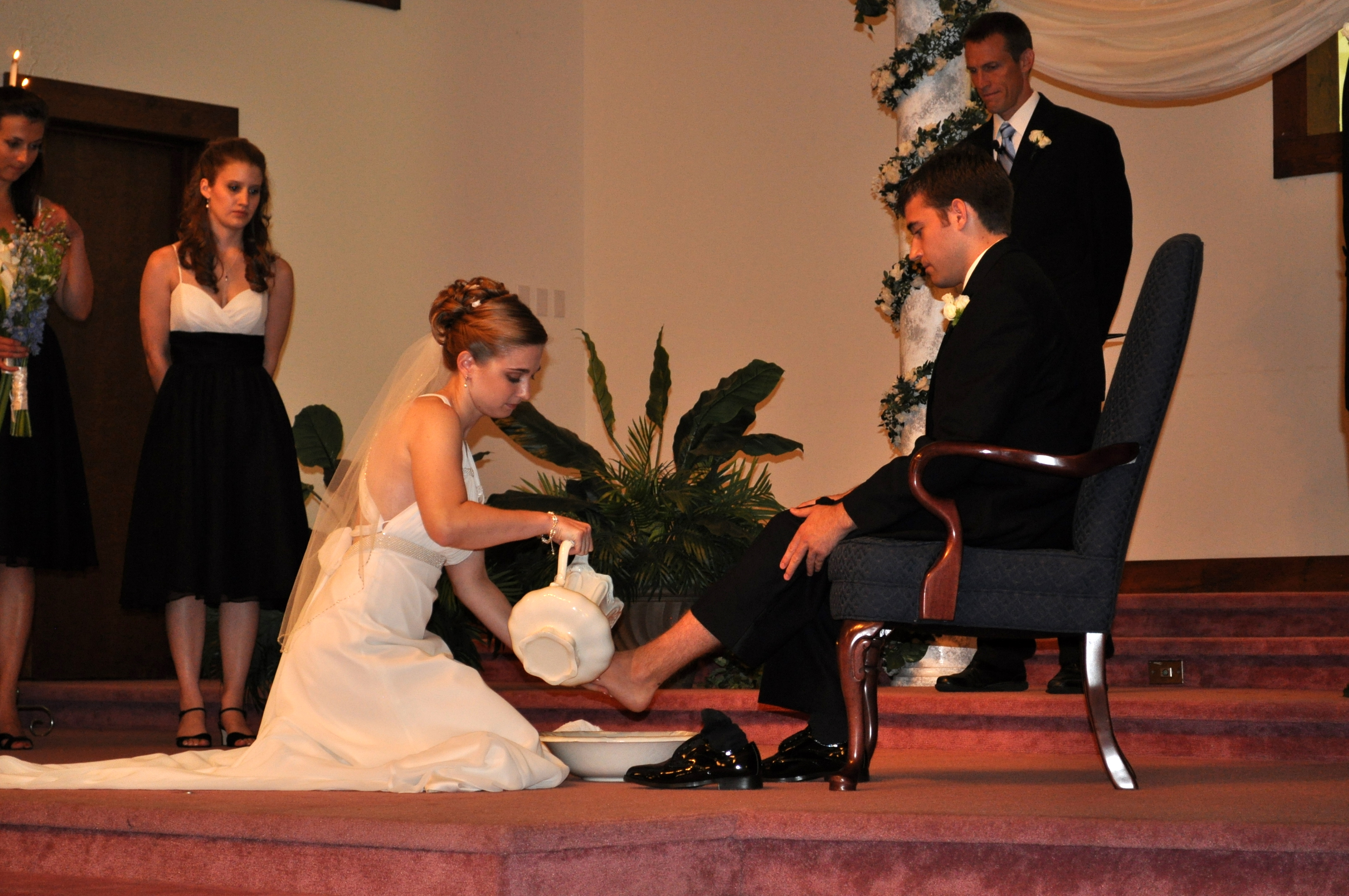
Two years ago today, I walked down the aisle of my hometown church in North Carolina in a white wedding dress . . . and washed my husband’s feet.

Foot-washing at wedding

I anticipate some raised eyebrows right about now, perhaps even some recoiling in disgust. How awkward, how distasteful, for a moment that’s meant to be so sacred—and so photographed!  The apostle Peter had a similar reaction when on the night before his Lord’s crucifixion, Jesus rolled up his tunic, bent down, and raised a washcloth to his feet.  “Lord, why are you washing my feet?” Peter asked, embarrassed.  Jesus responded, “Unless I wash your feet, you have no part with me.”  Continuing on to John 13:12 . . .

So when He had washed their feet, taken His garments, and sat down again, He said to them, “Do you know what I have done to you?  You call Me Teacher and Lord, and you say well, for so I am.  If I then, your Lord and Teacher, have washed your feet, you also ought to wash one another’s feet.  For I have given you an example, that you should do as I have done to you.  Most assuredly, I say to you, a servant is not greater than his master; nor is he who is sent greater than he who sent him.  If you know these things, blessed are you if you do them.”

Yes, that’s right.  Eric and I chose John 13 as our wedding text.  Not 1 Corinthians 13 (the “love chapter”), and not Ephesians 5 (husbands lead, wives submit).  Instead of centering the ceremony on the words of Paul, we wanted to center it on the words of Jesus—on his message of radical, self-emptying love.  Although the context of this passage does not speak directly to the husband-wife relationship (it extends much farther than that), we found in it a picture, a standard, of what we want to aspire to in our marriage.  Continue reading

Posted in Uncategorized | Tagged , , , , | 8 Comments

Tap-Tap Art in Haiti

Last month a friend of mine, Rachel, told me about how when she visited Port-au-Prince, Haiti, in 2010, she found Jesus’s name and face painted all over the city’s public transportation vehicles, known as “tap-taps.”  Tap-taps are privately owned and elaborately painted buses or pickup trucks that serve as shared taxis; they follow fixed routes, and riders can disembark at any time—simply by tapping the wall or ceiling.  A ride across town costs only ten to twenty-five cents, depending on what the driver chooses to charge.

According to Google Translate, the French (or Haitian Creole?) inscriptions translate as: “Trust in God” (windshield), “In memory of my brother” (top side), “The throne of God” (middle side), and “Nothing but God” (bottom side). (Photo by Rachel Hastings)

Jesus tap-tap

“I love you, Jesus.” (Photo by Rachel Hastings)

In the four-and-a-half-minute news segment below, Adam Davidson of NPR’s Planet Money reports that tap-tap owners pay artists upwards of $1200 to paint their buses—more than most Haitians make in a year.  Why?  Because competition is steep, Davidson says, and owners feel that the prettier and more colorful their bus is, the more passengers will be attracted to it.  Also, in general passengers feel that if tap-tap owners can afford to pay for such high-quality art, they can also afford to keep the vehicle in good working condition, guaranteeing a safer ride.  Continue reading

Posted in Non-Western Art, Pop Culture, Popular Art | Tagged , , , , | 2 Comments

Tee Time: Jesus Is My Rockstar

Found at funkyurban.net.

Posted in Jesus Kitsch | Tagged , | Leave a comment