Book Review: Red Letter Revolution

Red Letter Revolution“Red Letter Christianity” is the name of a nonpartisan political/religious movement that aims to see the red letters of the Bible (the words attributed to Jesus) translated into social policy. Red Letter Christians align themselves with Jesus’s platform, committing themselves to the causes he advocated for, and even though they are theologically evangelical, they resist the term “evangelical” because of the negative stereotype it conjures of anti-gay, anti-feminist, anti-environmentalist, pro-war, pro-capital punishment Republicans.

At the forefront of this movement is Tony Campolo, professor emeritus of sociology at Eastern University and founder of redletterchristians.org. Representing the younger generation is Shane Claiborne, founder and creative director of The Simple Way, a “new monastic” community in inner-city Philadelphia that practices renewal in a variety of imaginative ways. Together these two guys wrote a book called Red Letter Revolution: What If Jesus Really Meant What He Said?, released this Tuesday by Thomas Nelson. The subtitle’s provocation is this: to compel us to imagine what the world would look like if Christians would only take Jesus more seriously—that is, more literally, and embracing all of what he had to say, not just the easy or convenient parts. Red Letter Revolution challenges us to consider the breadth of Jesus’s concern for his world, and especially for “the least of these,” and the ways his teachings might inform the way we engage with the individuals and institutions that surround us.

Here’s a short promotional video for the book:

Continue reading

Posted in Politics | Tagged , , , , | Leave a comment

Tee Time: Tougher than Nails

My Savior is Tougher than NailsFound at kerusso.com.

Posted in Jesus Kitsch | Tagged , | Leave a comment

Near to the Broken and Crushed

Near to the Broken and Crushed

Jyoti Sahi, “Near to the Broken and Crushed,” 1984. Woodcut published in “The Holy Waters: Indian Psalm-Meditations,” Martin Kaempchen & Jyoti Sahi, ATC, Bangalore 1984.

“The Lord is nigh unto them that are of a broken heart, and saveth such as be of a contrite spirit. Many are the afflictions of the righteous: but the Lord delivereth him out of them all.”
—Psalm 34:18-19

“Make me to hear joy and gladness; [that] the bones [which] thou hast broken may rejoice.”
—Psalm 51:8

The nearness of God, and eventual deliverance from the chains of suffering: these are the promises that we can cling to when we’re grieving.  Continue reading

Posted in Uncategorized | 1 Comment

Tee Time: Jesus Inside

jesus insideFound at velvetfreeway.com.

Posted in Jesus Kitsch | Tagged , | Leave a comment

Art is unuseful

Read Part 1.

In the second part of his essay “The Gospel: How Is Art a Gift, a Calling, and an Obedience?” (published in For the Beauty of the Church), Andy Crouch argues that the church should not justify art in terms of its usefulness to the church’s ends, for then we violate the very definition of art:  those aspects of culture that cannot be reduced to utility.  Let’s stop forcing Christian art to be functional, and just let it be!  Art for art’s sake, not for some canned moral lesson.

Many times churches will permit art on its grounds only if it depicts an explicitly “Christian” subject—if it is useful in teaching a biblical truth or inspiring greater devotion.  Indeed, throughout history the church commissioned art to serve this pointed purpose, but, as Crouch points out, “even the artist who made these goods couldn’t help but explore beyond the boundaries of strictly religious usefulness, and in this way they went far beyond the straightforward purposefulness of so much art created for the church today” (38).  In medieval churches, for example, there were crucifixes, yes, but there were also gargoyles, and nonrepresentational stained glass.  In Bible manuscripts, there were depictions of Christ and other characters, but there were also flowers and deer and intricate interlacing and ornamentation, details that, though lovely, were completely irrelevant to the stories they illustrated.

Crouch reminds readers that art is valuable as art; its purpose can be explained only in terms of itself.  For example, it would be easy to explain why you want four walls, but how would you explain why you want wallpaper?  With almost all cultural goods, there is the option of paying extra money for an artful quality which has nothing to do with the usefulness of the good.  Think lamps, shoes, dinner plates, bed sheets, cars, and so on.  Our willingness to pay a higher price for, let’s say, a car with a sleek exterior, or a dresser with a carved border, shows that we value the unuseful, though it’s hard to explain why.  Continue reading

Posted in Non-Western Art, Western Art | Tagged , , | 2 Comments

The Lower Lights (A Hymn Revival)

Ever heard of the musical group The Lower Lights? I really love what they’re doing: taking old hymns and refreshing them. The goal, they write on their website, is “to connect with these beautiful old songs on a deeper level, to have a new and personal experience with them.” They have three albums out: A Hymn Revival, vols. 1 and 2, and Come Let Us Adore Him.

I appreciate the variety represented in the song selection: it’s a balance between well known and lesser known; penitent, petitionary, and celebratory; slow and fast; quiet and loud. The style is folk/bluegrass, and in addition to traditional, mostly American-born hymns, the albums include African American spirituals (“Go Down, Moses”; “Swing Low, Sweet Chariot”) and classic country songs (“I Saw the Light”; “Calling You”). The sound of these songs is beautiful, but even more so their spirit, their theology, and the rich tradition(s) they represent.

Continue reading

Posted in Music | Tagged , , | 3 Comments

Tee Time: DJ Jesus

DJ JesusFound at zazzle.com.

Posted in Jesus Kitsch | Tagged , | Leave a comment

Artists as priests and sense sharpeners

“The artist stands at the head of the people to offer on their behalf a sacrifice of praise.  It’s a priesthood because, first, they stand before us.  We feed them, support them, put them up there, and then they produce a prayer on behalf of all of us that takes the form of making, not speaking. . . . They make a response to God from us and God gives a gift of revelation back through them.”
—Barbara Nicolosi, “The Artist: What Exactly Is an Artist, and How Do We Shepherd Them?”, in For the Beauty of the Church, p. 113

~~~

“Consider two lists of verbs that describe what happens in worship:

List A: seeing, listening, touching, gesturing, smelling, imagining, speaking, singing
List B: praising, lamenting, confessing, thanking, being, convicted, being inspired, being comforted

List A are verbs that focus on embodied sensory experience, the rudiments of artistic production and reception.  These words are not unique to worship.  They are building blocks for all human actions.  We can not worship without these verbs.  And they are the reason that the arts matter in worship:  the arts elevate, deepen, and sharpen each of these basic sensory actions and prime them as acts of worship.”
John D. Witvliet, “The Worship: How Can Art Serve the Corporate Worship of the Church?”, in For the Beauty of the Church, p. 55

Posted in Western Art | Tagged , | 1 Comment

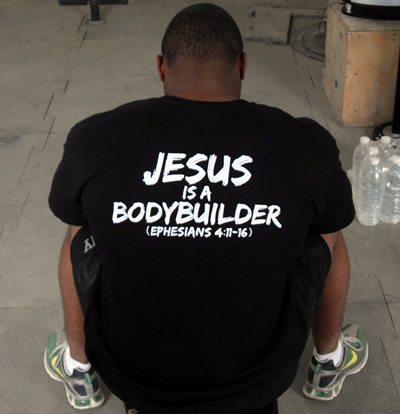
Tee Time: Jesus is a Bodybuilder

Jesus is a bodybuilderFound at discipletraininggear.com.

Posted in Jesus Kitsch | Tagged , | Leave a comment

Culture is God’s idea

My favorite essay in the collection For the Beauty of the Church is “The Gospel: How Is Art a Gift, a Calling, and an Obedience?” by Andy Crouch (pp. 29-43).  He packs so many insights into fifteen pages, with two main emphases:  God’s creation and blessing of culture in the Garden of Eden and during the Last Supper, and the “unusefulness” of art (linked to the unusefulness of prayer and praise).  Today I’ll cover the first of the two.  All of this is a paraphrase of Crouch.  I’ll save my thoughts for a later post.

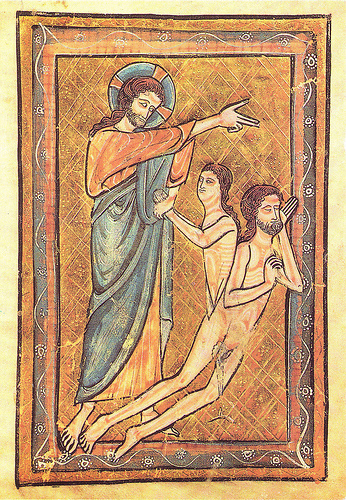
Creation of Eve, medieval illuminationCultural critic Ken Myers defines culture as what we make of the world—in both a material and spiritual sense.  It is literally making stuff out of the materials at hand, but it is also making meaning.  In Genesis 2, we see God making something of the world—creatio ex creatio—in contrast to the creatio ex nihilo of Genesis 1.  He could have created man from nothing, but instead he chose to create him from the dust of the ground, and woman from the rib of man.  Artists likewise create out of what has been created.  They call forth beauty from where it lies latent.  In this way, they mimic the creative impulse of God.

Genesis 2 depicts God as the very first culture-maker.  He combines, shapes, and transforms the stuff of the world, and he thinks thoughts about this stuff.  He plants, waters, selects, protects, weeds, and nurtures a garden—he takes what is wild and makes it habitable.  And then he gives this garden, this culture, as a gift to Adam, and tells him to continue cultivating it.  Continue reading

Posted in Theology, Western Art | 1 Comment